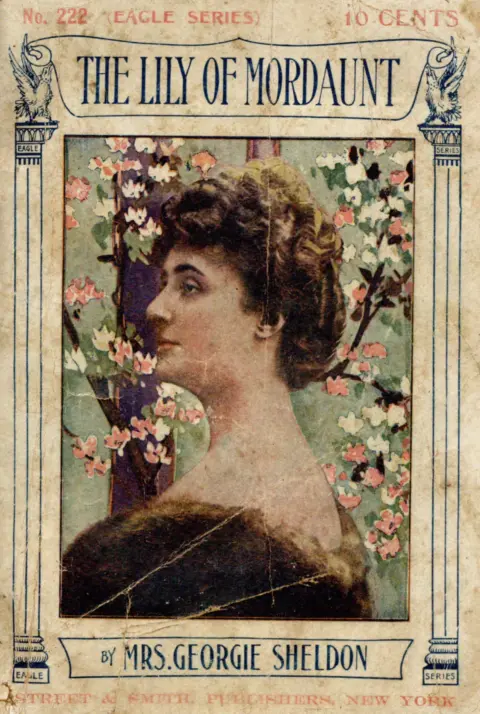
The lily of Mordaunt
Georgie, Mrs. Sheldon
THE CLASSIC COLLECTION · 1891
"Thrice Wedded, but Only Once a Wife" by Mrs. Georgie Sheldon is a fictional novel written in the late 19th century. The story unfolds in a quaint Massachusetts cottage and introduces us to young Robert Ellerton and his close friend, the lively Dora Dupont, as they embark on a whimsical adventure of childhood romance and impulsive decisions. This lighthearted narrative, however, quickly hints at deeper themes of societal expectations and familial conflict that foreshadow challenges ahead for the young couple. The opening of the novel sets the stage by vividly describing a charming June morning in a cottage adorned with flowers. We meet Robert as he arrives to take Dora for a ride, and the innocent excitement of youthful love is palpable as they decide to marry on a whim. Their joy is interrupted by the dark character of Squire Moulton, who harbors a mysterious grudge against Robert's father. The initial thrill of their marriage is clouded by the threats of Squire Moulton, as he crafts a sinister plan that could wreak havoc on the children's lives. The stage is thus set for a compelling narrative exploring the intricate dynamics of love, resentment, and the repercussions of past actions.
Introduction adapted from the source catalogue; source summaries may be automatically generated.
Free to read · English · 84,866 words · No account needed
MAKE TIME FOR A GOOD BOOK
On by default. Untick to stop anonymous reading totals. Each page counts after 10 seconds in view. How this works.
Anonymous counting is on unless you have switched it off.
“A gentleman with white hair,” he respectfully answered, and which was true, for Ralph had cunningly given the note to his uncle to send by the boy.
With a beating heart Robert hastily tore it open, and read the following
lines:
“I arrived to-day, but not in time to see you before the exercises commenced. Come to me at once, for my heart aches to welcome my long absent boy to my arms. Come quickly to your impatient father.
“The hotels are all full, so I have been obliged to take up with such accommodations as I can get. The bearer of the note will conduct you to me.
“When was this note given to you?” he asked again, turning to the boy, and with a joyous smile upon his fine face.
“Just a few minutes since, sir.”
“Which way did the gentleman go?” asked Robert, with a sharp glance over
the boy.
“I will show you, sir,” he replied, quickly dropping his eyes before
Robert’s clear gaze.
“What is your name?” pursued our hero, who did not like the youngster’s
looks at all.
“Hans Weichel, sir.”
“What is your father’s name?”
“Hans Weichel, sir?”
Robert smiled at the boy’s concise replies, and said:
“Well, we will not wait for this crowd to get out; we can go out through
the chapel.”
And turning, they went through another large room, then down some steps, and thus reached the street.
The boy led Robert away from the town, down toward the sea, where there were several little cottages in which fishermen lived. They passed these and walked on some distance before Robert noticed where he was going, so deeply was he engaged in thought, wondering at his darling’s unexpected presence that day.
At length, on looking up, he saw only the vast expanse of the sea upon one side of him, and on the other great, rocky cliffs, rising high against the sky in somber and majestic grandeur; while behind him, nearly half a mile distant, was the town, and the great buildings of the institute.
Turning suddenly to his guide, he said, sternly:
“Where are you leading me?”
“We are most there,” answered the boy, somewhat confusedly. “Just beyond that clump of trees is the house.”
“Are you sure the gentleman told you to come to this place?” pursued Robert, somewhat suspiciously.
“Yes, sir; he said he did not like noise, and wanted to be where he could see the ocean, and be quiet,” replied young Hans, with evident truth.
Your reading position is saved on this browser. Take it to another device with a library code. Reading pages adapt to text, rather than matching a printed edition.
Georgie, Mrs. Sheldon
Georgie, Mrs. Sheldon
Georgie, Mrs. Sheldon
Georgie, Mrs. Sheldon
BEHIND THE BOOK
This eBook is for the use of anyone anywhere in the United States and most other parts of the world at no cost and with almost no restrictions whatsoever. You may copy it, give it away or re-use it under the terms of the Project Gutenberg License included with this eBook or online at www.gutenberg.org. If you are not located in the United States, you will have to check the laws of the country where you are located before using this eBook. Read the source licence.
The original source file, including credits and licence, is retained by this library. Request an original-format copy at no charge. Please include the book title and Project Gutenberg identifier #70837.
KEEP YOUR CURIOSITY GOING
Coulson Kernahan

Maurice Baring
Frances Wright
Cécile Tormay

Frederic Jesup Stimson

W. H. P. (William Henry Pope) Jarvis