
Last letters from the living dead man
David Patterson (Spirit) Hatch
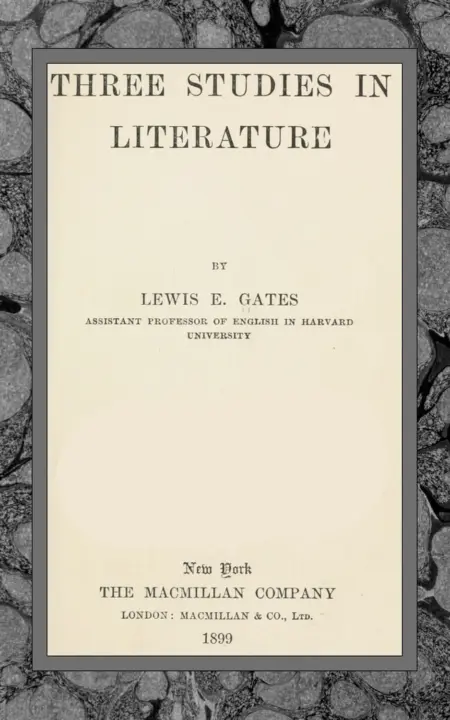
THE CLASSIC COLLECTION · 1899
"Three Studies in Literature" by Lewis E. Gates is a collection of literary critiques written in the late 19th century. This work evaluates the critical contributions and reputations of three notable literary figures: Francis Jeffrey, John Henry Newman, and Matthew Arnold. It delves into their styles and the lasting impact they have made on literature and criticism, exploring how these writers shaped public opinion and literary discourse. The opening of the book begins with an exploration of Francis Jeffrey's critical prowess, setting the stage for a discussion of his fluctuating reputation in literary circles. It describes how Jeffrey, once a prominent figure revered for his contributions to the "Edinburgh Review", has somewhat faded from scholarly attention. Gates praises Jeffrey's versatility and sharp style while also raising questions about the relative merits of his critiques. Through careful analysis, the text presents Jeffrey's influence on literary criticism and situates it within a broader narrative of the evolving landscape of 19th-century literature. This initial examination hints at the deeper evaluations of Newman and Arnold that will follow, making it clear that this work aims to provide a comprehensive understanding of these critics' roles in shaping literary criticism.
Introduction adapted from the source catalogue; source summaries may be automatically generated.
Free to read · English · 49,848 words · No account needed
MAKE TIME FOR A GOOD BOOK
On by default. Untick to stop anonymous reading totals. Each page counts after 10 seconds in view. How this works.
Anonymous counting is on unless you have switched it off.
In all these various ways, then, that have been illustrated, culture is a specific against the ills that society is heir to. Culture is vital knowledge, and the critic is its fosterer and guardian; culture and criticism work together for the preservation of the integrity of the human type against all the disasters that threaten it from the storm and stress of modern life. Politics, religion, scholarship, science, each has its special danger for the individual; each seizes upon him, subdues him relentlessly to the need of the moment and the requirements of some particular function, and converts him often into a mere distorted fragment of humanity. Against this tyranny of the moment, against the specializing and materializing trend of modern life, criticism offers a powerful safeguard. Criticism is ever concerned with archetypal excellence, is continually disengaging, with fine discrimination, what is transitory and accidental from what is permanent and essential in all that man busies himself about, and is thus perpetually helping every individual to the apprehension of his “best self,” to the development of what is real and absolute and the elimination of what is false or deforming. And in doing all this the critic acts as the appreciator of life; he is not the abstract thinker. He apprehends the ideal intuitively; he reaches it by the help of the feelings and the imagination and a species of exquisite tact, not through a series of syllogisms; he is really a poet, rather than a philosopher.
This conception of the nature and functions of criticism makes intelligible and justifies a phrase of Arnold’s that has often been impugned--his description of poetry as a criticism of life. To this account of poetry it has been objected that criticism is an intellectual process, while poetry is primarily an affair of the imagination and the heart; and that to regard poetry as a criticism of life is to take a view of poetry that tends to convert it into mere rhetorical moralizing--the decorative expression in rhythmical language of abstract truth about life. This misinterpretation of Arnold’s meaning becomes impossible, if the foregoing theory of criticism be borne in mind. Criticism is the determination and the representation of the archetypal, of the ideal. Moreover, it is not a determination of the archetypal formally and theoretically, through speculation or the enumeration of abstract qualities; Arnold’s disinclination for abstractions has been repeatedly noted. The process to be used in criticism is a vital process of appreciation, in which the critic, sensitive to the whole value of human life, to the appeal of art and of conduct and of manners as well as of abstract truth, feels his way to a synthetic grasp upon what is ideally best, and portrays this concretely and persuasively for the popular imagination. Such an appreciator of life, if he produce beauty in verse, if he embody his vision of the ideal in metre, will be a poet. In other words, the poet is the appreciator of human life who sees in it most sensitively, inclusively, and penetratingly what is archetypal, and evokes his vision before others through rhythm and rhyme. In this sense poetry can hardly be denied to be a criticism of life; it is the winning portrayal of the ideal of human life as this ideal shapes itself in the mind of the poet. Such a criticism of life Dante gives, a determination and portrayal of what is ideally best in life according to mediæval conceptions; a representation of life in its integrity with a due adjustment of the claims of all the powers that enter into it--friendship, ambition, patriotism, loyalty, religion, artistic ardour, love. Such a criticism of life Shakespeare incidentally gives in terms of the full scope of Elizabethan experience in England, with due imaginative setting forth of the splendid vistas of possible achievement and unlimited development that the new knowledge and the discoveries of the Renaissance had opened. In short, the great poet is the typically sensitive, penetrative, and suggestive appreciator of life,--who calls to his aid, to make his appreciation as resonant and persuasive as possible, as potent as possible over men’s minds and hearts, all the emotional and imaginative resources of language,--rhythm, figures, allegory, symbolism,--whatever will enable him to impose his appreciation of life upon others and to insinuate into their souls his sense of the relative values of human acts and characters and passions; whatever will help him to make more overweeningly beautiful and insistently eloquent his vision of truth and beauty. In this sense the poet is the limiting ideal of the appreciative critic, and poetry is the ultimate criticism of life--the finest portrayal each age can attain to of what seems to it in life most significant and delightful.
Your reading position is saved on this browser. Take it to another device with a library code. Reading pages adapt to text, rather than matching a printed edition.
BEHIND THE BOOK
This eBook is for the use of anyone anywhere in the United States and most other parts of the world at no cost and with almost no restrictions whatsoever. You may copy it, give it away or re-use it under the terms of the Project Gutenberg License included with this eBook or online at www.gutenberg.org. If you are not located in the United States, you will have to check the laws of the country where you are located before using this eBook. Read the source licence.
The original source file, including credits and licence, is retained by this library. Request an original-format copy at no charge. Please include the book title and Project Gutenberg identifier #74191.
KEEP YOUR CURIOSITY GOING
David Patterson (Spirit) Hatch

David Patterson (Spirit) Hatch

David Patterson (Spirit) Hatch
Cécile Tormay

Moritz Busch
John L. Ransom