
Last letters from the living dead man
David Patterson (Spirit) Hatch
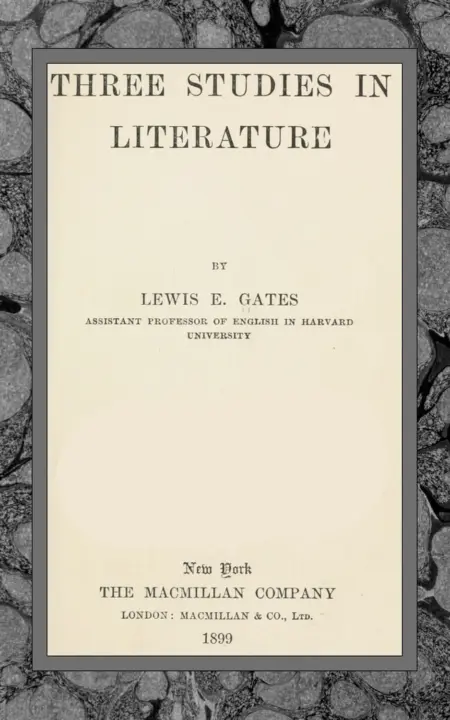
THE CLASSIC COLLECTION · 1899
"Three Studies in Literature" by Lewis E. Gates is a collection of literary critiques written in the late 19th century. This work evaluates the critical contributions and reputations of three notable literary figures: Francis Jeffrey, John Henry Newman, and Matthew Arnold. It delves into their styles and the lasting impact they have made on literature and criticism, exploring how these writers shaped public opinion and literary discourse. The opening of the book begins with an exploration of Francis Jeffrey's critical prowess, setting the stage for a discussion of his fluctuating reputation in literary circles. It describes how Jeffrey, once a prominent figure revered for his contributions to the "Edinburgh Review", has somewhat faded from scholarly attention. Gates praises Jeffrey's versatility and sharp style while also raising questions about the relative merits of his critiques. Through careful analysis, the text presents Jeffrey's influence on literary criticism and situates it within a broader narrative of the evolving landscape of 19th-century literature. This initial examination hints at the deeper evaluations of Newman and Arnold that will follow, making it clear that this work aims to provide a comprehensive understanding of these critics' roles in shaping literary criticism.
Introduction adapted from the source catalogue; source summaries may be automatically generated.
Free to read · English · 49,848 words · No account needed
MAKE TIME FOR A GOOD BOOK
On by default. Untick to stop anonymous reading totals. Each page counts after 10 seconds in view. How this works.
Anonymous counting is on unless you have switched it off.
The same insistent desire that culture be vital is at the root of Arnold’s discomfort in the presence of German scholarship. For the thoroughness and the disinterestedness of this scholarship he has great respect; but he cannot endure its trick of losing itself in the letter, its “pedantry, slowness,” its way of “fumbling” after truth, its “ineffectiveness.”[33] “In the German mind,” he exclaims in Literature and Dogma, “as in the German language, there does seem to be something splay, something blunt-edged, unhandy, infelicitous,--some positive want of straightforward, sure perception.”[34] Of scholarship of this splay variety, that comes from exaggerated intellectuality and from lack of a delicate temperament and of nice perceptions, Arnold is intolerant. Such scholarship he finds working its customary mischief in Professor Francis Newman’s translation of Homer, and, accordingly, he gives large parts of the lectures on Translating Homer to the illustration of its shortcomings and maladroitness; he is bent on showing how inadequate is great learning alone to cope with any nice literary problem. Newman’s philological knowledge of Greek and of Homer is beyond dispute, but his taste may be judged from his assertion that Homer’s verse, if we could hear the living Homer, would affect us “like an elegant and simple melody from an African of the Gold Coast.”[35] The remedy for such inept scholarship lies in culture, in the vitalization of knowledge. The scholar must not be a mere knower; all his powers must be harmoniously developed.
A last illustration of Arnold’s insistence that knowledge be vital may be drawn from his writings on religion and theology. Again criticism and culture are the passwords that open the way to a new and better order of things. Formulas, Arnold urges, have fastened themselves constrainingly upon the English religious mind. Traditional interpretations of the Bible have come to be received as beyond cavil. These interpretations are really human inventions--the product of the ingenious thinking of theologians like Calvin and Luther. Yet they have so authenticated themselves that for most readers to-day the Bible means solely what it meant for the exacerbated theological mind of the sixteenth and seventeenth centuries. If religion is to be vital, if knowledge of the Bible is to be genuine and real, there must be a critical examination of what this book means for the disinterested intelligence of to-day; the Bible, as literature, must be interpreted anew, sympathetically and imaginatively; the moral inspiration the Bible has to offer, even to men who are rigidly insistent on scientific habits of thought and standards of historical truth, must be disengaged from what is unverifiable and transitory, and made real and persuasive. “I write,” Arnold declares, “to convince the lover of religion that by following habits of intellectual seriousness he need not, so far as religion is concerned, lose anything. Taking the Old Testament as Israel’s magnificent establishment of the theme, Righteousness is salvation! taking the New as the perfect elucidation by Jesus of what righteousness is and how salvation is won, I do not fear comparing even the power over the soul and imagination of the Bible, taken in this sense,--a sense which is at the same time solid,--with the like power in the old materialistic and miraculous sense for the Bible, which is not.”[36] This definition of what Arnold hopes to do for the Bible may be supplemented by a description of the method in which culture works towards the ends desired: “Difficult, certainly, is the right reading of the Bible, and true culture, too, is difficult. For true culture implies not only knowledge, but right tact and justness of judgment, forming themselves by and with knowledge; without this tact it is not true culture. Difficult, however, as culture is, it is necessary. For, after all, the Bible is not a talisman, to be taken and used literally; neither is any existing church a talisman, whatever pretensions of the sort it may make, for giving the right interpretation of the Bible. Only true culture can give us this interpretation; so that if conduct is, as it is, inextricably bound up with the Bible and the right interpretation of it, then the importance of culture becomes unspeakable. For if conduct is necessary (and there is nothing so necessary), culture is necessary.”[37]
Your reading position is saved on this browser. Take it to another device with a library code. Reading pages adapt to text, rather than matching a printed edition.
BEHIND THE BOOK
This eBook is for the use of anyone anywhere in the United States and most other parts of the world at no cost and with almost no restrictions whatsoever. You may copy it, give it away or re-use it under the terms of the Project Gutenberg License included with this eBook or online at www.gutenberg.org. If you are not located in the United States, you will have to check the laws of the country where you are located before using this eBook. Read the source licence.
The original source file, including credits and licence, is retained by this library. Request an original-format copy at no charge. Please include the book title and Project Gutenberg identifier #74191.
KEEP YOUR CURIOSITY GOING
David Patterson (Spirit) Hatch

David Patterson (Spirit) Hatch

David Patterson (Spirit) Hatch
Cécile Tormay

Moritz Busch
John L. Ransom