
Last letters from the living dead man
David Patterson (Spirit) Hatch
THE CLASSIC COLLECTION · 1899
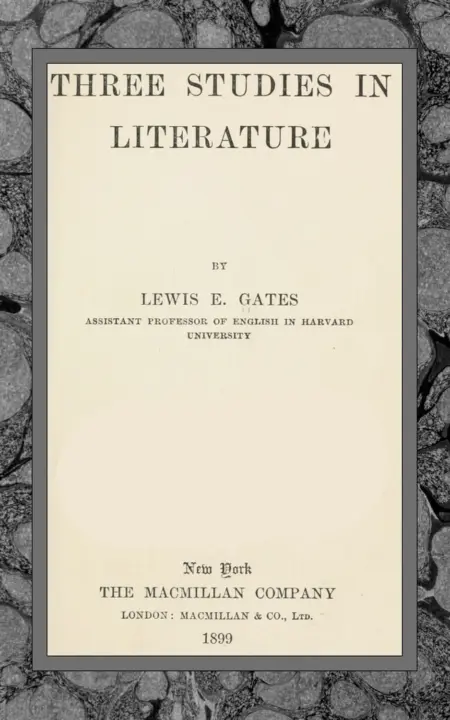
"Three Studies in Literature" by Lewis E. Gates is a collection of literary critiques written in the late 19th century. This work evaluates the critical contributions and reputations of three notable literary figures: Francis Jeffrey, John Henry Newman, and Matthew Arnold. It delves into their styles and the lasting impact they have made on literature and criticism, exploring how these writers shaped public opinion and literary discourse. The opening of the book begins with an exploration of Francis Jeffrey's critical prowess, setting the stage for a discussion of his fluctuating reputation in literary circles. It describes how Jeffrey, once a prominent figure revered for his contributions to the "Edinburgh Review", has somewhat faded from scholarly attention. Gates praises Jeffrey's versatility and sharp style while also raising questions about the relative merits of his critiques. Through careful analysis, the text presents Jeffrey's influence on literary criticism and situates it within a broader narrative of the evolving landscape of 19th-century literature. This initial examination hints at the deeper evaluations of Newman and Arnold that will follow, making it clear that this work aims to provide a comprehensive understanding of these critics' roles in shaping literary criticism.
Introduction adapted from the source catalogue; source summaries may be automatically generated.
Free to read · English · 49,848 words · No account needed
MAKE TIME FOR A GOOD BOOK
On by default. Untick to stop anonymous reading totals. Each page counts after 10 seconds in view. How this works.
Anonymous counting is on unless you have switched it off.
[1] Life and Letters of Lord Macaulay, chap. 3.
[2] Ibid., chap. 9.
[3] Carlyle’s Reminiscences, II, 271.
[4] Hours in a Library, III, 176.
[5] Lord Cockburn’s Life of Jeffrey (ed. Philadelphia, 1852), I, 101
ff.
[6] The Life and Times of Lord Brougham (ed. New York, 1871), I, 176
ff.
[7] Lord Cockburn’s Life of Jeffrey, II, 64.
[8] Forster’s Goldsmith (ed. London, 1848), p. 170.
[9] J. W. Robberd’s Life of William Taylor, I, 130-132.
[10] J. W. Robberd’s Life of William Taylor, I, 139.
[11] Ibid., I, 122.
[12] Coleridge, Biographia Literaria, chap. 21.
[13] Hazlitt’s Table Talk, 2d series, essay 6.
[14] Coleridge’s Biographia Literaria, chap. 21.
[15] Memoirs and Correspondence of Horner, I, 419.
[16] Philomythus, by E. A. Abbott, London, 1891.
[17] Letters and Correspondence of J. H. Newman, 1891, II, 156.
[18] Ibid., I, 416.
[19] Oxford University Sermons, ed. 1887, p. 257.
[20] Ibid., p. 259.
[21] Letters, II, 476.
[22] Discourses to Mixed Congregations, ed. 1892, p. 373.
[23] Development of Christian Doctrine, ed. 1891, pp. 39-40.
[24] See above, p. 79.
[25] Apologia, ed. 1890, p. 96.
[26] Letters and Correspondence, I, 18.
[27] Apologia, p. 28.
[28] Grammar of Assent, ed. 1889, p. 359.
[29] Grammar of Assent, ed. 1889, p. 360.
[30] Ibid., p. 353.
[31] Ibid., p. 345.
[32] Ibid., p. 350.
[33] Celtic Literature, p. 75.
[34] Literature and Dogma, p. xxi.
[35] On Translating Homer, p. 295.
[36] God and the Bible, p. xxxiv.
[37] Literature and Dogma, p. xxvii.
[38] This image may have been suggested by a sentence of Joubert’s: “Plato loses himself in the void, but one sees the play of his wings, one hears their rustle.... It is good to breathe his air, but not to live upon him.” The translation is Arnold’s own. See his Joubert, in Essays in Criticism, I, 294.
[39] On Translating Homer, ed. 1883, p. 197.
[40] On Translating Homer, ed. 1883, p. 295.
[41] Essays, ed. 1891, II, p. 143.
[42] Ibid., p. 5.
[43] Pater’s Appreciations, ed. 1890, p. 36.
[44] Essays, ed. 1891, II, pp. 186-187.
[45] Essays, ed. 1891, II, p. 141.
[46] Ibid., p. 187.
[47] Essays, ed. 1891, II, p. 22.
[48] Essays, ed. 1891, II, p. 33.
[49] Mixed Essays, ed. 1883, p. 209.
[50] On Translating Homer, p. 245.
[51] Letters, I, 282.
[52] Essays, ed. 1891, I, p. v.
[53] On Translating Homer, ed. 1883, p. 264.
[54] On Translating Homer, ed. 1883, p. 194.
[55] Mixed Essays, ed. 1883, p. 210.
[56] Essays, ed. 1891, I, p. 75.
[57] Friendship’s Garland, ed. 1883, p. 279.
[58] Letters, I, 240.
[59] Literature and Dogma, ed. 1893, p. 321.
[60] Culture and Anarchy, ed. 1883, p. 205.
[61] Letters, II, 165.
[62] Mixed Essays, pp. 233-234.
Typographical errors corrected by the etext transcriber:
into the precints=> into the precincts {pg 25}
more elusive susbtance=> more elusive substance {pg 70}
Your reading position is saved on this browser. Take it to another device with a library code. Reading pages adapt to text, rather than matching a printed edition.
BEHIND THE BOOK
This eBook is for the use of anyone anywhere in the United States and most other parts of the world at no cost and with almost no restrictions whatsoever. You may copy it, give it away or re-use it under the terms of the Project Gutenberg License included with this eBook or online at www.gutenberg.org. If you are not located in the United States, you will have to check the laws of the country where you are located before using this eBook. Read the source licence.
The original source file, including credits and licence, is retained by this library. Request an original-format copy at no charge. Please include the book title and Project Gutenberg identifier #74191.
KEEP YOUR CURIOSITY GOING
David Patterson (Spirit) Hatch

David Patterson (Spirit) Hatch

David Patterson (Spirit) Hatch
Cécile Tormay

Moritz Busch
John L. Ransom