
Last letters from the living dead man
David Patterson (Spirit) Hatch
THE CLASSIC COLLECTION · 1921
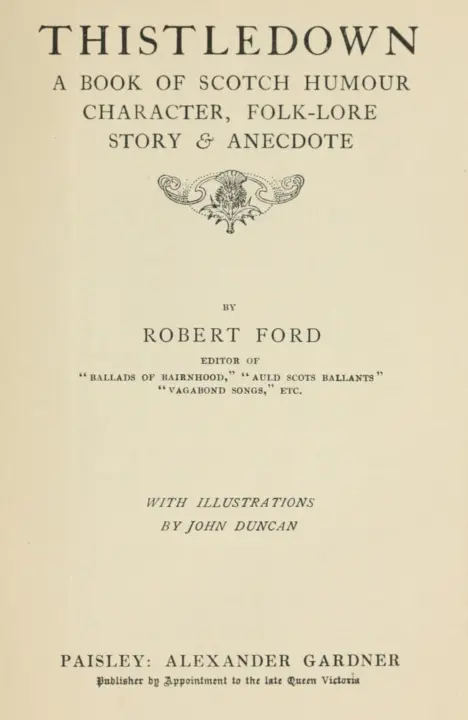
"Thistledown: A Book of Scotch Humour, Character, Folk-lore, Story & Anecdote" by Robert Ford is a collection of humorous essays and anecdotes reflecting Scottish culture and character, likely written in the late 19th century. The work delves into various aspects of Scottish life, capturing the quirks and nuances of the Scottish tongue, and showcasing the unique blend of pathos and humor inherent to the people. Through a wide range of stories, it aims to provide not just laughter but also insight into the heart of Scottish identity. The opening of the book establishes the significance of the Scottish language, asserting that its richness and expressiveness are vital to understanding Scotland’s history and culture. Ford argues against the idea that the language is fading from the upper echelons of society, emphasizing that humor is ingrained in the Scottish character, appearing in the most unexpected places and situations. He introduces anecdotes that illustrate the intricacies of dialects across Scotland, highlighting both the charm and the humor found in its everyday use. As he lays the groundwork for the themes of the book, Ford positions Scotch humour not just as a source of entertainment but as a reflection of the nation’s spirit and resilience.
Introduction adapted from the source catalogue; source summaries may be automatically generated.
Free to read · English · 111,279 words · No account needed
MAKE TIME FOR A GOOD BOOK
On by default. Untick to stop anonymous reading totals. Each page counts after 10 seconds in view. How this works.
Anonymous counting is on unless you have switched it off.
The old man stopped and looked reflectively.
“Ay! are ye gaein’ to be precentin’ the day, Willie?”
“Yes,” replied Willie, proudly.
“Weel, then,” said Mr. C⸺, “I’m gaein’ hame;” and home he went.
He might have gone to church that day, however, for Willie came off with flying colours and, though he has precented many a year and day since, he has never had occasion again to “redeem his character.”
But precentors have “stuck” after they have had years of experience, and I have heard of one in a country kirk who frequently pitched his tunes too high, and when he failed in his efforts to carry them through, he would stop and shake his head and exclaim, “It’ll no do, chaps; we’ll need to try’t a wee thocht laicher.”
Another, after repeated ineffectual attempts to raise the tune on a certain occasion, turned round, and looking up to the minister, exclaimed, “Dod, sir, that psalm’ll no sing ava.”
One who was suffering from cold occupied the desk so imperfectly that the minister whispered to him over the pulpit—
“What’s the matter wi’ ye, John?”
“’Deed, sir,” replied John, “I’m fash’d wi’ an unco kittlin’ i’ the paup o’ my hass.”
“A kittlin’, do ye ca’t?” exclaimed the minister, loud enough for all the congregation to hear him. “It soonds to my lug mair like the catterwaw o’ an auld tam-cat.”
And there have been humorous incidents connected with the praise of the Church for which the precentor could only be held directly responsible. Thus in the Statistical Account we read that, in the days of Mr. Cumming, the late Episcopal minister in the parish of Halkirk, in Caithness-shire, there was no singer of psalms in the church but the “lettergae” and one Tait, gardener in Braal. This Tait sang so loud, and with such a large open mouth, that a young fellow of the name of Inverach was tempted to throw a small round stone into his mouth, whereby his teeth were broken and his singing stopped at once, and he himself almost choked. Inverach immediately took to his heels; the service was converted to laughter; two of Tait’s sons chased and overtook him; and the scene was closed with a desperate fight.
Precentors, like musical men generally, of course, have not suffered from an overstock of modesty. Dr. Blair used to tell the following anecdote of his precentor with a great deal of glee. Happening to preach one day at a distance, he next day met that official as he was returning home—
“Well,” said the Doctor, “how did matters proceed yesterday at church in
my absence?”
Your reading position is saved on this browser. Take it to another device with a library code. Reading pages adapt to text, rather than matching a printed edition.
BEHIND THE BOOK
This eBook is for the use of anyone anywhere in the United States and most other parts of the world at no cost and with almost no restrictions whatsoever. You may copy it, give it away or re-use it under the terms of the Project Gutenberg License included with this eBook or online at www.gutenberg.org. If you are not located in the United States, you will have to check the laws of the country where you are located before using this eBook. Read the source licence.
The original source file, including credits and licence, is retained by this library. Request an original-format copy at no charge. Please include the book title and Project Gutenberg identifier #67576.
KEEP YOUR CURIOSITY GOING
David Patterson (Spirit) Hatch

David Patterson (Spirit) Hatch

David Patterson (Spirit) Hatch

Ralph Waldo Emerson

Maurice Baring

Oscar Wilde & James McNeill Whistler