
Last letters from the living dead man
David Patterson (Spirit) Hatch
THE CLASSIC COLLECTION · 1921
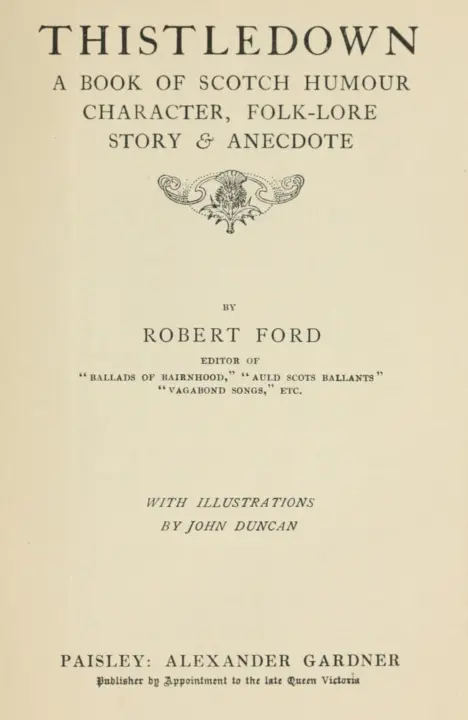
"Thistledown: A Book of Scotch Humour, Character, Folk-lore, Story & Anecdote" by Robert Ford is a collection of humorous essays and anecdotes reflecting Scottish culture and character, likely written in the late 19th century. The work delves into various aspects of Scottish life, capturing the quirks and nuances of the Scottish tongue, and showcasing the unique blend of pathos and humor inherent to the people. Through a wide range of stories, it aims to provide not just laughter but also insight into the heart of Scottish identity. The opening of the book establishes the significance of the Scottish language, asserting that its richness and expressiveness are vital to understanding Scotland’s history and culture. Ford argues against the idea that the language is fading from the upper echelons of society, emphasizing that humor is ingrained in the Scottish character, appearing in the most unexpected places and situations. He introduces anecdotes that illustrate the intricacies of dialects across Scotland, highlighting both the charm and the humor found in its everyday use. As he lays the groundwork for the themes of the book, Ford positions Scotch humour not just as a source of entertainment but as a reflection of the nation’s spirit and resilience.
Introduction adapted from the source catalogue; source summaries may be automatically generated.
Free to read · English · 111,279 words · No account needed
MAKE TIME FOR A GOOD BOOK
On by default. Untick to stop anonymous reading totals. Each page counts after 10 seconds in view. How this works.
Anonymous counting is on unless you have switched it off.
“Ralph, man, I’m glad to see you, ye hae come in gude time. I have a diet of examination to-day, and I have also important business to attend to at Perth. Ye’ll tak’ the examination, will ye, and let me gang to Perth?”
“With all my heart,” said Ralph.
“Weel,” said Ebenezer, “ye’ll find a’ my fouk easy to examine but ane, and him, I reckon, ye had better no meddle wi’. He has an auld-fashioned Scotch way o’ answering a’e question by putting anither, an’ he’ll maybe affront ye.”
“Affront me!” said Ralph indignantly. “Do you think he’ll foil me wi’ my ain weapons?”
“Aweel,” said his brother, “I gi’e ye fair warning, ye had better no ca’
him up.”
The individual thus referred to was Walter Simpson, the village blacksmith, who at former diets of examination had proved himself rather troublesome to his minister. The gifted Ralph, indignant to the last degree at the idea of an illiterate blacksmith perplexing him, determined to encounter him at once by putting a grand, leading, unanswerable question. Accordingly, after putting a variety of simple preliminary interrogations to some of the senior members of his brother’s congregation present, he cried out with a loud voice, “Walter Simpson.”
“Here, sir,” responded the smith.
“Now, Walter, attend,” said the examiner. “Can ye tell me how long Adam continued in a state of innocence?”
“Oh, ay, sir; just till he got a wife,” said Vulcan; “but can ye tell me how lang he remained innocent after that?”
“Sit down, Walter,” said the discomfited divine, and proceeded to examine
another.
Scotch folks have each a mind of their own, which they respect. Still they are seldom found to be doggedly unreasonable. When it was proposed by the Secession congregation at Haddington to give a call to the afterwards celebrated Mr. John Brown, one of the adherents of the church expressed his decided opposition. Subsequent to his ordination, Mr. Brown waited on the solitary dissentient, who was threatening to leave the meeting-house. “Why do you think of leaving us?” mildly enquired Mr. Brown. “Because,” said the sturdy oppositionist, “I don’t think you a good preacher.” “That is quite my own opinion,” replied the minister; “but the great majority of the congregation think the reverse, and it would not do for you and me to set up our opinion against theirs. I have given in, you see, and I would suggest you might just do so too.” “Weel, weel,” said the grumbler, quite reconciled by the candidate’s frank confession, “I think I’ll just follow your example, sir.” All differences were ended; and afterwards, than this same individual, the Rev. John Brown had no greater admirer in the town of Haddington.
Your reading position is saved on this browser. Take it to another device with a library code. Reading pages adapt to text, rather than matching a printed edition.
BEHIND THE BOOK
This eBook is for the use of anyone anywhere in the United States and most other parts of the world at no cost and with almost no restrictions whatsoever. You may copy it, give it away or re-use it under the terms of the Project Gutenberg License included with this eBook or online at www.gutenberg.org. If you are not located in the United States, you will have to check the laws of the country where you are located before using this eBook. Read the source licence.
The original source file, including credits and licence, is retained by this library. Request an original-format copy at no charge. Please include the book title and Project Gutenberg identifier #67576.
KEEP YOUR CURIOSITY GOING
David Patterson (Spirit) Hatch

David Patterson (Spirit) Hatch

David Patterson (Spirit) Hatch

Ralph Waldo Emerson

Maurice Baring

Oscar Wilde & James McNeill Whistler