
Last letters from the living dead man
David Patterson (Spirit) Hatch
THE CLASSIC COLLECTION · 1921
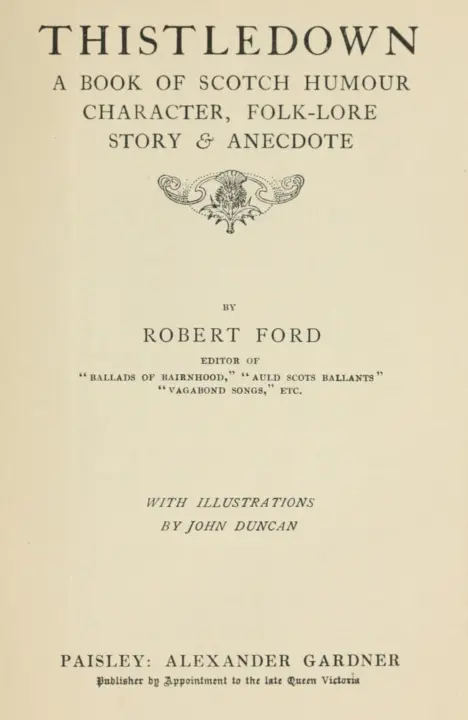
"Thistledown: A Book of Scotch Humour, Character, Folk-lore, Story & Anecdote" by Robert Ford is a collection of humorous essays and anecdotes reflecting Scottish culture and character, likely written in the late 19th century. The work delves into various aspects of Scottish life, capturing the quirks and nuances of the Scottish tongue, and showcasing the unique blend of pathos and humor inherent to the people. Through a wide range of stories, it aims to provide not just laughter but also insight into the heart of Scottish identity. The opening of the book establishes the significance of the Scottish language, asserting that its richness and expressiveness are vital to understanding Scotland’s history and culture. Ford argues against the idea that the language is fading from the upper echelons of society, emphasizing that humor is ingrained in the Scottish character, appearing in the most unexpected places and situations. He introduces anecdotes that illustrate the intricacies of dialects across Scotland, highlighting both the charm and the humor found in its everyday use. As he lays the groundwork for the themes of the book, Ford positions Scotch humour not just as a source of entertainment but as a reflection of the nation’s spirit and resilience.
Introduction adapted from the source catalogue; source summaries may be automatically generated.
Free to read · English · 111,279 words · No account needed
MAKE TIME FOR A GOOD BOOK
On by default. Untick to stop anonymous reading totals. Each page counts after 10 seconds in view. How this works.
Anonymous counting is on unless you have switched it off.
Many years ago a strolling musician, of remarkable appearance, of the name of Abercromby, or “Crummy,” as he was usually called, was well known throughout the north of Scotland. He supported himself and his partner by his penny whistle, with which he had no difficulty in charming the musical of any village. He was buried in the churchyard of Cruden, in Aberdeenshire. He composed his own epitaph in these words:—
“Here Crummy lies, enclosed in wood,
Full six feet one and better,
When tyrant Death grim o’er him stood,
He faced him like a hatter.
Now lies he low without a boot,
Free from a world of bustle,
And silent now is Crummy’s flute,
And awful dry his whustle.”
The following is copied from a tombstone in the East Neuk o’ Fife—Crail,
I think:—
“Here lies my good and gracious Auntie,
Wham Death has packed in his portmanty,
Threescore and ten years God did gift her,
And here she lies, wha de’il daurs lift her?”
On a tombstone in the old churchyard of Peterhead there was wont to appear this interrogatory inscription:—
“Wha lies here?
John Sim, ye needna’ spier.
Hullo, John, is that you?
Ay, ay, but I’m deed noo.”
This is from Haddington kirkyard:—
“Underneath this stone doth lie
As much beauty as could die,
Which while it lived did vigour give
To as much virtue as could live.”
The next is from the same place:—
“Hout, Atropos, hard-hearted Hag,
To cut the sheugh of Jamie Craig;
For had he lived a wheen mae years,
He had been owre tough for all your sheirs;
Now Jamie’s deed, sua man we a’,
And for his sake I’ll say this sa,
In Heiven Jamie be thy saul!”
Mr. Pryse Gordon relates, in his Autobiography, that a sailor having thought proper to enclose the parish churchyard of Deskford, near Cullen, in order to keep it decent, his executor placed a tombstone over him after death, on which was the following:—
“Hic jacet Joannes Anderson, Aberdoniensis, Who built this churchyard dyke at his own expenses.”
That suggests another which is like unto it:—
“Here lies the laird o’ Lundie,
Sic transit gloria Mundi.”
The following curious specimen of sepulchral literature is said to be copied from an old tombstone which marks the grave of a soldier in the kirkyard of Dumfries:—
“Here lies Andrew M’Pherson,
Who was a peculiar person;
He stood six foot two
Without his shoe,
And was slew
At Waterloo.”
The following is a copy of an epitaph on an old tombstone at Logiepert, in the neighbourhood of Montrose:—
Your reading position is saved on this browser. Take it to another device with a library code. Reading pages adapt to text, rather than matching a printed edition.
BEHIND THE BOOK
This eBook is for the use of anyone anywhere in the United States and most other parts of the world at no cost and with almost no restrictions whatsoever. You may copy it, give it away or re-use it under the terms of the Project Gutenberg License included with this eBook or online at www.gutenberg.org. If you are not located in the United States, you will have to check the laws of the country where you are located before using this eBook. Read the source licence.
The original source file, including credits and licence, is retained by this library. Request an original-format copy at no charge. Please include the book title and Project Gutenberg identifier #67576.
KEEP YOUR CURIOSITY GOING
David Patterson (Spirit) Hatch

David Patterson (Spirit) Hatch

David Patterson (Spirit) Hatch

Ralph Waldo Emerson

Maurice Baring

Oscar Wilde & James McNeill Whistler