
Last letters from the living dead man
David Patterson (Spirit) Hatch
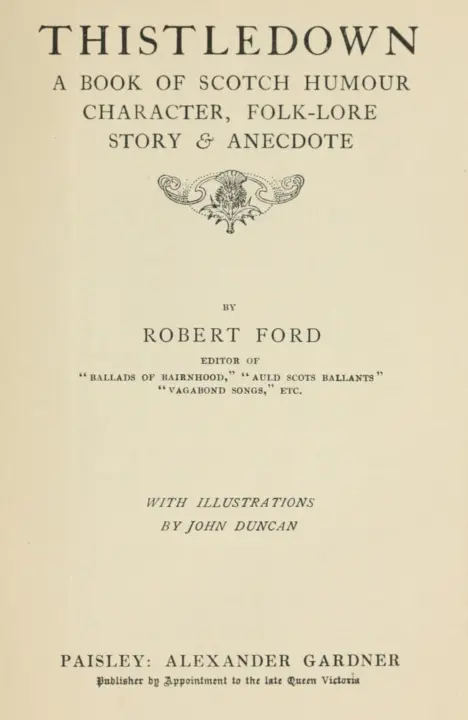
THE CLASSIC COLLECTION · 1921
"Thistledown: A Book of Scotch Humour, Character, Folk-lore, Story & Anecdote" by Robert Ford is a collection of humorous essays and anecdotes reflecting Scottish culture and character, likely written in the late 19th century. The work delves into various aspects of Scottish life, capturing the quirks and nuances of the Scottish tongue, and showcasing the unique blend of pathos and humor inherent to the people. Through a wide range of stories, it aims to provide not just laughter but also insight into the heart of Scottish identity. The opening of the book establishes the significance of the Scottish language, asserting that its richness and expressiveness are vital to understanding Scotland’s history and culture. Ford argues against the idea that the language is fading from the upper echelons of society, emphasizing that humor is ingrained in the Scottish character, appearing in the most unexpected places and situations. He introduces anecdotes that illustrate the intricacies of dialects across Scotland, highlighting both the charm and the humor found in its everyday use. As he lays the groundwork for the themes of the book, Ford positions Scotch humour not just as a source of entertainment but as a reflection of the nation’s spirit and resilience.
Introduction adapted from the source catalogue; source summaries may be automatically generated.
Free to read · English · 111,279 words · No account needed
MAKE TIME FOR A GOOD BOOK
On by default. Untick to stop anonymous reading totals. Each page counts after 10 seconds in view. How this works.
Anonymous counting is on unless you have switched it off.
Mr. Fullerton had advertised from the pulpit that he was to hold a diet of examination in a certain district of the parish, and meeting Will on his way thither, he inquired of the half-wit why he never appeared on such occasions.
“Because ye dinna gi’e fair play,” was the reply.
“Why,” said the minister, “what do you mean Will?”
“Ye should aloo question aboot,” returned Will.
This point was conceded by the minister, and Will, accordingly, appeared
at the next diet.
“How many Gods are there, William?” the catechiser asked.
“There is but one only, the living and true God,” replied Will.
Mr. F. was proceeding with the next question, “How many persons,” etc., when he was interrupted with, “Na na, minister, a bargain’s a bargain; it’s my turn noo. How many deevils are there?”
“I really cannot tell,” replied the divine.
“Is that the gate o’ ye already?” exclaimed Will, and made off with himself as quickly as possible.
Will was a sort of half-privileged haunter of Eglinton Castle and grounds, and knew the Earl very well. Discovering him crossing a fence one day preparatory to making a “short cut” towards some point in the demesne, the Earl called out, “Come back, sir; that is not the road.”
“Do you ken,” asked Will, “whaur I’m gaun?”
“No,” replied his Lordship.
“Weel, hoo the deil do you ken whether this be the road or no?” and having said so, away he went.
Entering the house of a clergyman in Beith, famed as a skilful performer on the violin, and hearing the minister playing on the fiddle, Will began to dance, and continued in his own unmeasured style till the clergyman was fairly tired. The practical commentator on catgut then handed Will a shilling. “Hech,” said Will, “this world’s uncoly changed, for in my young days it was the dancers that aye pay’d the fiddler.”
Passing along the road by the side of the minister’s glebe one morning, whilst haymaking was in progress, the minister asked Will if he thought the weather would keep up, as it looked rather like rain.
“Weel,” says Will, “I canna be sure sae early in the day, but I’ll be passin’ this way the nicht again, an’ I’ll ca’ in and tell ye.”
On making his way to a farmhouse one day where he was usually quite at home, Will accidentally lighted on a young cow of his host’s, which had got swamped in a bog.
Your reading position is saved on this browser. Take it to another device with a library code. Reading pages adapt to text, rather than matching a printed edition.
BEHIND THE BOOK
This eBook is for the use of anyone anywhere in the United States and most other parts of the world at no cost and with almost no restrictions whatsoever. You may copy it, give it away or re-use it under the terms of the Project Gutenberg License included with this eBook or online at www.gutenberg.org. If you are not located in the United States, you will have to check the laws of the country where you are located before using this eBook. Read the source licence.
The original source file, including credits and licence, is retained by this library. Request an original-format copy at no charge. Please include the book title and Project Gutenberg identifier #67576.
KEEP YOUR CURIOSITY GOING
David Patterson (Spirit) Hatch

David Patterson (Spirit) Hatch

David Patterson (Spirit) Hatch

Ralph Waldo Emerson

Maurice Baring

Oscar Wilde & James McNeill Whistler