
Last letters from the living dead man
David Patterson (Spirit) Hatch
THE CLASSIC COLLECTION · 1921
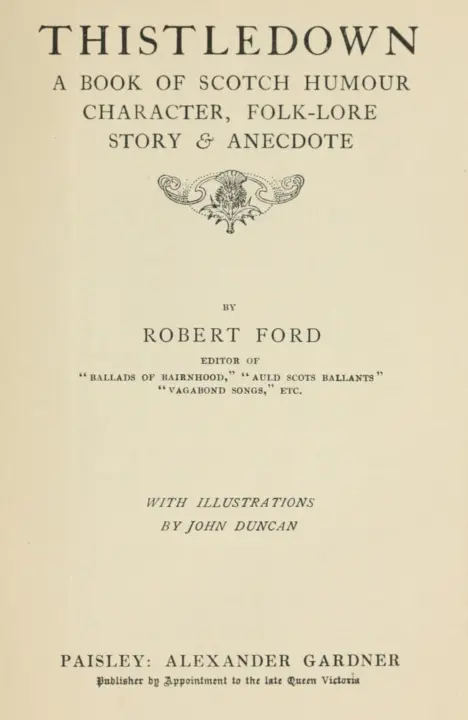
"Thistledown: A Book of Scotch Humour, Character, Folk-lore, Story & Anecdote" by Robert Ford is a collection of humorous essays and anecdotes reflecting Scottish culture and character, likely written in the late 19th century. The work delves into various aspects of Scottish life, capturing the quirks and nuances of the Scottish tongue, and showcasing the unique blend of pathos and humor inherent to the people. Through a wide range of stories, it aims to provide not just laughter but also insight into the heart of Scottish identity. The opening of the book establishes the significance of the Scottish language, asserting that its richness and expressiveness are vital to understanding Scotland’s history and culture. Ford argues against the idea that the language is fading from the upper echelons of society, emphasizing that humor is ingrained in the Scottish character, appearing in the most unexpected places and situations. He introduces anecdotes that illustrate the intricacies of dialects across Scotland, highlighting both the charm and the humor found in its everyday use. As he lays the groundwork for the themes of the book, Ford positions Scotch humour not just as a source of entertainment but as a reflection of the nation’s spirit and resilience.
Introduction adapted from the source catalogue; source summaries may be automatically generated.
Free to read · English · 111,279 words · No account needed
MAKE TIME FOR A GOOD BOOK
On by default. Untick to stop anonymous reading totals. Each page counts after 10 seconds in view. How this works.
Anonymous counting is on unless you have switched it off.
Rab Hamilton, like others of his class, was an example to some sane folks from the fact that he was a frequent, if not regular, attender of the church. In Ayr he was well known as a staunch Seceder. One day, however, he went to hear a sermon in a church belonging to the Establishment, and produced a sensation which was not soon forgotten by those who witnessed it. He took his seat on an inside stair, which had what is known as a “wooden rail,” and having put his head through the railing, in attempting to pull it back he found himself caught by the ears. He shouted at the utmost pitch of his stentorian voice—
“Murder!—my head’ll be cuttit aff! Holy minister! congregation!—oh, my head maun be cuttit aff! It’s a judgment for leaving my ain godlie Mr. Peebles at the Newton, an’ comin’ to hear a paper minister.”
After being extricated, and asked why he put his head there, he said, “It was to look on wi’ anither woman!”
Rab was one day offered the choice of a sixpence or a penny.
“I’ll no be greedy,” said he, “I’ll jist tak’ the wee white ane.”
Receiving a gratuitous dinner at a favourite inn in Kilmarnock one day, and dining to his heart’s content, the waiter remarked, as he was preparing to leave the table—
“I’m sure ye’ve gotten a guid dinner the day, Rab!”
“Ou, ay,” replied Rab; “atweel have I; but if the folk o’ Ayr speir if I got a dram after’t, what will I say?”
Rab’s dream is well known. Dr. Auld often showed him kindness, but being once addressed by him when in a hurry, and out of humour, he said—
“Get away, Rab—I’ve nothing for you to-day.”
“Whaw! whew!” cried Rab, in a half howl, half whining tone, “I dinna want onything the day, Mister Auld. I wanted just to tell you aboot an awsome dream I had; I dreamed I was dead.”
“Well, what then?” asked Dr. Auld.
“Ou, I was carried far, far, far, and up, up, up, till I cam’ to heaven’s yett, whaur I chappit, an’ chappit, till at last an angel keeked out an’ said, ‘Wha are ye?’
“‘I’m puir Rab Hamilton,’ says I.
“‘Whaur are ye frae?’ says he.
“‘Frae the wicked toun o’ Ayr,’ says I.
Your reading position is saved on this browser. Take it to another device with a library code. Reading pages adapt to text, rather than matching a printed edition.
BEHIND THE BOOK
This eBook is for the use of anyone anywhere in the United States and most other parts of the world at no cost and with almost no restrictions whatsoever. You may copy it, give it away or re-use it under the terms of the Project Gutenberg License included with this eBook or online at www.gutenberg.org. If you are not located in the United States, you will have to check the laws of the country where you are located before using this eBook. Read the source licence.
The original source file, including credits and licence, is retained by this library. Request an original-format copy at no charge. Please include the book title and Project Gutenberg identifier #67576.
KEEP YOUR CURIOSITY GOING
David Patterson (Spirit) Hatch

David Patterson (Spirit) Hatch

David Patterson (Spirit) Hatch

Ralph Waldo Emerson

Maurice Baring

Oscar Wilde & James McNeill Whistler