
Last letters from the living dead man
David Patterson (Spirit) Hatch
THE CLASSIC COLLECTION · 1921
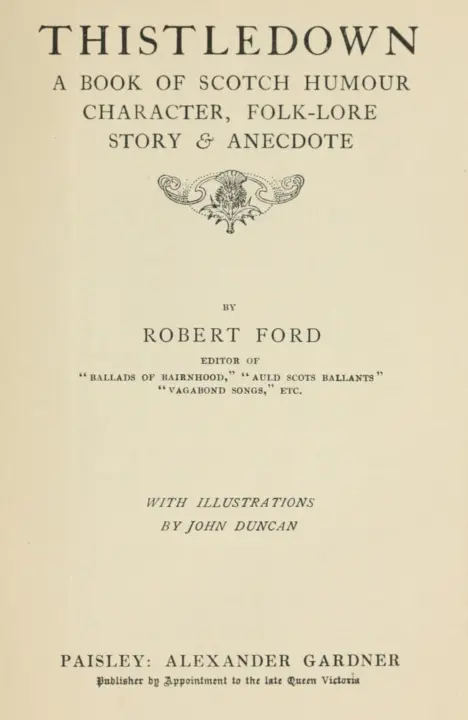
"Thistledown: A Book of Scotch Humour, Character, Folk-lore, Story & Anecdote" by Robert Ford is a collection of humorous essays and anecdotes reflecting Scottish culture and character, likely written in the late 19th century. The work delves into various aspects of Scottish life, capturing the quirks and nuances of the Scottish tongue, and showcasing the unique blend of pathos and humor inherent to the people. Through a wide range of stories, it aims to provide not just laughter but also insight into the heart of Scottish identity. The opening of the book establishes the significance of the Scottish language, asserting that its richness and expressiveness are vital to understanding Scotland’s history and culture. Ford argues against the idea that the language is fading from the upper echelons of society, emphasizing that humor is ingrained in the Scottish character, appearing in the most unexpected places and situations. He introduces anecdotes that illustrate the intricacies of dialects across Scotland, highlighting both the charm and the humor found in its everyday use. As he lays the groundwork for the themes of the book, Ford positions Scotch humour not just as a source of entertainment but as a reflection of the nation’s spirit and resilience.
Introduction adapted from the source catalogue; source summaries may be automatically generated.
Free to read · English · 111,279 words · No account needed
MAKE TIME FOR A GOOD BOOK
On by default. Untick to stop anonymous reading totals. Each page counts after 10 seconds in view. How this works.
Anonymous counting is on unless you have switched it off.
Asked why he never went to church, a Fife “natural”—at least a Fifer more Fifish than his fellows—struck a dramatic attitude and exclaimed—“I love the lark that rises from the green sod with the dew sparkling from his breast, and soars far up in the blue heavens—that’s my religion.” Many perfectly sane persons have not so much. And your “natural” could admonish a stinging reproof when the occasion seemed to demand it. About the year 1820, at the time of the trial of Queen Caroline, Dr. Wightman was the popular and esteemed minister of Kirkmahoe, in the County of Dumfries, and he, like all the old Established clergymen, had been ordered to omit the Queen’s name from his public prayers. In those days the Doctor was often seen in the streets of the County town on market days, and on one of those occasions he happened to meet with daft Jock Gordon, and as usual stopped to have a little chat with him.
“Good morning, Jock, and how are you to-day?” said the kindly divine.
“Oh, gaily weel, gaily weel, Doctor,” replied Jock; “but, man, they tell me ye dinna pray for the Queen noo.”
“Quite true, Jock, for I’m afraid she is not a good woman,” replied Dr.
Wightman.
“God bless me, Doctor, ye ken I’m a puir daft creature, and maybe kens nae better,” said Jock, “but I aye thocht, the waur a body was they aye wanted the prayin’ for the mair.”
Dr. Wightman felt he had been justly rebuked, and quietly slipped away.
It has become a proverb that “everybody has his bubblyjock,” and the well-known aphorism rose from the remark of a Scottish half-wit. The circumstances which produced it occurred in the experience of Sir Walter Scott, and deserves to be told.
A gentleman conversing with the illustrious author, remarked that he believed it possible that perfect happiness might be enjoyed, even in this world.
Sir Walter dissented.
“Well,” said the gentleman, “there is an idiot whom I am certain will confirm my opinion, he seems the very beau-ideal of animal contentment.”
The daft individual was moving along humming to himself, when Sir Walter
addressed him.
“Weel, Jamie, hoo are ye the day?”
“Brawly, ou brawly,” answered he.
“Have you plenty to eat and drink, Jamie?”
“Ou ay.”
“There,” said the poet’s antagonist, crowing, “is a perfectly happy
creature.”
“Not so fast,” continued Sir Walter. Then to Jamie—
“Is there nathing that bothers ye ava, Jamie?”
“Ou ay,” said the idiot, changing his merry look, “I’m sair hadden doon by the muckle bubblyjock; he follows me whaurever I gang.”
Your reading position is saved on this browser. Take it to another device with a library code. Reading pages adapt to text, rather than matching a printed edition.
BEHIND THE BOOK
This eBook is for the use of anyone anywhere in the United States and most other parts of the world at no cost and with almost no restrictions whatsoever. You may copy it, give it away or re-use it under the terms of the Project Gutenberg License included with this eBook or online at www.gutenberg.org. If you are not located in the United States, you will have to check the laws of the country where you are located before using this eBook. Read the source licence.
The original source file, including credits and licence, is retained by this library. Request an original-format copy at no charge. Please include the book title and Project Gutenberg identifier #67576.
KEEP YOUR CURIOSITY GOING
David Patterson (Spirit) Hatch

David Patterson (Spirit) Hatch

David Patterson (Spirit) Hatch

Ralph Waldo Emerson

Maurice Baring

Oscar Wilde & James McNeill Whistler