
Last letters from the living dead man
David Patterson (Spirit) Hatch
THE CLASSIC COLLECTION · 1921
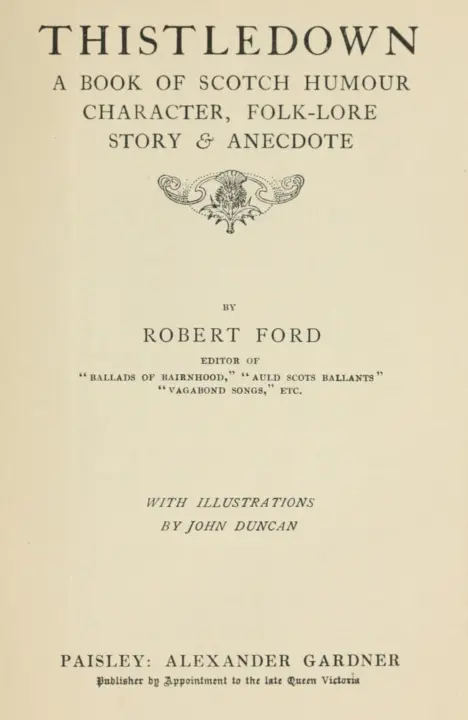
"Thistledown: A Book of Scotch Humour, Character, Folk-lore, Story & Anecdote" by Robert Ford is a collection of humorous essays and anecdotes reflecting Scottish culture and character, likely written in the late 19th century. The work delves into various aspects of Scottish life, capturing the quirks and nuances of the Scottish tongue, and showcasing the unique blend of pathos and humor inherent to the people. Through a wide range of stories, it aims to provide not just laughter but also insight into the heart of Scottish identity. The opening of the book establishes the significance of the Scottish language, asserting that its richness and expressiveness are vital to understanding Scotland’s history and culture. Ford argues against the idea that the language is fading from the upper echelons of society, emphasizing that humor is ingrained in the Scottish character, appearing in the most unexpected places and situations. He introduces anecdotes that illustrate the intricacies of dialects across Scotland, highlighting both the charm and the humor found in its everyday use. As he lays the groundwork for the themes of the book, Ford positions Scotch humour not just as a source of entertainment but as a reflection of the nation’s spirit and resilience.
Introduction adapted from the source catalogue; source summaries may be automatically generated.
Free to read · English · 111,279 words · No account needed
MAKE TIME FOR A GOOD BOOK
On by default. Untick to stop anonymous reading totals. Each page counts after 10 seconds in view. How this works.
Anonymous counting is on unless you have switched it off.
and so I returned to my own shape, as I am at this instant, again. The dogs will sometimes get some bites of us when we are in hares, but will not get us killed. When we turn out of a hare’s likeness to our own shape we will have the bites and rives and scratches on our bodies. When we would be in the shape of cats we did nothing but cry and wraw, and riving, and, as it were, worrying one another; and when we come to our shapes again we will find the scratches and rives on our skin very sore. When one of us, or more, are in the shape of cats, and meet with any others, our neighbours, we will say—
‘Devil speed thee,
Go thou with me!’
and immediately they will turn into the shape of a cat and go with us. When we will be in the shape of crows we will be larger than ordinary crows, and will sit upon branches of trees.”
The spells, incantations, and cantrips, employed by witches when working out their diableries were quaint and curious enough. Students of Shakespeare are familiar with the
“Toil and trouble, toil and trouble,
Fire burn, and cauldron bubble,”
of the witches in the play of Macbeth, as well as the request of the
first witch, to
“Pour in sow’s blood, that hath eaten
Her nine farrow; grease that’s sweaten
From the murderer’s gibbet throw
Into the flame,”
making an uncouth mixture. But think of the following—one of two snatches of cantrip rhymes quoted by M’Taggart in the Scottish Gallovidian Encyclopedia—
“In the pingle or the pan,
Or the haurnpan o’ man,
Boil the heart’s blude o’ the tade,
Wi’ the tallow o’ the gled;
Hawcket kail, and hen dirt,
Chow’d cheese, and chicken-wort;
Yellow paddocks champit sma’,
Spiders ten, and gelloch’s twa;
Sclaters twall, frae foggy dyke,
Bumbees twenty, frae their byke;
Asks frae stinkin’ lochens blue,
Aye will mak’ a better stew;
Bachelors maun hae a charm,
Hearts hae they a’ fu’ o’ harm,
Aye the aulder, aye the caulder,
Aye the caulder, aye the baulder.
Taps snaw white, and tails green,
Snappin’ maiden’s o’ fifteen,
Mingle, mingle, in the pingle,
Join the cantrip wi’ the jingle;
Now we see, and now we see,
Plots o’ poachin’ ane, twa, three.”
By tugging at a hair-rope, in the usual manner of milking a cow—said rope being made up of tufts of hair drawn from cows’ tails, and having on it a knot for each cow—and chanting the following, or a similar charm—
Your reading position is saved on this browser. Take it to another device with a library code. Reading pages adapt to text, rather than matching a printed edition.
BEHIND THE BOOK
This eBook is for the use of anyone anywhere in the United States and most other parts of the world at no cost and with almost no restrictions whatsoever. You may copy it, give it away or re-use it under the terms of the Project Gutenberg License included with this eBook or online at www.gutenberg.org. If you are not located in the United States, you will have to check the laws of the country where you are located before using this eBook. Read the source licence.
The original source file, including credits and licence, is retained by this library. Request an original-format copy at no charge. Please include the book title and Project Gutenberg identifier #67576.
KEEP YOUR CURIOSITY GOING
David Patterson (Spirit) Hatch

David Patterson (Spirit) Hatch

David Patterson (Spirit) Hatch

Ralph Waldo Emerson

Maurice Baring

Oscar Wilde & James McNeill Whistler