
Last letters from the living dead man
David Patterson (Spirit) Hatch
THE CLASSIC COLLECTION · 1921
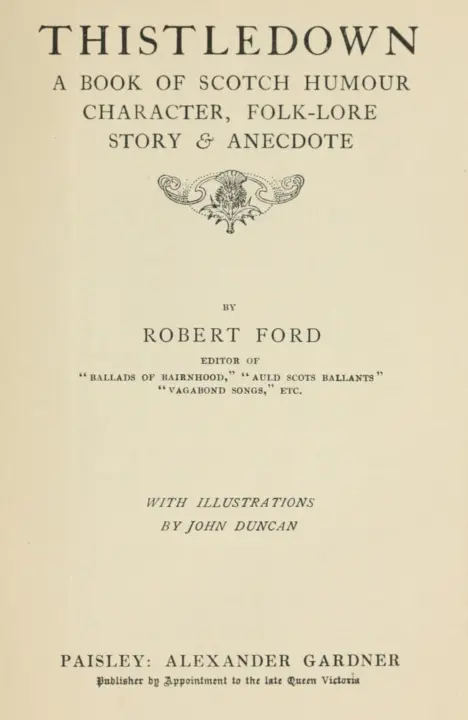
"Thistledown: A Book of Scotch Humour, Character, Folk-lore, Story & Anecdote" by Robert Ford is a collection of humorous essays and anecdotes reflecting Scottish culture and character, likely written in the late 19th century. The work delves into various aspects of Scottish life, capturing the quirks and nuances of the Scottish tongue, and showcasing the unique blend of pathos and humor inherent to the people. Through a wide range of stories, it aims to provide not just laughter but also insight into the heart of Scottish identity. The opening of the book establishes the significance of the Scottish language, asserting that its richness and expressiveness are vital to understanding Scotland’s history and culture. Ford argues against the idea that the language is fading from the upper echelons of society, emphasizing that humor is ingrained in the Scottish character, appearing in the most unexpected places and situations. He introduces anecdotes that illustrate the intricacies of dialects across Scotland, highlighting both the charm and the humor found in its everyday use. As he lays the groundwork for the themes of the book, Ford positions Scotch humour not just as a source of entertainment but as a reflection of the nation’s spirit and resilience.
Introduction adapted from the source catalogue; source summaries may be automatically generated.
Free to read · English · 111,279 words · No account needed
MAKE TIME FOR A GOOD BOOK
On by default. Untick to stop anonymous reading totals. Each page counts after 10 seconds in view. How this works.
Anonymous counting is on unless you have switched it off.
“Ye’ll excuse me, sir,” said the farmer and elder, “but ye’re the Edinborough minister that was preachin’ to us the day, an’ I would like to ken if ye’re walkin’ oot the gate for mere pleasure on the blessed day, or if ye’re on a mission o’ mercy?”
“Oh, it’s a delightful afternoon,” replied the divine, “and I am just enjoying a meditative walk amid the beauties of Nature, so rich and——”
“I just suspectit as muckle,” broke in the elder; “but you that’s a minister o’ the Gospel sud ken that this is no a day for ony sic thing.”
“Well,” returned the Doctor, “we find good precedent for walking on the Sabbath. You remember that even the Master himself walked in the fields with His disciples on the Sabbath day.”
“Ou, I ken a’ aboot that brawly,” snorted the elder; “but I dinna think ony mair o’ Him for’t either!” and immediately turning on his heel, he strode sulkily towards the steading.
But, of course, the ministers are more commonly the accusers than the accused in the matter of supposed or actual Sabbath desecration—both in town and country.
“Wherefore did you go and shoot the hare on the Sabbath day, John?” asked a reverend gentleman once of a parishioner who was “before the Session” for the misdeed in question.
“Weel, ye see,” replied John, not unphilosophically, “I had a strong dreed that the beastie michtna sit till Monday, say just dressed his drodrum when I had the chance.”
But a certain minister and elder in Perthshire once combined to transact dubious business, even “between the preachin’s.”
“Had it not been the Sabbath day, Mr. Blank,” remarked the preacher, “I would have asked you how the hay was selling in Perth on Friday?”
“Weel, sir,” replied the sessional confrere, “had it no been the day that it is, I wad just hae tell’t ye it was gaun at a shillin’ the stane.”
“Indeed! Well, had it been Monday instead of Sabbath, I would have told you that I have some to sell.”
“Imphm, ay, ou ay, sir. An’ had it been Monday, as ye say, then, I wad just hae tell’t ye I wad gie ye market price for’t.”
The significant nod which the minister gave to this last remark brought the elder with a couple of carts to the manse on Monday morning, and before mid-day the minister’s hay-stack was non est.
These fellows were wise as serpents, though scarcely as innocent as doves.
Your reading position is saved on this browser. Take it to another device with a library code. Reading pages adapt to text, rather than matching a printed edition.
BEHIND THE BOOK
This eBook is for the use of anyone anywhere in the United States and most other parts of the world at no cost and with almost no restrictions whatsoever. You may copy it, give it away or re-use it under the terms of the Project Gutenberg License included with this eBook or online at www.gutenberg.org. If you are not located in the United States, you will have to check the laws of the country where you are located before using this eBook. Read the source licence.
The original source file, including credits and licence, is retained by this library. Request an original-format copy at no charge. Please include the book title and Project Gutenberg identifier #67576.
KEEP YOUR CURIOSITY GOING
David Patterson (Spirit) Hatch

David Patterson (Spirit) Hatch

David Patterson (Spirit) Hatch

Ralph Waldo Emerson

Maurice Baring

Oscar Wilde & James McNeill Whistler