
Last letters from the living dead man
David Patterson (Spirit) Hatch
THE CLASSIC COLLECTION · 1921
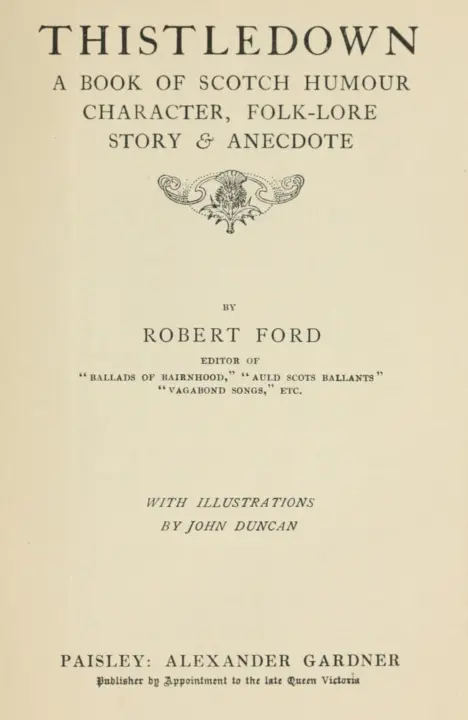
"Thistledown: A Book of Scotch Humour, Character, Folk-lore, Story & Anecdote" by Robert Ford is a collection of humorous essays and anecdotes reflecting Scottish culture and character, likely written in the late 19th century. The work delves into various aspects of Scottish life, capturing the quirks and nuances of the Scottish tongue, and showcasing the unique blend of pathos and humor inherent to the people. Through a wide range of stories, it aims to provide not just laughter but also insight into the heart of Scottish identity. The opening of the book establishes the significance of the Scottish language, asserting that its richness and expressiveness are vital to understanding Scotland’s history and culture. Ford argues against the idea that the language is fading from the upper echelons of society, emphasizing that humor is ingrained in the Scottish character, appearing in the most unexpected places and situations. He introduces anecdotes that illustrate the intricacies of dialects across Scotland, highlighting both the charm and the humor found in its everyday use. As he lays the groundwork for the themes of the book, Ford positions Scotch humour not just as a source of entertainment but as a reflection of the nation’s spirit and resilience.
Introduction adapted from the source catalogue; source summaries may be automatically generated.
Free to read · English · 111,279 words · No account needed
MAKE TIME FOR A GOOD BOOK
On by default. Untick to stop anonymous reading totals. Each page counts after 10 seconds in view. How this works.
Anonymous counting is on unless you have switched it off.
Swearers, of course, who view the oath as a thing of expediency, as evidently that man did, come in handy about Courts of Law, and not very long since, in the same Sheriff Court, a batch of witnesses “swore” a young man so clearly out of a charge of assault that a party in Court, who was subsequently to be called on a similar charge, was heard whispering to a friend—“Lord, Tam, I wad gie a pound for half an oor o’ thae witnesses.”
Witnesses are a widely various lot, and are often the source of much amusement ’tween Bench and Bar. Great tact is required by the lawyer who would get “the truth, the whole truth, and nothing but the truth,” out of some of them; and this sometimes, not because of any desire on the witnesses’ part to prevaricate, but from perfectly innocent causes. Cockburn was exceedingly happy in the management of some of those who hailed from country places, and one case in which Jeffrey and he were engaged as counsel is memorable. A vital question in the cause was the sanity of one of the parties primarily concerned.
“Is the defendant, in your opinion, perfectly sane?” said Jeffrey, interrogating one of the witnesses, a plain, stupid-looking country man.
The witness gazed in bewilderment at the questioner, and gave no answer. Jeffrey repeated the question, altering the words—
“Do you think the defendant is perfectly capable of managing his own
affairs?”
Still in vain.
“I ask you,” said Jeffrey, “do you consider the man is perfectly
rational?”
No answer yet.
“Let me tackle him,” said Cockburn.
Jeffrey sat down, whereupon Cockburn assumed his broadest Scottish tone and accent, and turning to the obdurate witness, began—
“Hae ye your mull wi’ ye?”
“Ou, ay!” said the awkward countryman, and diving his hand into his coat pocket he drew forth his snuff-horn and handed it over to the witty counsel.
“Noo, hoo lang hae ye kent John Sampson?” inquired Cockburn, tapping the mull familiarly with his finger, and taking a pinch.
“Ever since he was that heicht,” was the ready reply, the witness indicating with his hand the alleged altitude.
“An’ d’ ye really think noo, atween you an’ me,” said the advocate, in his most insinuating Scotch manner, “that there’s onything ava intill the cratur’?”
“I wadna lippen him wi’ a bull-stirk,” was the instant and brilliant rejoinder; and Jeffrey admitted that Cockburn had fairly extracted the essence of the evidence.
Your reading position is saved on this browser. Take it to another device with a library code. Reading pages adapt to text, rather than matching a printed edition.
BEHIND THE BOOK
This eBook is for the use of anyone anywhere in the United States and most other parts of the world at no cost and with almost no restrictions whatsoever. You may copy it, give it away or re-use it under the terms of the Project Gutenberg License included with this eBook or online at www.gutenberg.org. If you are not located in the United States, you will have to check the laws of the country where you are located before using this eBook. Read the source licence.
The original source file, including credits and licence, is retained by this library. Request an original-format copy at no charge. Please include the book title and Project Gutenberg identifier #67576.
KEEP YOUR CURIOSITY GOING
David Patterson (Spirit) Hatch

David Patterson (Spirit) Hatch

David Patterson (Spirit) Hatch

Ralph Waldo Emerson

Maurice Baring

Oscar Wilde & James McNeill Whistler