
Last letters from the living dead man
David Patterson (Spirit) Hatch
THE CLASSIC COLLECTION · 1921
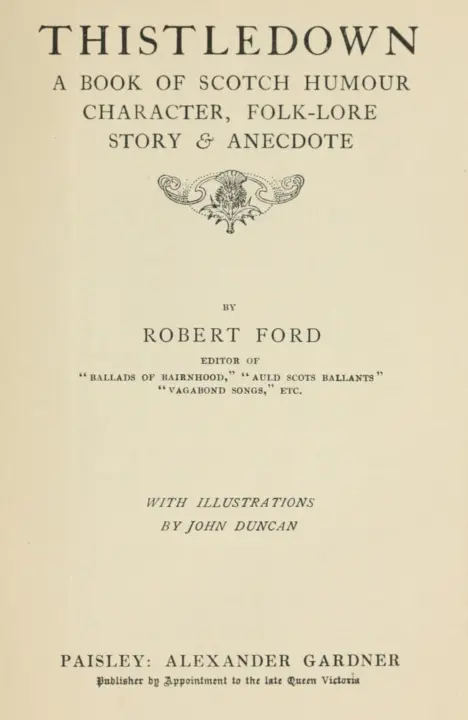
"Thistledown: A Book of Scotch Humour, Character, Folk-lore, Story & Anecdote" by Robert Ford is a collection of humorous essays and anecdotes reflecting Scottish culture and character, likely written in the late 19th century. The work delves into various aspects of Scottish life, capturing the quirks and nuances of the Scottish tongue, and showcasing the unique blend of pathos and humor inherent to the people. Through a wide range of stories, it aims to provide not just laughter but also insight into the heart of Scottish identity. The opening of the book establishes the significance of the Scottish language, asserting that its richness and expressiveness are vital to understanding Scotland’s history and culture. Ford argues against the idea that the language is fading from the upper echelons of society, emphasizing that humor is ingrained in the Scottish character, appearing in the most unexpected places and situations. He introduces anecdotes that illustrate the intricacies of dialects across Scotland, highlighting both the charm and the humor found in its everyday use. As he lays the groundwork for the themes of the book, Ford positions Scotch humour not just as a source of entertainment but as a reflection of the nation’s spirit and resilience.
Introduction adapted from the source catalogue; source summaries may be automatically generated.
Free to read · English · 111,279 words · No account needed
MAKE TIME FOR A GOOD BOOK
On by default. Untick to stop anonymous reading totals. Each page counts after 10 seconds in view. How this works.
Anonymous counting is on unless you have switched it off.
“Weel, Jenny, ye’re deein’; but ye’ve done the richt gaet here, an’ ye’ll gang to heaven; an’ when ye gang there, should you see ony o’ oor fouk, ye micht tell them that we’re a’ weel.”
“Ou,” said Jenny half-heartedly, “gin I see them I’se tell them; but ye maunna expect that I’m to be gaun clank, clankin’ about through heaven lookin’ for your fouk.”
Of all the stories of this class, however, the following death-bed conversation between a husband and wife affords perhaps the very best specimen of the dry humour peculiar to Scotch folk:—An old shoemaker in Glasgow was sitting by the bedside of his wife, who was dying. Taking her husband by the hand, the old woman said, “Weel, John, we’re to pairt. I hae been a gude wife to you, John.”
“Oh, middlin’, middlin’, Jenny,” said John, not disposed to commit
himself wholly.
“Ay, I’ve been a gude wife to you, John,” says she, “an’ ye maun promise to bury me in the auld kirkyard at Stra’von, beside my ain kith and kin, for I couldna rest in peace among unoo fouk, in the dirt an’ smoke o’ Gleska’.”
“Weel, weel, Jenny, my woman,” said John, soothingly, “I’ll humour ye thus far. We’ll pit ye in the Gorbals first, an’ gin ye dinna lie quiet there, we’ll tak’ ye to Stra’von syne.”
And yet there is on record a retort of a Scotch beadle, which is almost equally moving. Saunders was a victim to chronic asthma, and one day, whilst in the act of opening a grave, was seized with a violent fit of coughing. The minister, towards whom Saunders bore little affection, at the same time entering the kirkyard, came up to the old man as he was leaning over his spade wiping the tears from his eyes, and said, “That’s a very bad cough you’ve got, Saunders.”
“Ay, it’s no very gude,” was the dry response, “but there’s a hantle fouk lyin’ round aboot ye that wud be gey glad o’t.”
Speaking of beadles reminds me of another good illustration of the “practicality,” if I may dare to coin a word, of the Scottish mind. A country beadle had had repeated cause to complain to his minister of interference with his duties on the part of his superannuated predecessor. Coming up to the minister one day, “John’s been interfeerin’ again,” said he, “an’ I’ve come to see what’s to be dune?”
Your reading position is saved on this browser. Take it to another device with a library code. Reading pages adapt to text, rather than matching a printed edition.
BEHIND THE BOOK
This eBook is for the use of anyone anywhere in the United States and most other parts of the world at no cost and with almost no restrictions whatsoever. You may copy it, give it away or re-use it under the terms of the Project Gutenberg License included with this eBook or online at www.gutenberg.org. If you are not located in the United States, you will have to check the laws of the country where you are located before using this eBook. Read the source licence.
The original source file, including credits and licence, is retained by this library. Request an original-format copy at no charge. Please include the book title and Project Gutenberg identifier #67576.
KEEP YOUR CURIOSITY GOING
David Patterson (Spirit) Hatch

David Patterson (Spirit) Hatch

David Patterson (Spirit) Hatch

Ralph Waldo Emerson

Maurice Baring

Oscar Wilde & James McNeill Whistler