
Last letters from the living dead man
David Patterson (Spirit) Hatch
THE CLASSIC COLLECTION · 1921
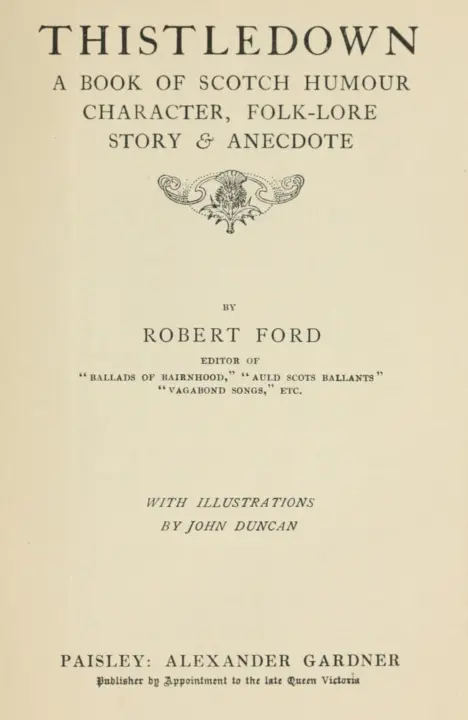
"Thistledown: A Book of Scotch Humour, Character, Folk-lore, Story & Anecdote" by Robert Ford is a collection of humorous essays and anecdotes reflecting Scottish culture and character, likely written in the late 19th century. The work delves into various aspects of Scottish life, capturing the quirks and nuances of the Scottish tongue, and showcasing the unique blend of pathos and humor inherent to the people. Through a wide range of stories, it aims to provide not just laughter but also insight into the heart of Scottish identity. The opening of the book establishes the significance of the Scottish language, asserting that its richness and expressiveness are vital to understanding Scotland’s history and culture. Ford argues against the idea that the language is fading from the upper echelons of society, emphasizing that humor is ingrained in the Scottish character, appearing in the most unexpected places and situations. He introduces anecdotes that illustrate the intricacies of dialects across Scotland, highlighting both the charm and the humor found in its everyday use. As he lays the groundwork for the themes of the book, Ford positions Scotch humour not just as a source of entertainment but as a reflection of the nation’s spirit and resilience.
Introduction adapted from the source catalogue; source summaries may be automatically generated.
Free to read · English · 111,279 words · No account needed
MAKE TIME FOR A GOOD BOOK
On by default. Untick to stop anonymous reading totals. Each page counts after 10 seconds in view. How this works.
Anonymous counting is on unless you have switched it off.
When pleading before the same learned senator, after he had assumed the judicial title of Lord Meadowbank, it was suggested to Clerk by his Lordship that in the legal document which he had submitted to the Court he might have varied the frequently recurring expression “also,” by the occasional use of “likewise.”
“I beg your pardon, my Lord,” said Clerk, “but the terms are not always
synonymous.”
“In every case,” retorted Meadowbank, gruffly.
Clerk still dissented.
“Then cite an instance,” demanded the Judge.
“Well,” remarked Clerk, doubtless chuckling inwardly the while, “your Lordship’s father was a Judge of Session. You are a Judge of Session also, but not likewise.”
Clerk’s ready wit helped him well on many an occasion. In pleading, he frequently dropped into broad Scotch, and once when arguing a Scotch appeal case before the House of Lords, in which his client claimed the use of a mill-stream by a prescriptive right, he contended that “the watter had run that way for forty years.”
“Indeed,” argued Clerk, “naebody kens how lang, and why should my client now be deprived of the watter?” etc.
The Chancellor, much amused at the pronunciation of the Scottish advocate, in a rather bantering tone, asked—“Mr. Clerk, do you spell water in Scotland with two t’s?”
Nettled at this hit at his national tongue, Clerk immediately replied—“No, my Lord, we dinna spell watter in Scotland wi’ twa t’s, but we spell manners in Scotland wi’ twa n’s.”
On one occasion, when he had been pleading a case before Lord Hermand, already mentioned, after he had finished and sat down to receive judgment, his Lordship took up the case rather warmly, and when in the heat of an excited harangue, the saliva from his lips was spurted in the face of the sarcastic advocate.
“I have often heard o’ the dews o’ Hermon,” remarked Clerk, “but I never felt them before.”
Mr. James Wolfe-Murray became a Judge of the Court of Session, under the title of Lord Cringletie. When he was appointed, doubts were expressed by some as to his legal acquirements, and Clerk expressed his view in the following clever epigram:—
“Necessity and Cringletie
Are fitted to a tittle;
Necessity has nae law,
Cringletie has as little.”
When in his sixty-fifth year he was raised to the Bench, Clerk took the title of Lord Eldin, from his family estate. Some one remarked to him that his title nearly resembled that of the Lord-Chancellor Eldon.
“The difference,” said he, “is all in my eye (i).”
Your reading position is saved on this browser. Take it to another device with a library code. Reading pages adapt to text, rather than matching a printed edition.
BEHIND THE BOOK
This eBook is for the use of anyone anywhere in the United States and most other parts of the world at no cost and with almost no restrictions whatsoever. You may copy it, give it away or re-use it under the terms of the Project Gutenberg License included with this eBook or online at www.gutenberg.org. If you are not located in the United States, you will have to check the laws of the country where you are located before using this eBook. Read the source licence.
The original source file, including credits and licence, is retained by this library. Request an original-format copy at no charge. Please include the book title and Project Gutenberg identifier #67576.
KEEP YOUR CURIOSITY GOING
David Patterson (Spirit) Hatch

David Patterson (Spirit) Hatch

David Patterson (Spirit) Hatch

Ralph Waldo Emerson

Maurice Baring

Oscar Wilde & James McNeill Whistler