
Last letters from the living dead man
David Patterson (Spirit) Hatch
THE CLASSIC COLLECTION · 1921
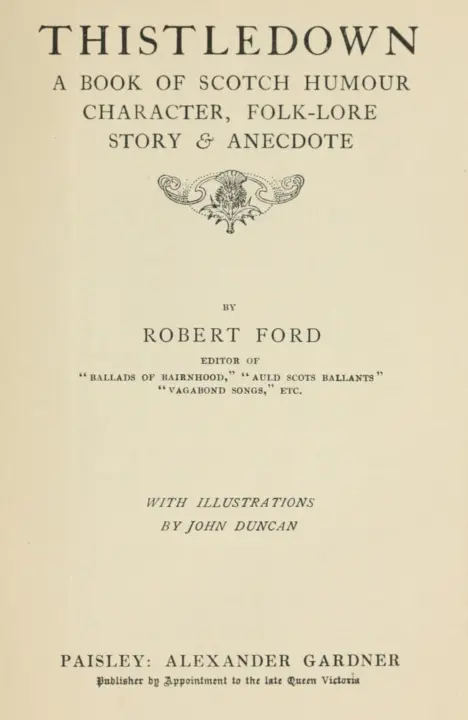
"Thistledown: A Book of Scotch Humour, Character, Folk-lore, Story & Anecdote" by Robert Ford is a collection of humorous essays and anecdotes reflecting Scottish culture and character, likely written in the late 19th century. The work delves into various aspects of Scottish life, capturing the quirks and nuances of the Scottish tongue, and showcasing the unique blend of pathos and humor inherent to the people. Through a wide range of stories, it aims to provide not just laughter but also insight into the heart of Scottish identity. The opening of the book establishes the significance of the Scottish language, asserting that its richness and expressiveness are vital to understanding Scotland’s history and culture. Ford argues against the idea that the language is fading from the upper echelons of society, emphasizing that humor is ingrained in the Scottish character, appearing in the most unexpected places and situations. He introduces anecdotes that illustrate the intricacies of dialects across Scotland, highlighting both the charm and the humor found in its everyday use. As he lays the groundwork for the themes of the book, Ford positions Scotch humour not just as a source of entertainment but as a reflection of the nation’s spirit and resilience.
Introduction adapted from the source catalogue; source summaries may be automatically generated.
Free to read · English · 111,279 words · No account needed
MAKE TIME FOR A GOOD BOOK
On by default. Untick to stop anonymous reading totals. Each page counts after 10 seconds in view. How this works.
Anonymous counting is on unless you have switched it off.
It happened that three breekless bands
O’ caterans came frae distant lands,
And took what fell amang their hands,
O’ sheep and duddies.
Just like your reivin’ Hielan’ clans,
Or Border bodies.
I tell thee, Rab, I had nae share
In a’ the tulzie, here or there,
I lookit on, I do declare,
A mere spectator,
Nor said, nor acted, less or mair,
Aboot the matter.
Job had a minstrel o’ his ain,
A genius rare, and somewhat vain
Of rhyme and lear, but then again,
Just like yersel’,
O’ drink and lasses unco fain,
The ne’er-do-weel.
He’d sing o’ lads and lasses fair,
O’ love, and hope, and mirk despair,
And wond’rous tales wad whiles prepare,
And string together,
For a’ he wanted was a hair
To mak’ a tether.
So with intention fully bent,
My doings to misrepresent,
That Book o’ Job he did invent,
And then his rhymes
Got published, in Arabic prent,
To suit the times.
You poets, Rab, are a’ the same,
O’ ilka kintra, age, and name,
Nae matter what may be your aim,
Or your intentions,
Maist a’ your characters of fame,
Are pure inventions.
Your dogs are baith debaters, rare,
Wi’ sense, galore, and some to spare,
While e’en the verra Brigs o’ Ayr,
Ye gar them quarrel—
Tak’ Coila ben to deck your hair
Wi’ Scottish laurel.
Yet, Robin, lad, for a’ your spite,
And taunts, and jeers, and wrangfu’ wyte,
I find, before you end your flyte,
And wind yer pirn,
Ye’re nae sae cankered in the bite
As in the girn.
For when you think I’m doomed to dwell,
The lang for-ever-mair in hell,
Ye come and bid a kind farewell—
And, guid be here,
E’en for the very Deil himsel’,
Let fa’ a tear.
And, Rab, I’m just as wae for thee,
As ever thou can’st be for me,
For less ye let the drink abee,
I’ll tak’ my aith,
Ye’ll a’ gang wrang, and, maybe, dee
A drunkard’s death.
Sure as ye mourned the daisy’s fate,
That fate is thine, nae distant date,
Stern Ruin’s ploughshare drives elate,
Full on thy bloom,
And crushed beneath the furrow’s weight
May be thy doom.
Much more might be written under this heading, for of the humours of living and recent poets I have scarcely dared to speak. Yea, of the humours of those about whom one may write with perfect freedom, the half has not been told; and to the bookish reader, I feel, the chapter will be interesting as much for what it suggests as for what it contains.
Your reading position is saved on this browser. Take it to another device with a library code. Reading pages adapt to text, rather than matching a printed edition.
BEHIND THE BOOK
This eBook is for the use of anyone anywhere in the United States and most other parts of the world at no cost and with almost no restrictions whatsoever. You may copy it, give it away or re-use it under the terms of the Project Gutenberg License included with this eBook or online at www.gutenberg.org. If you are not located in the United States, you will have to check the laws of the country where you are located before using this eBook. Read the source licence.
The original source file, including credits and licence, is retained by this library. Request an original-format copy at no charge. Please include the book title and Project Gutenberg identifier #67576.
KEEP YOUR CURIOSITY GOING
David Patterson (Spirit) Hatch

David Patterson (Spirit) Hatch

David Patterson (Spirit) Hatch

Ralph Waldo Emerson

Maurice Baring

Oscar Wilde & James McNeill Whistler