
Last letters from the living dead man
David Patterson (Spirit) Hatch
THE CLASSIC COLLECTION · 1921
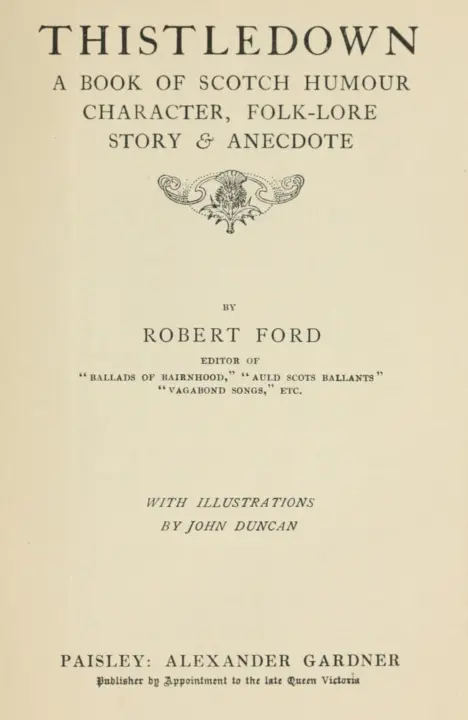
"Thistledown: A Book of Scotch Humour, Character, Folk-lore, Story & Anecdote" by Robert Ford is a collection of humorous essays and anecdotes reflecting Scottish culture and character, likely written in the late 19th century. The work delves into various aspects of Scottish life, capturing the quirks and nuances of the Scottish tongue, and showcasing the unique blend of pathos and humor inherent to the people. Through a wide range of stories, it aims to provide not just laughter but also insight into the heart of Scottish identity. The opening of the book establishes the significance of the Scottish language, asserting that its richness and expressiveness are vital to understanding Scotland’s history and culture. Ford argues against the idea that the language is fading from the upper echelons of society, emphasizing that humor is ingrained in the Scottish character, appearing in the most unexpected places and situations. He introduces anecdotes that illustrate the intricacies of dialects across Scotland, highlighting both the charm and the humor found in its everyday use. As he lays the groundwork for the themes of the book, Ford positions Scotch humour not just as a source of entertainment but as a reflection of the nation’s spirit and resilience.
Introduction adapted from the source catalogue; source summaries may be automatically generated.
Free to read · English · 111,279 words · No account needed
MAKE TIME FOR A GOOD BOOK
On by default. Untick to stop anonymous reading totals. Each page counts after 10 seconds in view. How this works.
Anonymous counting is on unless you have switched it off.
“And Major Bowle, that worthy sowl,
Was brought down to the ground, man;
His horse being shot, it was his lot,
For to get many a wound, man;
Lieutenant Smith, of Irish birth,
Frae whom he called for aid, man,
Being full of dread, lap owre his head,
And wadna be gainsaid, man.
“He made sic haste, sae spurred his beast,
’Twas little there he saw, man;
To Berwick rade, and safely said,
The Scots were rebels a’, man;
But let that end—for weel ’tis kenn’d
His use and wont to lee, man,
The league is nought, he never fought
When he had room to flee, man.”
Immediately on the satire and its source of emanation being communicated to the heroic (?) Lieutenant Smith, he despatched a junior officer to Skirving, with a challenge to the poet to meet him in single combat.
The bard’s reply was of a piece with his attack—“Gang back,” said he, “and tell Lieutenant Smith that I hae nae leisure to come to Haddington; but tell him to come here, and I’ll tak’ a look o’ him, and if I think I’m fit to fecht, I’ll fecht him; and if no, I’ll do as he did—I’ll rin awa’.”
Hard and stinging things have been uttered against poets, but the hardest and sharpest have been those hurled by one poet against another. As instance, the “Flyting” of Dunbar and Kennedy, the less remote encounter between Tennyson and Bulwer Lytton in the pages of Punch, and the more recent scalping scuffle which took place between Buchanan, Swinburne, and Rossetti. The wit of the poet is indispensable for affording the proper point to the sting of humorous satire. Here is a good example:—A few years ago the late William C. Cameron, of Glasgow, a shoemaker to trade, and author of a meritorious volume of verses, entitled Light, Shade, and Toil, contributed a little poem to the columns of the Weekly Herald, each succeeding stanza of which opened somewhat ostentatiously with the request—“Write me my epitaph!” one entire verse being:—
“Write me my epitaph! short let it be, Say that here, ’neath the sod, lies one of the free, One who has wrote and sung the lays of the poor, One who has loved more than gold, field, wood, and moor.”
Responsive to the poet’s request a local bard wrote, and the Herald of the following week contained “His Epitaph,” in these words:—
“Toil over, Light snuffed out, himself a Shade, For evermore removed from pitiless chaff, Hic jacet!—A judicious reader made (Excuse his tears) this touching epitaph.”
Your reading position is saved on this browser. Take it to another device with a library code. Reading pages adapt to text, rather than matching a printed edition.
BEHIND THE BOOK
This eBook is for the use of anyone anywhere in the United States and most other parts of the world at no cost and with almost no restrictions whatsoever. You may copy it, give it away or re-use it under the terms of the Project Gutenberg License included with this eBook or online at www.gutenberg.org. If you are not located in the United States, you will have to check the laws of the country where you are located before using this eBook. Read the source licence.
The original source file, including credits and licence, is retained by this library. Request an original-format copy at no charge. Please include the book title and Project Gutenberg identifier #67576.
KEEP YOUR CURIOSITY GOING
David Patterson (Spirit) Hatch

David Patterson (Spirit) Hatch

David Patterson (Spirit) Hatch

Ralph Waldo Emerson

Maurice Baring

Oscar Wilde & James McNeill Whistler