
Last letters from the living dead man
David Patterson (Spirit) Hatch
THE CLASSIC COLLECTION · 1921
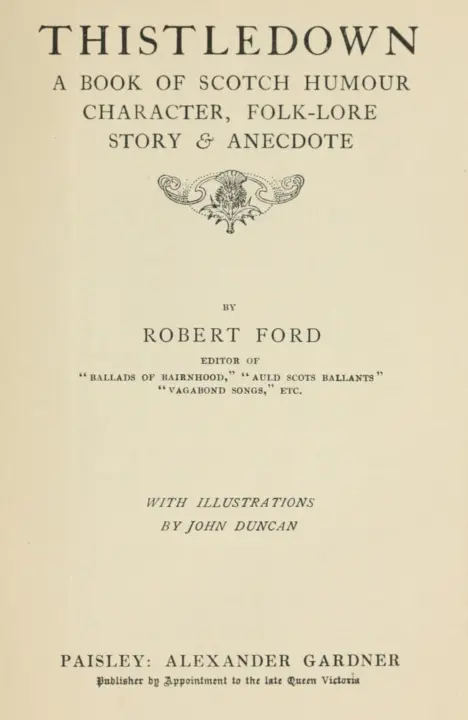
"Thistledown: A Book of Scotch Humour, Character, Folk-lore, Story & Anecdote" by Robert Ford is a collection of humorous essays and anecdotes reflecting Scottish culture and character, likely written in the late 19th century. The work delves into various aspects of Scottish life, capturing the quirks and nuances of the Scottish tongue, and showcasing the unique blend of pathos and humor inherent to the people. Through a wide range of stories, it aims to provide not just laughter but also insight into the heart of Scottish identity. The opening of the book establishes the significance of the Scottish language, asserting that its richness and expressiveness are vital to understanding Scotland’s history and culture. Ford argues against the idea that the language is fading from the upper echelons of society, emphasizing that humor is ingrained in the Scottish character, appearing in the most unexpected places and situations. He introduces anecdotes that illustrate the intricacies of dialects across Scotland, highlighting both the charm and the humor found in its everyday use. As he lays the groundwork for the themes of the book, Ford positions Scotch humour not just as a source of entertainment but as a reflection of the nation’s spirit and resilience.
Introduction adapted from the source catalogue; source summaries may be automatically generated.
Free to read · English · 111,279 words · No account needed
MAKE TIME FOR A GOOD BOOK
On by default. Untick to stop anonymous reading totals. Each page counts after 10 seconds in view. How this works.
Anonymous counting is on unless you have switched it off.
“But did you’ll opserve,” says Donald, “if it was ta Gaelic that was spoket in ta Garden of Eden, maybe they’ll say ta Teevil was a Hielandman, and she wouldn’t like that to pe at all, whatever!”
I have said that the Highlander is proud of his name and clan, and there are stories that reveal to what extent.
“Did you’ll know what day this is, Donald?” inquired one Celt of another, on the morning of a certain national occasion which will come out in the sequel.
“Hooch, ay,” replied Donald; “it’s just ta day after ta morn, Dugald.”
“Yes, Donald, to be shurely,” replied his friend. “But did you’ll forgot this was ta day ta Queen’s dochter was to be married to ta Tuke o’ Argyll’s son—ta Marquis o’ Lorne?”
“Ay, ay, did you’ll told me that? Well, well, it’s the prood, prood mans ta Queen will be this day.”
On the occasion aforesaid there was, of course, great national rejoicing, and the town of Inverness was, like every other municipality, illuminated at night.
“Dear me, Donald,” exclaimed one local shopkeeper to another, as he issued from his own door, “did you ever behold the likes of that? There’s five-fourths of the whole town under luminations this nicht!”
“Toots, man, Angus, I’ll thought that you know better than spoke like that,” replied his neighbour. “A fourth is a quarter, and five quarters would be more than the whole.”
“Och, Donald Fraser, my lad,” retorted Angus, “I’ve seen too many snowy days not to know what I’ll say. I’ve got cloths in my own shop six-quarters, and that is more—there, now, with your ignorance.”
The following is an amusing instance of the tenacity with which the Highlanders hold to the honours and antiquity of their kindred. A dispute arose between a Campbell and a M’Lean upon the never-ending subject. The M’Lean would not allow that the Campbells had any right to rank with his clan in the matter of antiquity, who, he insisted, were in existence as a clan from the beginning of the world. Campbell had a little more Biblical lore than his antagonist, and asked him if the Clan M’Lean was before the Flood.
“Flood! what flood?” demanded the M’Lean.
“The Flood that you know drowned all the world but Noah and his family, and his flocks and herds,” said Campbell.
“Pooh! you and your flood too,” said the M’Lean. “My clan was before ta
Flood.”
“I have not read in my Bible,” said Campbell, “of the name of M’Lean going into Noah’s Ark.”
Your reading position is saved on this browser. Take it to another device with a library code. Reading pages adapt to text, rather than matching a printed edition.
BEHIND THE BOOK
This eBook is for the use of anyone anywhere in the United States and most other parts of the world at no cost and with almost no restrictions whatsoever. You may copy it, give it away or re-use it under the terms of the Project Gutenberg License included with this eBook or online at www.gutenberg.org. If you are not located in the United States, you will have to check the laws of the country where you are located before using this eBook. Read the source licence.
The original source file, including credits and licence, is retained by this library. Request an original-format copy at no charge. Please include the book title and Project Gutenberg identifier #67576.
KEEP YOUR CURIOSITY GOING
David Patterson (Spirit) Hatch

David Patterson (Spirit) Hatch

David Patterson (Spirit) Hatch

Ralph Waldo Emerson

Maurice Baring

Oscar Wilde & James McNeill Whistler