
Last letters from the living dead man
David Patterson (Spirit) Hatch
THE CLASSIC COLLECTION · 1921
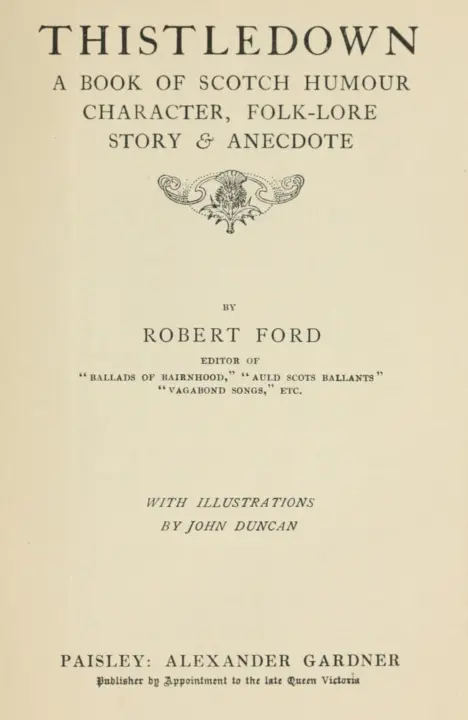
"Thistledown: A Book of Scotch Humour, Character, Folk-lore, Story & Anecdote" by Robert Ford is a collection of humorous essays and anecdotes reflecting Scottish culture and character, likely written in the late 19th century. The work delves into various aspects of Scottish life, capturing the quirks and nuances of the Scottish tongue, and showcasing the unique blend of pathos and humor inherent to the people. Through a wide range of stories, it aims to provide not just laughter but also insight into the heart of Scottish identity. The opening of the book establishes the significance of the Scottish language, asserting that its richness and expressiveness are vital to understanding Scotland’s history and culture. Ford argues against the idea that the language is fading from the upper echelons of society, emphasizing that humor is ingrained in the Scottish character, appearing in the most unexpected places and situations. He introduces anecdotes that illustrate the intricacies of dialects across Scotland, highlighting both the charm and the humor found in its everyday use. As he lays the groundwork for the themes of the book, Ford positions Scotch humour not just as a source of entertainment but as a reflection of the nation’s spirit and resilience.
Introduction adapted from the source catalogue; source summaries may be automatically generated.
Free to read · English · 111,279 words · No account needed
MAKE TIME FOR A GOOD BOOK
On by default. Untick to stop anonymous reading totals. Each page counts after 10 seconds in view. How this works.
Anonymous counting is on unless you have switched it off.
“Gracious Providence! Bless all ta Macdonalds, and ta Macdonalds’ children, tere sons’ sons and tere daughters’ daughters, for a thoosand years langsyne. Be gracious to send us mountains of snuff and tobacco, and send us oceans of whisky—ta very finest of whisky! Oh, yes! And send us hills of potatoes, and breads and cheeses as big as all ta Howe of Strathmore. And, moreover, likewise, send us floods of water, tat tere may pe grass for plenty to man and beast, and some to spare to ta poor of ta parish. Send us guns and pistols as more as ta sea and ta sand-shore; and swords, too, likewise, to kill all ta Grants and ta Macphersons for evermore. Bless ta wee stirk, and mak’ him a big coo pefore Martinmas. Bless ta wee soo, too, and mak’ him a big boar likewise. Oh, yes! Put the strength of Samson into Donald’s arms, and send us parley, kail, and corn prodigious. Bless all ta pairns—Duncan and Rory and Flora, and you, Donald, and you, Lauchie, and you, Peter; and glorious, yours for evermore.”
I do not ask any one to swallow the above, minus the proverbial “grain of salt.” I like to take it that way myself. And yet there are well-authenticated instances and occasions revealing deliverances quite as ludicrous and absurd. Witness the following fragment of a pulpit homily which appears in Hugh Boyd’s admittedly veracious Reminiscences of Fifty Years, and which the recorder appears to have heard himself, or received on highly credible authority:—
“Ah, my friends,” exclaimed the preacher, “what causes have we for gratitude! Oh, yes! for the deepest gratitude! Look at the place of our habitation. How grateful should we be that we do not leeve in the far North, Oh, no! amid the frost and the snaw, and the cauld and the weet, Oh, no! where there’s a lang day the a’e half o’ the year, Oh, yes! and a lang nicht the tither, Oh, yes! That we do not depend upon the aurawry boreawlis, Oh, no! That we do not gang shivering aboot in skins, Oh, no! snookin’ amang the snaw like mowdiewarts, Oh, no, no! And how grateful should we be that we do not leeve in the for Sooth, beneath the equawter, and the sun aye burnin’, burnin’. Where the sky’s het, Ah, yes! and the earth’s het, and the water’s het, and ye’re burnt black as a smiddy, Ah, yes! Where there’s teegurs, Oh, yes! And lions, Oh, yes! And crocodiles, Oh, yes! And fearsome beasts growlin’ and girnin’ at ye amang the woods. Where the very air is a fever, like the burnin’ breath o’ a fiery drawgon; that we do not leeve in these places—Oh, no, no, no, no! But that we leeve in this blessit island of ours, call’t Great Britain, Oh, yes, yes! and in that part of it named Scotland, that looks up at Ben Nevis—Oh, yes, yes, yes! Where’s neither frost, nor cauld, nor wund, nor weet, nor hail, nor rain, nor teegurs, nor lions, nor burnin’ suns, nor hurricanes, nor——”
Your reading position is saved on this browser. Take it to another device with a library code. Reading pages adapt to text, rather than matching a printed edition.
BEHIND THE BOOK
This eBook is for the use of anyone anywhere in the United States and most other parts of the world at no cost and with almost no restrictions whatsoever. You may copy it, give it away or re-use it under the terms of the Project Gutenberg License included with this eBook or online at www.gutenberg.org. If you are not located in the United States, you will have to check the laws of the country where you are located before using this eBook. Read the source licence.
The original source file, including credits and licence, is retained by this library. Request an original-format copy at no charge. Please include the book title and Project Gutenberg identifier #67576.
KEEP YOUR CURIOSITY GOING
David Patterson (Spirit) Hatch

David Patterson (Spirit) Hatch

David Patterson (Spirit) Hatch

Ralph Waldo Emerson

Maurice Baring

Oscar Wilde & James McNeill Whistler