
Last letters from the living dead man
David Patterson (Spirit) Hatch
THE CLASSIC COLLECTION · 1921
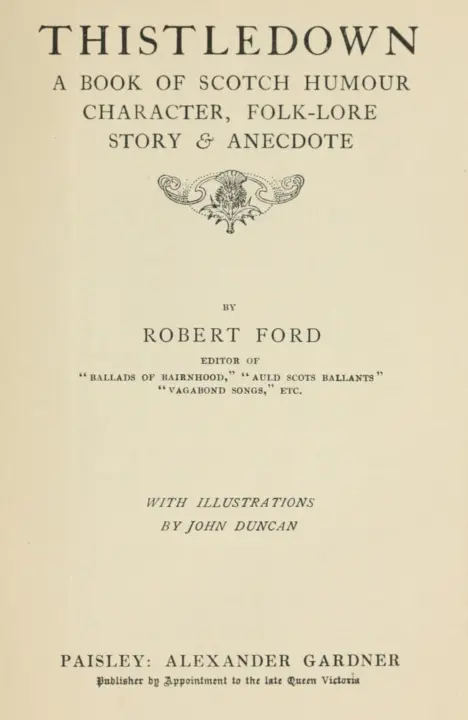
"Thistledown: A Book of Scotch Humour, Character, Folk-lore, Story & Anecdote" by Robert Ford is a collection of humorous essays and anecdotes reflecting Scottish culture and character, likely written in the late 19th century. The work delves into various aspects of Scottish life, capturing the quirks and nuances of the Scottish tongue, and showcasing the unique blend of pathos and humor inherent to the people. Through a wide range of stories, it aims to provide not just laughter but also insight into the heart of Scottish identity. The opening of the book establishes the significance of the Scottish language, asserting that its richness and expressiveness are vital to understanding Scotland’s history and culture. Ford argues against the idea that the language is fading from the upper echelons of society, emphasizing that humor is ingrained in the Scottish character, appearing in the most unexpected places and situations. He introduces anecdotes that illustrate the intricacies of dialects across Scotland, highlighting both the charm and the humor found in its everyday use. As he lays the groundwork for the themes of the book, Ford positions Scotch humour not just as a source of entertainment but as a reflection of the nation’s spirit and resilience.
Introduction adapted from the source catalogue; source summaries may be automatically generated.
Free to read · English · 111,279 words · No account needed
MAKE TIME FOR A GOOD BOOK
On by default. Untick to stop anonymous reading totals. Each page counts after 10 seconds in view. How this works.
Anonymous counting is on unless you have switched it off.
Reaper (in amazement)—“I really don’t know what you are saying, sir.”
Farmer (in equal astonishment)—“Gude—save—us—do ye no understand gude plain English? Are—yer—aits—muckle—bookit?”
He might as well have asked the road to Stronachlacher, Auchtermuchty, Ecclefechan, or Ponfeigh. The reaper decamped to her nearest companion declaring him a madman; while the farmer shouted in great wrath, “They are naething else than a set o’ ignorant pock-puddin’s.”
“My girl,” enquired a Cockney tourist of a Scotch lassie whom he met tripping lightly barefoot, “is it the custom for girls to go barefooted in these parts?”
“Pairtly they do,” she replied, “and pairtly they mind their ain
business.”
The dour, plodding, persevering nature of the Scot, by virtue of which he has often prevailed over his less crafty English brother, is well exemplified in the following little narrative, which humorously describes the opening of a large mercantile business between the West of Scotland and the English capital:—
A West country Scot, who had engaged in the manufacture of a certain description of goods, then recently introduced into that part of the country, found it necessary, or conjectured it might be profitable, to establish a permanent connection with some respectable house in London. With this design he packed up a quantity of goods, equipped himself for the journey, and departed. Upon his arrival he made diligent enquiry as to those who were likely to prove his best customers, and accordingly proceeded to call upon one of the most opulent drapers, with whom he resolved to establish a regular correspondence. When Saunders entered the shop in question he found it crowded with customers, and the salesmen all bustling about making sales, and displaying their wares to prospective purchasers. Saunders waited what he considered a reasonable time, then in a lull of the business, laid down his pack, his bonnet, and staff, upon the counter, and enquired for “the head o’ the hoose.”
One of the clerks asked him what he wanted.
“I’m wantin’ to see gin he wants ocht in my line,” was the answer.
“No!” shouted the foreman.
“Will ye no tak’ a look o’ the gudes, sir?” inquired Saunders.
“No, not at all; I have not time. Take them away.”
“Ye’ll maybe find them worth your while; and I dootna but ye’ll buy,” said Saunders, as he coolly proceeded to untie his pack.
“Go away, go away!” was reiterated half a dozen times with great impatience, but the persevering Scotsman still persisted.
“Get along, you old Scotch fool,” cried the foreman, completely out of temper, as he pushed the already exposed contents of the pack off the counter. “Get along!”
Your reading position is saved on this browser. Take it to another device with a library code. Reading pages adapt to text, rather than matching a printed edition.
BEHIND THE BOOK
This eBook is for the use of anyone anywhere in the United States and most other parts of the world at no cost and with almost no restrictions whatsoever. You may copy it, give it away or re-use it under the terms of the Project Gutenberg License included with this eBook or online at www.gutenberg.org. If you are not located in the United States, you will have to check the laws of the country where you are located before using this eBook. Read the source licence.
The original source file, including credits and licence, is retained by this library. Request an original-format copy at no charge. Please include the book title and Project Gutenberg identifier #67576.
KEEP YOUR CURIOSITY GOING
David Patterson (Spirit) Hatch

David Patterson (Spirit) Hatch

David Patterson (Spirit) Hatch

Ralph Waldo Emerson

Maurice Baring

Oscar Wilde & James McNeill Whistler