
Last letters from the living dead man
David Patterson (Spirit) Hatch
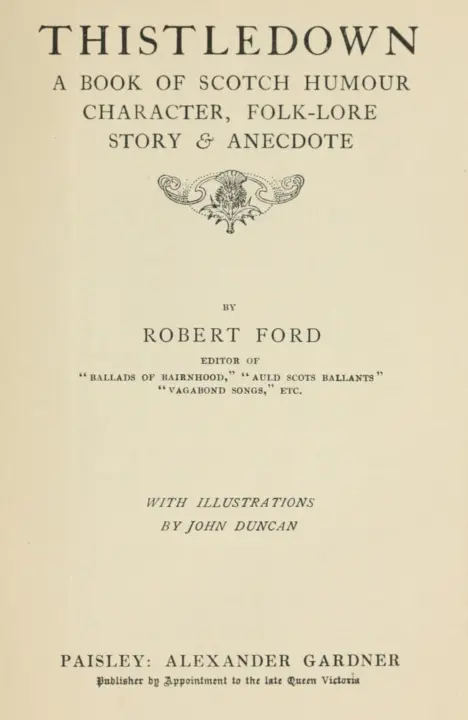
THE CLASSIC COLLECTION · 1921
"Thistledown: A Book of Scotch Humour, Character, Folk-lore, Story & Anecdote" by Robert Ford is a collection of humorous essays and anecdotes reflecting Scottish culture and character, likely written in the late 19th century. The work delves into various aspects of Scottish life, capturing the quirks and nuances of the Scottish tongue, and showcasing the unique blend of pathos and humor inherent to the people. Through a wide range of stories, it aims to provide not just laughter but also insight into the heart of Scottish identity. The opening of the book establishes the significance of the Scottish language, asserting that its richness and expressiveness are vital to understanding Scotland’s history and culture. Ford argues against the idea that the language is fading from the upper echelons of society, emphasizing that humor is ingrained in the Scottish character, appearing in the most unexpected places and situations. He introduces anecdotes that illustrate the intricacies of dialects across Scotland, highlighting both the charm and the humor found in its everyday use. As he lays the groundwork for the themes of the book, Ford positions Scotch humour not just as a source of entertainment but as a reflection of the nation’s spirit and resilience.
Introduction adapted from the source catalogue; source summaries may be automatically generated.
Free to read · English · 111,279 words · No account needed
MAKE TIME FOR A GOOD BOOK
On by default. Untick to stop anonymous reading totals. Each page counts after 10 seconds in view. How this works.
Anonymous counting is on unless you have switched it off.
By these illustrations I have endeavoured to shew forth, to all whom it may concern, the verbal beauty, the graphic force, and the powers for the expression of pathos and humour there is in the vernacular speech of Scotland. Like our national emblem—the thistle—it is, of course, nothing in the mouth of an ass. But well spoken, it is charming alike to the ear and the intellect; and, for the reasons already urged in this paper, is worthy of more general esteem and more general cultivation than the current generation of Scotch folk seem disposed to award it. Lord Cockburn pronounced it “the sweetest and most expressive of living languages;” and no unprejudiced reader of his Memorials will dispute the value of his opinion on the subject. He wrote excellent Doric himself, and made it the vehicle of his conversation in his family, and casually throughout the day, as long as he lived. Ho! for more such good old Scottish gentlemen! Ho! for another Jean, Duchess of Gordon, to teach our Scottish gentry how to speak naturally! That we had more men in our midst, with equal influence and education, and charged with the fine spirit of patriotism which animates Scotland’s ain “grand auld man”—Professor Blackie! It has been the fashion for English journalists with pretensions to wit, to animadvert by pen and pencil on what they regard as the idiosyncracies of Scottish speech and behaviour. Punch is a frequent offender in this way. I say offender advisedly, for no Punch artist, so far as I have seen—and I have scanned that journal from the first number to the last—ever drew a Scotsman in “his manner as he lived.” The originals of the pictures may have appeared in London Christmas pantomimes, but certainly nowhere else. Then the language which in their guileless innocence they expect will pass muster as Scotch, is a hash-up alike revolting to the ears of gods and men. We don’t expect very much from some folks, but surely even a London journalist should know that a Scotsman does not say “mon” when he means to say “man.” Charles Macklin put it that way, and the London journalist apparently can never get beyond Macklin. Don’t go to London for your Scotch, my reader! Listen to it as it may still be spoken at your granny’s ingleside. Familiarise yourself with it as it is to be found in its full vigour and purity in the Waverley Novels; in Burns’s Poems and Songs; in the “Noctes Ambrosianæ” of Professor Wilson; in Galt’s Tales; in the writings of the Ettrick Shepherd; in the stories of George MacDonald, J. M. Barrie, and S. R. Crockett; in the pages of “Mansie Wauch,” “Tammas Bodkin,” and “Johnny Gibb.” Don’t learn English less; but again, I say, read, write, and speak Scotch more frequently. And, when doing so, remember you are not indulging in a mere vulgar corruption of good English, comparable with the barbarous dialects of Yorkshire and Devon, but in a true and distinct, a powerful and beautiful language of your own, “differing not merely from modern English in pronunciation, but in the possession of many beautiful words, which have ceased to be English, and in the use of inflexions unknown to literary and spoken English since the days of Piers Ploughman and Chaucer.” “The Scotch,” as the late Lord Jeffrey said, “is not to be considered as a provincial dialect—the vehicle only of rustic vulgarity and rude local humour. It is the language of a whole country, long an independent kingdom, and still separate in laws, character, and manners. It is by no means peculiar to the vulgar, but is the common speech of the whole nation in early life, and with many of its most exalted and accomplished individuals throughout their whole existence; and though it be true that, in later times, it has been in some measure laid aside by the more ambitious and aspiring of the present generation, it is still recollected even by them as the familiar language of their childhood, and of those who were the earliest objects of their love and veneration. It is connected in their imagination not only with that olden time which is uniformly conceived as more pure, lofty, and simple than the present, but also with all the soft and bright colours of remembered childhood and domestic affection. All its phrases conjure up images of school-day innocence and sports, and friendships which have no pattern in succeeding years.”
Your reading position is saved on this browser. Take it to another device with a library code. Reading pages adapt to text, rather than matching a printed edition.
BEHIND THE BOOK
This eBook is for the use of anyone anywhere in the United States and most other parts of the world at no cost and with almost no restrictions whatsoever. You may copy it, give it away or re-use it under the terms of the Project Gutenberg License included with this eBook or online at www.gutenberg.org. If you are not located in the United States, you will have to check the laws of the country where you are located before using this eBook. Read the source licence.
The original source file, including credits and licence, is retained by this library. Request an original-format copy at no charge. Please include the book title and Project Gutenberg identifier #67576.
KEEP YOUR CURIOSITY GOING
David Patterson (Spirit) Hatch

David Patterson (Spirit) Hatch

David Patterson (Spirit) Hatch

Ralph Waldo Emerson

Maurice Baring

Oscar Wilde & James McNeill Whistler