
Last letters from the living dead man
David Patterson (Spirit) Hatch
THE CLASSIC COLLECTION · 1921
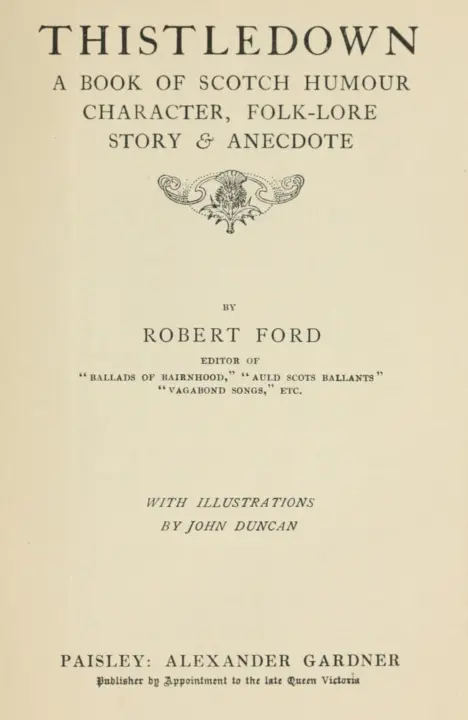
"Thistledown: A Book of Scotch Humour, Character, Folk-lore, Story & Anecdote" by Robert Ford is a collection of humorous essays and anecdotes reflecting Scottish culture and character, likely written in the late 19th century. The work delves into various aspects of Scottish life, capturing the quirks and nuances of the Scottish tongue, and showcasing the unique blend of pathos and humor inherent to the people. Through a wide range of stories, it aims to provide not just laughter but also insight into the heart of Scottish identity. The opening of the book establishes the significance of the Scottish language, asserting that its richness and expressiveness are vital to understanding Scotland’s history and culture. Ford argues against the idea that the language is fading from the upper echelons of society, emphasizing that humor is ingrained in the Scottish character, appearing in the most unexpected places and situations. He introduces anecdotes that illustrate the intricacies of dialects across Scotland, highlighting both the charm and the humor found in its everyday use. As he lays the groundwork for the themes of the book, Ford positions Scotch humour not just as a source of entertainment but as a reflection of the nation’s spirit and resilience.
Introduction adapted from the source catalogue; source summaries may be automatically generated.
Free to read · English · 111,279 words · No account needed
MAKE TIME FOR A GOOD BOOK
On by default. Untick to stop anonymous reading totals. Each page counts after 10 seconds in view. How this works.
Anonymous counting is on unless you have switched it off.
“Tam Skelpit on through mud and mire,
Despising wind and rain and fire.”
Then the family name of the householder immortalised in the “Cottar’s Saturday night,” according to this Cockney edition, was not Burns, as is popularly believed in Scotland, but Hafflins. The revelation appears in these lines:—
“The wily mother sees the conscious flame Sparkle in Jenny’s e’e and flush her cheek, Wi’ heart-struck anxious care inquires his name; While Jenny Hafflins is afraid to speak; Weel pleased the mother hears it’s nae wild, worthless rake.”
Tam Skelpit and Jenny Hafflins! My conscience! What next? Well, a cursory glance finds such improved readings as these (I will italicise the improvements):—
“The heapit happier’s ebbing still.”
“I held awe to Annie.”
“They reeled, they set, they crossed, they cleckit.”
“And well tak’ a cup o’ kindness yet.”
“Or wake the bosom-smelting throe.”
And there are many other blunders quite as ludicrous. Experience is a severe school, and when the Scotch becomes the universal tongue John Bull will perceive this; but perhaps not before.
A very humorous instance of the almost incomprehensibility of things Scotch by the English mind occurred during one of the earlier visits of the Royal Family to Balmoral. The late Prince Consort, dressed in a simple manner, was crossing one of the Scottish lochs in a steamer, and was curious to note everything relating to the management of the vessel, and, among other things, the cooking. Approaching the galley, where a brawny Scot was attending to the culinary matters, he was attracted by the savoury odours of a dish of hotch-potch which Sandy was preparing.
“What is that?” asked the Prince, who was not known to the cook.
“Hotch-potch, sir,” was the reply.
“How is it made?” was the next question.
“Weel, there’s mutton intill’t, and neeps intill’t, and carrots intill’t,
and——”
“Yes, yes,” said the Prince, “but what is intill’t?”
“Weel, there’s mutton intill’t, and neeps intill’t, and——”
“Yes, I see; but what is intill’t?”
The man looked at him, and, seeing that the Prince was serious he replied—
“There’s mutton intill’t, and neeps intill’t, and——”
“Yes, certainly, I know,” still argued the Prince; “but what is intill’t—intill’t?”
“Gudesake, man,” yelled the Scotsman, brandishing his big ladle, “am I no thrang tellin’ ye what’s intill’t? There’s mutton intill’t, and——”
Here the interview was brought to a close by one of the Prince’s suite, who fortunately was passing, explaining to His Royal Highness that “intill’t” simply meant “into it,” and nothing more!
Your reading position is saved on this browser. Take it to another device with a library code. Reading pages adapt to text, rather than matching a printed edition.
BEHIND THE BOOK
This eBook is for the use of anyone anywhere in the United States and most other parts of the world at no cost and with almost no restrictions whatsoever. You may copy it, give it away or re-use it under the terms of the Project Gutenberg License included with this eBook or online at www.gutenberg.org. If you are not located in the United States, you will have to check the laws of the country where you are located before using this eBook. Read the source licence.
The original source file, including credits and licence, is retained by this library. Request an original-format copy at no charge. Please include the book title and Project Gutenberg identifier #67576.
KEEP YOUR CURIOSITY GOING
David Patterson (Spirit) Hatch

David Patterson (Spirit) Hatch

David Patterson (Spirit) Hatch

Ralph Waldo Emerson

Maurice Baring

Oscar Wilde & James McNeill Whistler