
Last letters from the living dead man
David Patterson (Spirit) Hatch
THE CLASSIC COLLECTION · 1921
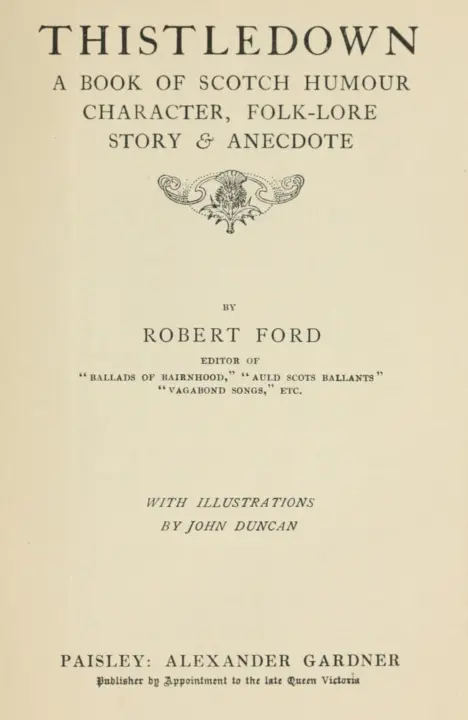
"Thistledown: A Book of Scotch Humour, Character, Folk-lore, Story & Anecdote" by Robert Ford is a collection of humorous essays and anecdotes reflecting Scottish culture and character, likely written in the late 19th century. The work delves into various aspects of Scottish life, capturing the quirks and nuances of the Scottish tongue, and showcasing the unique blend of pathos and humor inherent to the people. Through a wide range of stories, it aims to provide not just laughter but also insight into the heart of Scottish identity. The opening of the book establishes the significance of the Scottish language, asserting that its richness and expressiveness are vital to understanding Scotland’s history and culture. Ford argues against the idea that the language is fading from the upper echelons of society, emphasizing that humor is ingrained in the Scottish character, appearing in the most unexpected places and situations. He introduces anecdotes that illustrate the intricacies of dialects across Scotland, highlighting both the charm and the humor found in its everyday use. As he lays the groundwork for the themes of the book, Ford positions Scotch humour not just as a source of entertainment but as a reflection of the nation’s spirit and resilience.
Introduction adapted from the source catalogue; source summaries may be automatically generated.
Free to read · English · 111,279 words · No account needed
MAKE TIME FOR A GOOD BOOK
On by default. Untick to stop anonymous reading totals. Each page counts after 10 seconds in view. How this works.
Anonymous counting is on unless you have switched it off.
24. Then each man bade his neighbour farewell, embracing and vowing eternal friendship, and some were borne home by men in scanty raiment, and others in carriages which jingled as they went; and others drove their own chariots home, and saw many strange sights, for they found grass growing and ditches in the midst of the way where they had not perceived them before.
25. And it came to pass that in the morning many lamented, and took no breakfast that day; and the men in white raiment brought unto them many cunningly-devised drinks, yea, pick-me-ups, for their tongues clove unto the roofs of their mouths, and the spittle on their beard was like unto a small silver coin, even a sixpence.
26. But, when they thought on the previous day, they rejoiced again, for they said, Our brethren whom we have left will hear of it at the Feast of the New Year, and they will remember us and bless us, and our hearts and hands shall be strengthened for our labour here.
That is quite delicious! And now we will allow George Outram to close the chapter with his inimitable poem:—
He ance was holy
An’ melancholy,
Till he fand the folly
O’ singin’ psalms;
He’s now as red’s a rose,
An’ there’s pimples on his nose,
An’ in size it daily grows,
By drinkin’ drams.
He ance was weak,
An’ couldna eat a steak
Without gettin’ sick,
An’ takin’ qualms;
But now he can eat
O’ ony kind o’ meat,
For he’s got an appeteet,
By drinkin’ drams.
He ance was thin,
Wi’ a nose like a pen,
An’ hands like a hen,
An’ nae hams;
But now he’s roond an’ ticht,
An’ a deevil o’ a wicht,
For he’s got himsel’ put richt
By drinkin’ drams.
He ance was saft as dirt,
An’ as pale as ony shirt,
An’ as useless as a cart
Without the trams;
But now he’d face the deil,
Or swallow Jonah’s whale—
He’s as gleg’s a puddock’s tail,
Wi’ drinkin’ drams.
Oh! pale, pale was his hue,
An’ cauld, cauld was his broo,
An’ he grumbled like a ewe
’Mang libbit rams;
But now his broo is bricht,
An’ his een are orbs o’ licht,
An’ his nose is just a sicht,
Wi’ drinkin’ drams.
He studied mathematics,
Logic, ethics, hydrostatics,
Till he needed diuretics
To lowse his dams;
But now, without a lee,
He could mak’ anither sea,
For he’s left philosophy,
An’ ta’en to drams.
Your reading position is saved on this browser. Take it to another device with a library code. Reading pages adapt to text, rather than matching a printed edition.
BEHIND THE BOOK
This eBook is for the use of anyone anywhere in the United States and most other parts of the world at no cost and with almost no restrictions whatsoever. You may copy it, give it away or re-use it under the terms of the Project Gutenberg License included with this eBook or online at www.gutenberg.org. If you are not located in the United States, you will have to check the laws of the country where you are located before using this eBook. Read the source licence.
The original source file, including credits and licence, is retained by this library. Request an original-format copy at no charge. Please include the book title and Project Gutenberg identifier #67576.
KEEP YOUR CURIOSITY GOING
David Patterson (Spirit) Hatch

David Patterson (Spirit) Hatch

David Patterson (Spirit) Hatch

Ralph Waldo Emerson

Maurice Baring

Oscar Wilde & James McNeill Whistler