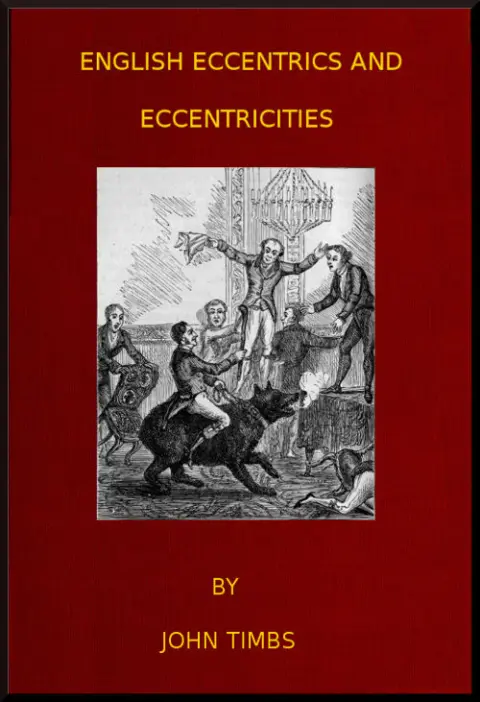
English Eccentrics and Eccentricities
John Timbs
THE CLASSIC COLLECTION · 1863
"Things to be Remembered in Daily Life" by John Timbs is a reflective guidebook written in the mid-19th century. This work examines timeless themes such as the concepts of time and human life, while providing personal experiences and historical anecdotes to illustrate practical lessons for everyday living. The aim is to distill important truths that one can apply to the complexities of daily existence. The opening of the book sets the stage by emphasizing the philosophical significance of time, likening it to a powerful force that shapes human experience and existence. Timbs introduces the personification of Time through various literary references, illustrating its relentless passage and impact on life. This section encourages readers to consider how they engage with time, urging a deeper reflection on its fleeting nature and the importance of making the most of each moment. Timbs' intention is to provide insights that resonate in the modern context while drawing from historical wisdom.
Introduction adapted from the source catalogue; source summaries may be automatically generated.
Free to read · English · 106,611 words · No account needed
MAKE TIME FOR A GOOD BOOK
On by default. Untick to stop anonymous reading totals. Each page counts after 10 seconds in view. How this works.
Anonymous counting is on unless you have switched it off.
The register of Middleton Tyas, adjoining, contains, in sixteen years, entries of 230 persons buried, of whom seventy-six had reached the age of 70 years or upwards. In 1813, of fifteen deceased, three were 90, 91, and 92; in 1815 a person died 97; and thirty-three of the number specified were 80 years old and upwards; and in the churchyard are buried two persons of 103 and 101 years. But within the last thirty-five years instances of longevity in this parish, once so common, form the exception.
Mr. Durrant Cooper, F.S.A., has communicated to Notes and Queries, No. 212, these interesting records from the burial register of Skelton-in-Cleveland, in the North Riding of Yorkshire:
Out of 799 persons buried between 1813 and 1852, no less than 263, or nearly one-third, attained the age of 70. Of these, two were respectively 101. Nineteen others were 90 years of age and upwards, viz. one 97, one 96, one 95, four 94, one 93, five 92, three 91, and three 90. Between the ages of 80 and 90 there died 109; and between 70 and 80 there died 133. In one page of the register, containing eight names, six were above 80, and in another five were above 70.
In the parish of Skelton there was then living a man named Moon, 104 years old, who was blind, but managed a small farm till nearly or quite 100; and a blacksmith, named Robinson Cook, aged 98, who worked at his trade until within six months of this age.
In the chapelry of Brotton, adjoining Skelton township, the longevity was even more remarkable. Out of 346 persons buried since the new register came into force in 1813, down to Oct. 1, 1853, more than one-third attained the age of 70. One Betty Thompson, who died in 1834, was 101; nineteen were more than 90, of whom one was 98, two 97, three 95, one 93, four 92, five 91, and three 90; forty-four died between 80 and 90 years old, and fifty-seven between 70 and 80, of whom thirty-one were 75 and upwards. That celibacy did not lessen the chance of life was proved by a bachelor named Simpson, who died at 82, and his maiden sister at 91.
Gilling, in Richmondshire, shows also a very great length of life, and in persons above 90 years of age a larger proportion even than in the Cleveland parishes. Between 1813 and 1853, of 701 persons buried, 207, or rather more than one-third, attained the age of 70 and upwards. Three were 100, or upwards; between 90 and 100, twenty-one; one 96, 95, and 94; two 92, six 91, and ten 90. Between 80 and 90 there died 87; between 70 and 80, ninety-six.
George Stephenson, a farm-labourer, of Runald-Kirk, near Barnard-Castle, Durham, who died 1812, aged 105, was a very early riser; he used to reprove (for lying a-bed) his daughter and her husband, both about 70 years of age, but who rose before six o’clock in the morning,—George saying, “if they would not work while they were young, what would they do when they became old?”
Your reading position is saved on this browser. Take it to another device with a library code. Reading pages adapt to text, rather than matching a printed edition.
John Timbs
John Timbs
John Timbs
John Timbs
BEHIND THE BOOK
This eBook is for the use of anyone anywhere in the United States and most other parts of the world at no cost and with almost no restrictions whatsoever. You may copy it, give it away or re-use it under the terms of the Project Gutenberg License included with this eBook or online at www.gutenberg.org. If you are not located in the United States, you will have to check the laws of the country where you are located before using this eBook. Read the source licence.
The original source file, including credits and licence, is retained by this library. Request an original-format copy at no charge. Please include the book title and Project Gutenberg identifier #54703.
KEEP YOUR CURIOSITY GOING

David Patterson (Spirit) Hatch

David Patterson (Spirit) Hatch

David Patterson (Spirit) Hatch
Coulson Kernahan

Ralph Waldo Emerson

Maurice Baring