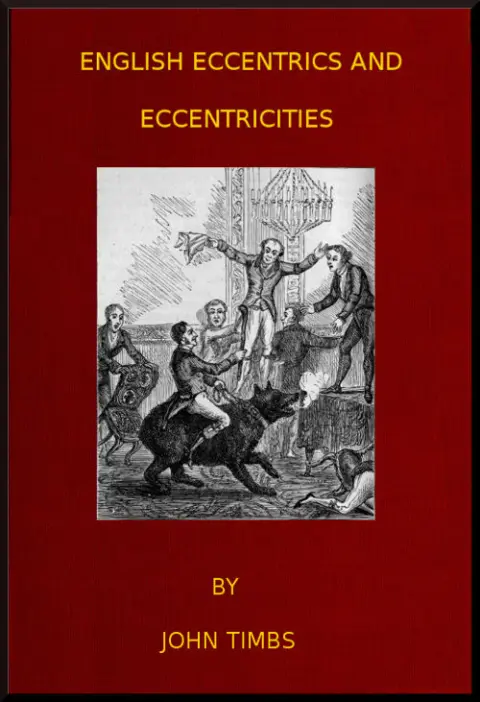
English Eccentrics and Eccentricities
John Timbs
THE CLASSIC COLLECTION · 1863
"Things to be Remembered in Daily Life" by John Timbs is a reflective guidebook written in the mid-19th century. This work examines timeless themes such as the concepts of time and human life, while providing personal experiences and historical anecdotes to illustrate practical lessons for everyday living. The aim is to distill important truths that one can apply to the complexities of daily existence. The opening of the book sets the stage by emphasizing the philosophical significance of time, likening it to a powerful force that shapes human experience and existence. Timbs introduces the personification of Time through various literary references, illustrating its relentless passage and impact on life. This section encourages readers to consider how they engage with time, urging a deeper reflection on its fleeting nature and the importance of making the most of each moment. Timbs' intention is to provide insights that resonate in the modern context while drawing from historical wisdom.
Introduction adapted from the source catalogue; source summaries may be automatically generated.
Free to read · English · 106,611 words · No account needed
MAKE TIME FOR A GOOD BOOK
On by default. Untick to stop anonymous reading totals. Each page counts after 10 seconds in view. How this works.
Anonymous counting is on unless you have switched it off.
Condensed from the Times journal.
The long life of different members of the same family is remarkable. In 1836, Mrs. H. P., residing near the Edgeware-road, attained her 103d year: she had three sisters,—one 107, another 105; and the other, who died about 1834, 100.
Mr. Bailey records the death of Widow Stephenson, of Wolverton, Durham, in 1816, aged 104: her mother lived to be 106, two sisters 106 and 107, and a brother 97; making an aggregate of 519 years as the age of these five relatives.
Edward Simon, 81 years a dock-labourer in Liverpool, died 1821, aged 101: his mother lived to 103; his father 101; and a brother 104.
Gilbert Wakefield states that his wife’s great-grandfather and great-grandmother’s matrimonial connexion lasted seventy-five years: they died nearly at the same time, she at the age of 98, he at the age of 108. He was out hunting a short time before his death. His portrait is in the hall of Mr. Legh, of Lyme.
Mary Tench, of Cromlin, Ireland, who died 1790, aged 100, was of aged parents; her father attained 104, and her mother 96; her uncle reached 110 and she left two sisters, whose aggregate ages made 170.
In the year 1811, within four miles of the house at Alderbury formerly occupied by Parr, there died, in the month of September, four persons, whose ages were 97, 80, 96, and 97. There were then living in the neighbourhood a man aged 100, and two others of 90.
The Costello family, county Kilkenny, lived to very great ages. On June 12, 1824, died Mary Costello, aged 102; her mother died at precisely the same age; her grandmother at 120; her great-grandmother exceeded 125: long before her death, she had to be rocked in a cradle, like an infant. Mary Costello’s brother lived beyond 100 years; and when 90, cut down half an acre of grass in a day.[43]
In Appleby churchyard is a tombstone in memory of three persons named Hall: the grandfather died in 1716, aged 109, and the father aged 86; and the son died in 1821, aged 106. “So that the father had seen a man (his father) who saw James I., and also a man (his son) who saw me, or might have done so.”[44]
The Countess of Mornington, who died in 1831, attained the age of 90: her eldest son, the Marquis Wellesley, ennobled for his administration in India, reached 82; his brother, Lord Maryborough, 83; Lady Maryborough, 91; and their brother, the Great Duke of Wellington, 83. We possess a small portrait of Lady Mary Irvine, aunt to Lady Maryborough, painted in her 82d year; the face is without a wrinkle, but of riant beauty.
The London bankers, Joseph and William Joseph Denison, exceeded 80; and the sister of the latter, Dowager Marchioness of Conyngham, 90.
Your reading position is saved on this browser. Take it to another device with a library code. Reading pages adapt to text, rather than matching a printed edition.
John Timbs
John Timbs
John Timbs
John Timbs
BEHIND THE BOOK
This eBook is for the use of anyone anywhere in the United States and most other parts of the world at no cost and with almost no restrictions whatsoever. You may copy it, give it away or re-use it under the terms of the Project Gutenberg License included with this eBook or online at www.gutenberg.org. If you are not located in the United States, you will have to check the laws of the country where you are located before using this eBook. Read the source licence.
The original source file, including credits and licence, is retained by this library. Request an original-format copy at no charge. Please include the book title and Project Gutenberg identifier #54703.
KEEP YOUR CURIOSITY GOING

David Patterson (Spirit) Hatch

David Patterson (Spirit) Hatch

David Patterson (Spirit) Hatch
Coulson Kernahan

Ralph Waldo Emerson

Maurice Baring