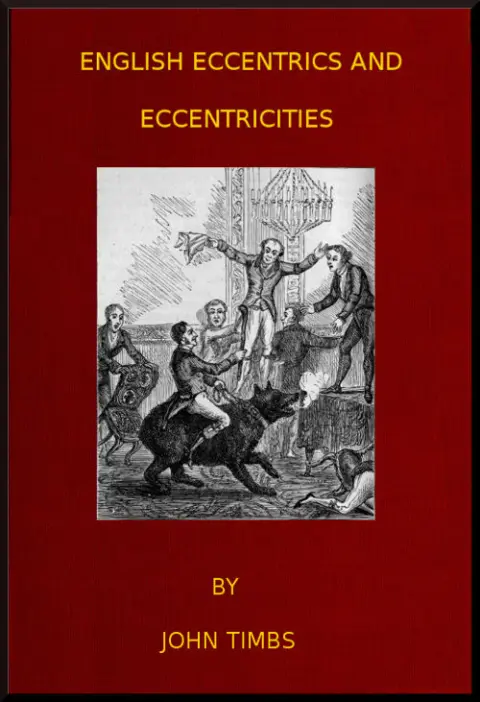
English Eccentrics and Eccentricities
John Timbs
THE CLASSIC COLLECTION · 1863
"Things to be Remembered in Daily Life" by John Timbs is a reflective guidebook written in the mid-19th century. This work examines timeless themes such as the concepts of time and human life, while providing personal experiences and historical anecdotes to illustrate practical lessons for everyday living. The aim is to distill important truths that one can apply to the complexities of daily existence. The opening of the book sets the stage by emphasizing the philosophical significance of time, likening it to a powerful force that shapes human experience and existence. Timbs introduces the personification of Time through various literary references, illustrating its relentless passage and impact on life. This section encourages readers to consider how they engage with time, urging a deeper reflection on its fleeting nature and the importance of making the most of each moment. Timbs' intention is to provide insights that resonate in the modern context while drawing from historical wisdom.
Introduction adapted from the source catalogue; source summaries may be automatically generated.
Free to read · English · 106,611 words · No account needed
MAKE TIME FOR A GOOD BOOK
On by default. Untick to stop anonymous reading totals. Each page counts after 10 seconds in view. How this works.
Anonymous counting is on unless you have switched it off.
In the obituary of the Times, February 20th, 1862, were recorded the deaths of persons who had attained the following ages: one of 103, one of 94, two of 90, one of 85, one of 84, one of 82, and eight of 70 years and upwards. And, on April 20th of the same year, were recorded the deaths of ten persons, whose united ages amount to 828 years, or an average of nearly 83. They comprise one of 100 and one of 99.
---------------------
Footnote 37:
See Burke’s Peerage and Baronetage, ed. 1848.
Of late years considerable interest has been added to the attraction of records of Longevity, by showing through how few individuals may be traced the evidence of far-distant events and incidents in our history.
Mr. Sidney Gibson, F.S.A., relates some curious instances of this class. A person living in 1847, then aged about 61, was frequently assured by his father that, in 1786, he repeatedly saw one Peter Garden, who died in that year at the age of 127 years; and who, when a boy, heard Henry Jenkins give evidence in a court of justice at York, to the effect that, when a boy, he was employed in carrying arrows up the hill before the battle of Flodden Field.
This battle was fought in 1513
Henry Jenkins died in 1670,
at the age of 169
Deduct for his age at the time of
the battle of Flodden Field 12
Peter Garden, the man who heard
Jenkins give his evidence, died at 127
Deduct for his age when he saw 11
Jenkins
The person whose father knew Peter
Garden was born shortly before
1786,
or seventy years since 70
So that a person living in 1786 conversed with a man that fought at
Flodden Field.
Mr. Gibson then passes on to some remarkable instances of longevity from the Scrope and Grosvenor Roll, the record of the celebrated cause in the reign of Richard II., when, among the noble and knightly deponents who gave evidence in the following year, 1386, were:
Sir John Sully, Knight of the Garter and a distinguished soldier of the cross, who had served for eighty years, was then, by his own account, 105 years of age, and who is supposed to have died in his 108th year.
But, more remarkable, John Thirlwall, an esquire of an ancient Northumbrian house, deposes to what he heard from his father, who died forty-four years before, at the age of 145.
Not far from Thirlwall Castle, at Irthington, Mr. B. Gibson has seen the register of the burial of Robert Bowman, one of the most remarkable of the long-lived yeomen of that parish, who died in the year 1823, at the age of 118.
Your reading position is saved on this browser. Take it to another device with a library code. Reading pages adapt to text, rather than matching a printed edition.
John Timbs
John Timbs
John Timbs
John Timbs
BEHIND THE BOOK
This eBook is for the use of anyone anywhere in the United States and most other parts of the world at no cost and with almost no restrictions whatsoever. You may copy it, give it away or re-use it under the terms of the Project Gutenberg License included with this eBook or online at www.gutenberg.org. If you are not located in the United States, you will have to check the laws of the country where you are located before using this eBook. Read the source licence.
The original source file, including credits and licence, is retained by this library. Request an original-format copy at no charge. Please include the book title and Project Gutenberg identifier #54703.
KEEP YOUR CURIOSITY GOING

David Patterson (Spirit) Hatch

David Patterson (Spirit) Hatch

David Patterson (Spirit) Hatch
Coulson Kernahan

Ralph Waldo Emerson

Maurice Baring