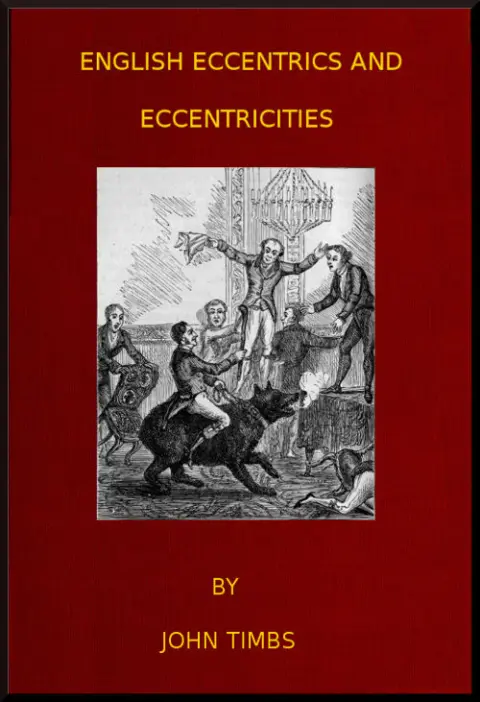
English Eccentrics and Eccentricities
John Timbs
THE CLASSIC COLLECTION · 1863
"Things to be Remembered in Daily Life" by John Timbs is a reflective guidebook written in the mid-19th century. This work examines timeless themes such as the concepts of time and human life, while providing personal experiences and historical anecdotes to illustrate practical lessons for everyday living. The aim is to distill important truths that one can apply to the complexities of daily existence. The opening of the book sets the stage by emphasizing the philosophical significance of time, likening it to a powerful force that shapes human experience and existence. Timbs introduces the personification of Time through various literary references, illustrating its relentless passage and impact on life. This section encourages readers to consider how they engage with time, urging a deeper reflection on its fleeting nature and the importance of making the most of each moment. Timbs' intention is to provide insights that resonate in the modern context while drawing from historical wisdom.
Introduction adapted from the source catalogue; source summaries may be automatically generated.
Free to read · English · 106,611 words · No account needed
MAKE TIME FOR A GOOD BOOK
On by default. Untick to stop anonymous reading totals. Each page counts after 10 seconds in view. How this works.
Anonymous counting is on unless you have switched it off.
1st generation 6 2d ” 18 3d ” 54 4th ” 162 5th ” 486 6th ” 1458 7th ” 4374 8th ” 13,122 9th ” 39,366 10th ” 118,098 11th ” 354,274 12th ” 1,062,812 13th ” 3,188,436 14th ” 9,565,308
That is to say, nine millions and a half of persons; or, as nearly as possible, the exact population might at this day be descended in a direct line from any individual buried in this or any other churchyard in the year 1395, who left six children, each of whose descendants have had on the average three children! And, by the same law, every individual who has six children may be the root of as many descendants within 420 years, provided they increase on the low average of only three in every branch. His descendants would represent an inverted triangle, of which he would constitute the lower angle.
“To place the same position in another point of view, I calculated also that every individual now living must have had for his ancestor every parent in Britain living in the year 1125, the age of Henry I., taking the population of that period at 8,000,000. Thus, as every individual must have had a father and mother, or two progenitors, each of whom had a father and mother, or four progenitors, each generation would double its progenitors every thirty years. Every person living may, therefore, be considered as the apex of a triangle, of which the base would represent the whole population of a remote age.
1815. Living individual 1 1785. His father and mother 2 1755. Their fathers and mothers 4 1725. ” ” 8 1695. ” ” 16 1665. ” ” 32 1635. ” ” 64 1605. ” ” 128 1575. ” ” 256 1545. ” ” 512 1515. ” ” 1,024 1485. ” ” 2,048 1455. ” ” 4,096 1425. ” ” 8,192 1395. ” ” 16,384 1365. ” ” 32,768 1335. ” ” 65,536 1305. ” ” 131,072 1275. ” ” 262,144 1245. ” ” 524,288 1215. ” ” 1,048,576 1185. ” ” 2,097,152 1155. ” ” 4,194,304 1125. ” ” 8,388,608
That is to say, if there have been a regular co-mixture of marriages, every individual of the living race must of necessity be descended from parents who lived in Britain in 1125. Some districts or clans may require a longer period for the co-mixture, and different circumstances may cut off some families, and expand others; but, in general, the lines of families would cross each other, and become interwoven, like the lines of lattice-work. A single intermixture, however remote, would unite all the subsequent branches in common ancestry, rendering the contemporaries of every nation members of one expanded family, after the lapse of an ascertainable number of generations.”[33]
---------------------
Footnote 31:
Dr. Johnson.
Footnote 32:
The Doctor.
Footnote 33:
Sir Richard Phillips’s Morning’s Walk from London to Kew.
Your reading position is saved on this browser. Take it to another device with a library code. Reading pages adapt to text, rather than matching a printed edition.
John Timbs
John Timbs
John Timbs
John Timbs
BEHIND THE BOOK
This eBook is for the use of anyone anywhere in the United States and most other parts of the world at no cost and with almost no restrictions whatsoever. You may copy it, give it away or re-use it under the terms of the Project Gutenberg License included with this eBook or online at www.gutenberg.org. If you are not located in the United States, you will have to check the laws of the country where you are located before using this eBook. Read the source licence.
The original source file, including credits and licence, is retained by this library. Request an original-format copy at no charge. Please include the book title and Project Gutenberg identifier #54703.
KEEP YOUR CURIOSITY GOING

David Patterson (Spirit) Hatch

David Patterson (Spirit) Hatch

David Patterson (Spirit) Hatch
Coulson Kernahan

Ralph Waldo Emerson

Maurice Baring