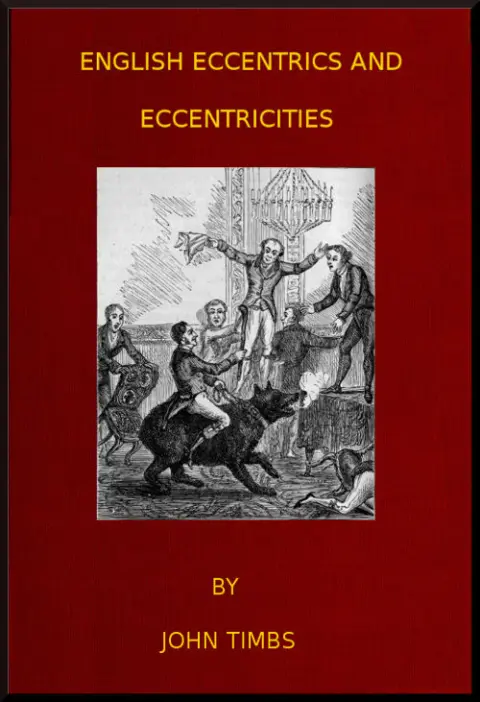
English Eccentrics and Eccentricities
John Timbs
THE CLASSIC COLLECTION · 1863
"Things to be Remembered in Daily Life" by John Timbs is a reflective guidebook written in the mid-19th century. This work examines timeless themes such as the concepts of time and human life, while providing personal experiences and historical anecdotes to illustrate practical lessons for everyday living. The aim is to distill important truths that one can apply to the complexities of daily existence. The opening of the book sets the stage by emphasizing the philosophical significance of time, likening it to a powerful force that shapes human experience and existence. Timbs introduces the personification of Time through various literary references, illustrating its relentless passage and impact on life. This section encourages readers to consider how they engage with time, urging a deeper reflection on its fleeting nature and the importance of making the most of each moment. Timbs' intention is to provide insights that resonate in the modern context while drawing from historical wisdom.
Introduction adapted from the source catalogue; source summaries may be automatically generated.
Free to read · English · 106,611 words · No account needed
MAKE TIME FOR A GOOD BOOK
On by default. Untick to stop anonymous reading totals. Each page counts after 10 seconds in view. How this works.
Anonymous counting is on unless you have switched it off.
Professor Faraday, at the close of a Lecture on Gas Glass-house Furnaces, delivered at the Royal Institution in 1862, alluded, in an affecting manner, to his increasing loss of memory. There was a time, he observed, when he inclined to think that Memory was a faculty of secondary order; but he now feels its great importance; and the deficiency of that power, he said, would prevent him from again bringing before them any thing that was new; for he was often unable to recollect even his own precious researches, and he could no longer trust himself to lecture without notes.
Great Ages (page 114).
An old woman who died in 1858 in St. Patrick-street, Dublin, at the age of 110 years, distinctly remembered and described the appearance of Dean Swift, and added, that he never went outside the Deanery-house that he was not attended through the streets by a vast crowd of washed and unwashed admirers.
Mrs. Keith, of Newnham, Gloucestershire, who died in 1772, aged 133, left three daughters, aged 111, 110, and 100.
In 1862, a lady residing at Cheltenham received a second donation of 5l. from her Majesty the Queen, for an old man of 107 years of age, named William Purser, a native of Redmarley, but living in Cheltenham.—Worcestershire Chronicle.
In 1862, a curious fact occurred at Downton, showing how few individuals are required to connect distant periods of history with the present time. A man was buried in this parish whose father was born in the reign of William III., and that father lived in three centuries, having been born in 1698 and died in 1801.—Salisbury Journal.
In 1853, the Irish newspapers announced the death of Mrs. Mary Power, aunt of the celebrated Mr. Shiel, at the Ursuline Convent, Cork, at the age of 116 years; but this statement lacks legal evidence to prove it.
The obituary of the Times of January 21, 1863, records the decease of persons who had attained the following advanced ages, viz.: 92, 90, 82, 82, 82, 80, 78, 78, 76, 74, 72, 72, 72, and 70 years respectively.
Dr. Mead, grandfather of the celebrated physician and antiquary, died at Ware, in Hertfordshire, 1652, aged 148.
In Scawen’s Dissertation on the Cornish Tongue, written in the reign of Charles II., is mentioned a woman recently deceased, who was "164 years old, of good memory, and healthful at her age; living in the parish of Gwithian. She married a second husband after she was 80, and buried him after he was 80 years of age."
A Philadelphia Correspondent of Notes and Queries, No. 213, 1853, records the death of "Aunt Polly" (Mary Simondson), near Shippensburg, Pennsylvania, at the age of 126 years.
Your reading position is saved on this browser. Take it to another device with a library code. Reading pages adapt to text, rather than matching a printed edition.
John Timbs
John Timbs
John Timbs
John Timbs
BEHIND THE BOOK
This eBook is for the use of anyone anywhere in the United States and most other parts of the world at no cost and with almost no restrictions whatsoever. You may copy it, give it away or re-use it under the terms of the Project Gutenberg License included with this eBook or online at www.gutenberg.org. If you are not located in the United States, you will have to check the laws of the country where you are located before using this eBook. Read the source licence.
The original source file, including credits and licence, is retained by this library. Request an original-format copy at no charge. Please include the book title and Project Gutenberg identifier #54703.
KEEP YOUR CURIOSITY GOING

David Patterson (Spirit) Hatch

David Patterson (Spirit) Hatch

David Patterson (Spirit) Hatch
Coulson Kernahan

Ralph Waldo Emerson

Maurice Baring