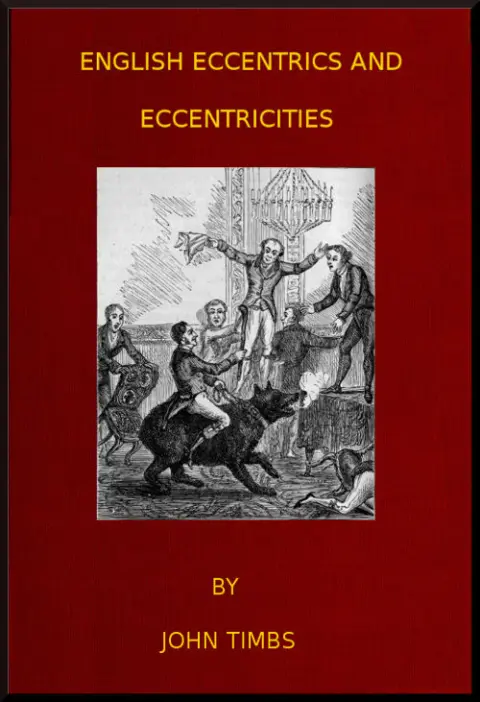
English Eccentrics and Eccentricities
John Timbs
THE CLASSIC COLLECTION · 1863
"Things to be Remembered in Daily Life" by John Timbs is a reflective guidebook written in the mid-19th century. This work examines timeless themes such as the concepts of time and human life, while providing personal experiences and historical anecdotes to illustrate practical lessons for everyday living. The aim is to distill important truths that one can apply to the complexities of daily existence. The opening of the book sets the stage by emphasizing the philosophical significance of time, likening it to a powerful force that shapes human experience and existence. Timbs introduces the personification of Time through various literary references, illustrating its relentless passage and impact on life. This section encourages readers to consider how they engage with time, urging a deeper reflection on its fleeting nature and the importance of making the most of each moment. Timbs' intention is to provide insights that resonate in the modern context while drawing from historical wisdom.
Introduction adapted from the source catalogue; source summaries may be automatically generated.
Free to read · English · 106,611 words · No account needed
MAKE TIME FOR A GOOD BOOK
On by default. Untick to stop anonymous reading totals. Each page counts after 10 seconds in view. How this works.
Anonymous counting is on unless you have switched it off.
Among Lawyers, Francis Maseres, fifty years Cursitor-Baron of the Court of Exchequer, died 1824, at the age of 93: he was a ripe classical scholar, and one of the ablest mathematicians of his day. The Eldon family present three noteworthy examples: Mr. Scott, the Newcastle merchant, father of Lord Stowell and the Earl of Eldon, died 1800, at the age of 92: the two eminent sons, Stowell, 1836, at 91, and Eldon, 1838, at 87. Lord Plunket, the statesman and lawyer, who died 1854, had reached 90. Lord Chancellor Campbell, who in his busy law-life wrote many volumes of biography, attained the age of 81.
Sir William Blizard, the Surgeon, who died in 1835, in his 94th year, rose to eminence under many disadvantages. With all his activity and industry, except a fever caught by working night and day in the dissecting-room, his health never failed him till the last; he was temperate; and the only wine he drank was Cape. Sir William Burnett, the physician and scientific inventor, reached 82.
In 1862 two eminent Mathematicians died within a month of each other: Jean Baptiste Biot, aged 88; and Peter Barlow, 86. Prof. Narrien, of Sandhurst, died 1860, at 77; and, same year and age, Finlaison, the actuary.
Francis Place, the Westminster Politician, who died 1854, had reached 82. The Duc de Pasquier, the celebrated French statesman, attained the great age of 96: he died 1862, and was the oldest statesman of our time. Talleyrand, next to Napoleon the most extraordinary man of the revolutionary period of France, died 1838, aged 84.
The oldest Poets of our time were W. L. Bowles, 1850, aged 88; same year, Wordsworth, poet-laureate, 80; James Montgomery, 1854, at 82; Samuel Rogers, 1855, aged 96; Arndt, the German poet, 1860, at 91; and Dr. Croly, the poet and divine, 86.
Mitscherlich, the German Philologist, died 1854, at 94; same year, Gresnall, biographer, 89, and Faber, theologian, 80. Hamner-Purgstall, the Oriental historian, who died 1856, had attained 87; 1857, Hincks, the Orientalist, 90.
Sir John Stoddart, the Newspaper editor, who died 1855, had reached 85,—a rare age for a public journalist. John Sharpe, the tasteful littérateur, who died 1860, reached 83.
Dr. Lingard, the Historian, died 1851, aged 82. In 1859, Hallam, the historian; same year, Elphinstone, the historian of India, aged 81.
John Britton, the Topographer and antiquary, who died 1857, had reached 86: he was cheerful and chirping almost to the end. His brother topographer, Brayley, died 1854, aged 85. John Adey Repton, the architect and archæologist, died 1860, aged 86; Joseph Hunter, archæologist, 1861, 78.
Your reading position is saved on this browser. Take it to another device with a library code. Reading pages adapt to text, rather than matching a printed edition.
John Timbs
John Timbs
John Timbs
John Timbs
BEHIND THE BOOK
This eBook is for the use of anyone anywhere in the United States and most other parts of the world at no cost and with almost no restrictions whatsoever. You may copy it, give it away or re-use it under the terms of the Project Gutenberg License included with this eBook or online at www.gutenberg.org. If you are not located in the United States, you will have to check the laws of the country where you are located before using this eBook. Read the source licence.
The original source file, including credits and licence, is retained by this library. Request an original-format copy at no charge. Please include the book title and Project Gutenberg identifier #54703.
KEEP YOUR CURIOSITY GOING

David Patterson (Spirit) Hatch

David Patterson (Spirit) Hatch

David Patterson (Spirit) Hatch
Coulson Kernahan

Ralph Waldo Emerson

Maurice Baring