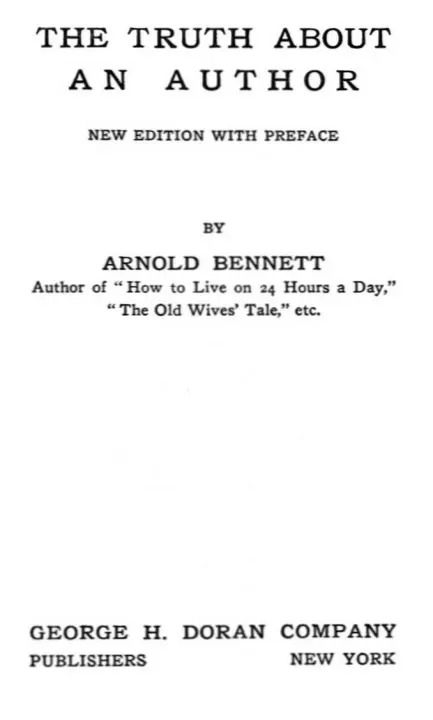
The Truth About an Author
Arnold Bennett
THE CLASSIC COLLECTION · 1915
"These Twain" by Arnold Bennett is a novel written in the early 20th century. The story centers around the life of Edwin Clayhanger, a successful master-printer, as he navigates his new responsibilities as a husband to Hilda, a woman with a complex past. As the narrative unfolds, it explores themes of societal expectations, domesticity, and the contrasts between old and new values in a changing world. The opening of the novel introduces us to Bleakridge, a suburb divided between old and new architectural styles reflecting the societal changes of the time. It establishes Edwin's character, a house-proud man who feels a mix of nervousness and pride about his new marriage to Hilda, who brings a vibrant energy into his life. As he prepares for a hosted evening gathering, readers witness his reflections on domestic life and the imprint of his past on his new surroundings. The interactions with other characters, including family members, servants, and Edwin's contemplation of his role, set the stage for a rich exploration of interpersonal dynamics within the context of the changing social fabric of the early 1900s.
Introduction adapted from the source catalogue; source summaries may be automatically generated.
Free to read · English · 147,013 words · No account needed
MAKE TIME FOR A GOOD BOOK
On by default. Untick to stop anonymous reading totals. Each page counts after 10 seconds in view. How this works.
Anonymous counting is on unless you have switched it off.
Ada was just crossing the hall to the drawing-room, a telegram on a
salver in her red hand.
"Here you are, Ada," said Edwin, stopping her, with a gesture towards
the telegram.
"It's for Mr. Tom Swetnam, sir."
Edwin and Hilda followed the starched and fussy girl into the drawing-room, in which were about a dozen people, including Fearns, the lawyer, and his wife, the recently married Stephen and Vera Cheswardine, several Swetnams, and Janet Orgreave, who sat at the closed piano, smiling vaguely.
Tom Swetnam, standing up, took the telegram.
"I never knew they delivered telegrams at this time o' night," said Fearns sharply, looking at his watch. He was wont to keep a careful eye on the organisation of railways, ships, posts, and other contrivances for the shifting of matter from one spot to another. An exacting critic of detail, he was proud of them in the mass, and called them civilisation.
"They don't," said Tom Swetnam naughtily, glad to plague a man older than himself, and the father of a family. Tom was a mere son, but he had travelled, and was, indeed, just returned from an excursion through Scandinavia. "Observe there's no deception. The envelope's been opened. Moreover, it's addressed to Ben Clewlow, not to me. Ben's sent it up. I asked him to. Now, we'll see."
Having displayed the envelope like a conjurer, he drew forth the telegram, and prepared to read it aloud. One half of the company was puzzled; the other half showed an instructed excitement. Tom read the message:
"'Twenty-seven pounds ten nine. Philosophers tell us that there is nothing new under the sun. Nevertheless it may well be doubted whether the discovery of gold at Barmouth, together with two earthquake shocks following each other in quick succession in the same district, does not constitute, in the history of the gallant little Principality, a double event of unique--'" He stopped.
Vera Cheswardine, pretty, fluffy, elegant, cried out with all the
impulsiveness of her nature:
"Novelty!"
"Whatever is it all about?" mildly asked Mrs. Fearns, a quiet and dignified, youngish woman whom motherhood had made somewhat absent-minded when she was away from her children.
"Missing-word competition," Fearns explained to her with curt, genial superiority. He laughed outright. "You do go it, some of you chaps," he said. "Why, that telegram cost over a couple of bob, I bet!"
"Well, you see," said Tom Swetnam, "three of us share it. We get it thirty-six hours before the paper's out--fellow in London--and there's so much more time to read the dictionary. No use half doing a thing! Twenty-seven pounds odd! Not a bad share this week, eh?"
"Won anything?"
Your reading position is saved on this browser. Take it to another device with a library code. Reading pages adapt to text, rather than matching a printed edition.
Arnold Bennett
Arnold Bennett
Arnold Bennett
Arnold Bennett
BEHIND THE BOOK
This eBook is for the use of anyone anywhere in the United States and most other parts of the world at no cost and with almost no restrictions whatsoever. You may copy it, give it away or re-use it under the terms of the Project Gutenberg License included with this eBook or online at www.gutenberg.org. If you are not located in the United States, you will have to check the laws of the country where you are located before using this eBook. Read the source licence.
The original source file, including credits and licence, is retained by this library. Request an original-format copy at no charge. Please include the book title and Project Gutenberg identifier #40483.
KEEP YOUR CURIOSITY GOING
Coulson Kernahan

Maurice Baring
Frances Wright
Cécile Tormay

Frederic Jesup Stimson

W. H. P. (William Henry Pope) Jarvis