
Last letters from the living dead man
David Patterson (Spirit) Hatch
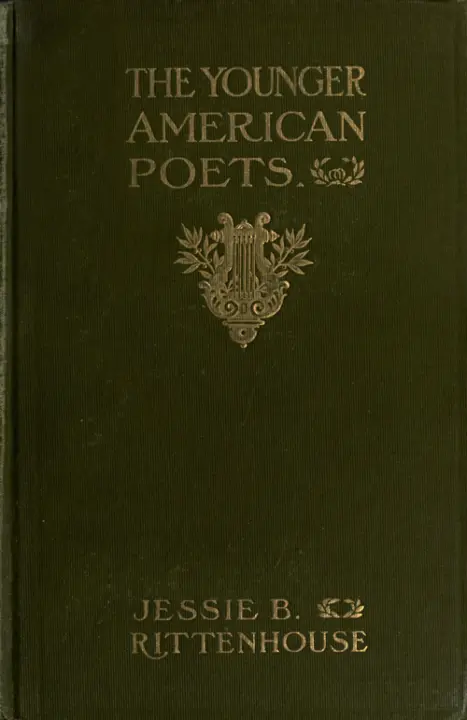
THE CLASSIC COLLECTION · 1904
"The Younger American Poets" by Jessie Belle Rittenhouse is a collection of literary studies written in the early 20th century. This work delves into the poetry of a selection of younger American poets, exploring their contributions and distinct styles within the broader context of contemporary poetry. Rittenhouse offers insight into the thematic elements and individual characteristics of these poets, likely focusing on their artistic approaches and the socio-cultural conditions of their time. The beginning of this collection introduces Richard Hovey, characterizing him as a poet grounded in convictions and comradeship rather than mere whimsies of rhyme. Hovey is depicted as an artist deeply engaged with the essence of life, capturing the vibrancy of nature alongside themes of human connection and national pride. Rittenhouse highlights specific works and ideas from Hovey, noting his Whitmanesque influence while asserting his unique voice that emphasizes a harmonious relationship with the world around him. This opening segment sets the stage for further explorations of the varied styles and themes represented by the younger poets discussed in the subsequent chapters.
Introduction adapted from the source catalogue; source summaries may be automatically generated.
Free to read · English · 71,656 words · No account needed
MAKE TIME FOR A GOOD BOOK
On by default. Untick to stop anonymous reading totals. Each page counts after 10 seconds in view. How this works.
Anonymous counting is on unless you have switched it off.
In her poem called “The Rival” human nature speaks a direct word, particularly in the contradiction of the last stanza. The lines have the quality of speech rather than of print:
This is the hardest of my fate:
She’s better whom he doth prefer
Than I am that he worshipped late,
As well as so much prettier,
So much more fortunate!
He’ll not repent; oh, you will see,
She’ll never give him cause to grieve!
I dream that he comes back to me,
Leaving her,—but he’ll never leave!
Hopelessly sweet is she.
So that if in my place she stood,
She’d spare to curse him, she’d forgive!
I loathe her, but I know she would—
And so will I, God, as I live,
Not she alone is good!
The ethical inconsistency of the above stanza, “I loathe her,” and “Not she alone is good,” is so human and racy with suggestion of these paradoxical moods of ours, that the stanza, together with its companion lines, becomes a leaf torn from the book of life.
In its spiritual quality Miss Hall’s work shows, perhaps, its finest distinction: brave, strong, acquiescent, inducing in one a nobler mood,—such is the spirit of the volume. Its philosophy is free from didacticism or moralizing; indeed, it should scarcely be called philosophy, but rather the personal record of experiences touching the inner life,—phases of feeling interpreted in their spiritual import. These lines express the mood:
Then lead me, Friend. Here is my hand,
Not in dumb resignation lent
Because Thee one cannot withstand—
In love, Lord, with complete consent.
Lead. If we come to the cliff’s crest,
And I hear deep below—O deep!—
The torrent’s roar, and “Leap!” Thou say’st,
I will not question—I will leap.
The last stanza, in its vivid illustrative quality, is an admirable expression of spiritual assurance.
Another brief lyric rings with the true note of valor, declaring the eternal potency of hope, and one’s obligation to pass on his unspent faith, though falling by the way:
Could I not be the pilgrim
To reach my saint’s abode,
I would make myself the road
To lead some other pilgrim
Where my soul’s treasure glowed.
Could not I in the eager van
Be the stalwart pioneer
Who points where the way is clear,
I would be the man who sinks in the swamp,
And cries to the rest, “Not here!”
From an Eastern Apologue Miss Hall has drawn a charming illustration of the power of influence and association:
Your reading position is saved on this browser. Take it to another device with a library code. Reading pages adapt to text, rather than matching a printed edition.
BEHIND THE BOOK
This eBook is for the use of anyone anywhere in the United States and most other parts of the world at no cost and with almost no restrictions whatsoever. You may copy it, give it away or re-use it under the terms of the Project Gutenberg License included with this eBook or online at www.gutenberg.org. If you are not located in the United States, you will have to check the laws of the country where you are located before using this eBook. Read the source licence.
The original source file, including credits and licence, is retained by this library. Request an original-format copy at no charge. Please include the book title and Project Gutenberg identifier #55447.
KEEP YOUR CURIOSITY GOING
David Patterson (Spirit) Hatch

David Patterson (Spirit) Hatch

David Patterson (Spirit) Hatch
Cécile Tormay

Moritz Busch
John L. Ransom