
Last letters from the living dead man
David Patterson (Spirit) Hatch
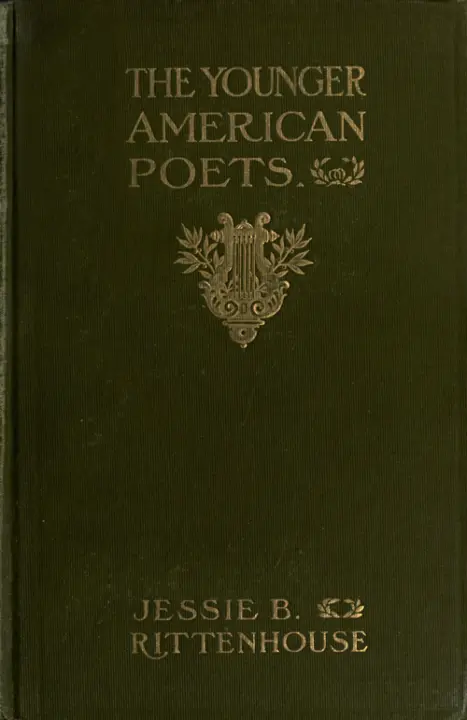
THE CLASSIC COLLECTION · 1904
"The Younger American Poets" by Jessie Belle Rittenhouse is a collection of literary studies written in the early 20th century. This work delves into the poetry of a selection of younger American poets, exploring their contributions and distinct styles within the broader context of contemporary poetry. Rittenhouse offers insight into the thematic elements and individual characteristics of these poets, likely focusing on their artistic approaches and the socio-cultural conditions of their time. The beginning of this collection introduces Richard Hovey, characterizing him as a poet grounded in convictions and comradeship rather than mere whimsies of rhyme. Hovey is depicted as an artist deeply engaged with the essence of life, capturing the vibrancy of nature alongside themes of human connection and national pride. Rittenhouse highlights specific works and ideas from Hovey, noting his Whitmanesque influence while asserting his unique voice that emphasizes a harmonious relationship with the world around him. This opening segment sets the stage for further explorations of the varied styles and themes represented by the younger poets discussed in the subsequent chapters.
Introduction adapted from the source catalogue; source summaries may be automatically generated.
Free to read · English · 71,656 words · No account needed
MAKE TIME FOR A GOOD BOOK
On by default. Untick to stop anonymous reading totals. Each page counts after 10 seconds in view. How this works.
Anonymous counting is on unless you have switched it off.
I trim my pen, I make it fine and neat;
There comes a flutter of brown wings.
A little bird alights and sings,
“Sweet!—sweet!”
O little bird, O go away! be dumb!
For I must ponder certain lines;
And straight a nodding flower makes signs,
“Come!—come!”
O Spring, let me alone! O bird, bloom, beam,
“I have no time to dream!” I cry;
The echo breathes a soft, long sigh,
“Dream!—dream!”
The beautiful lyric,
“Ah, worshipped one, ah, faithful Spring!”
tempers this blitheness to a pensive strain, though only as one may introduce a note of minor in a staccato melody. In another bit of verse celebrating the renewing year, and noting how joy lays his finger on one’s lips and makes him mute, occur these delicate lines:
Thrice happy, oh, thrice happy still the Earth
That can express herself in roses, yea,
Can make the lily tell her inmost thought!
One nature lyric of two stanzas, despite the fact that its cadence halts in the final couplet, is compact of atmosphere; and to one who has been companioned by the pines, it brings an aromatic breath, full of stimulus:
The sun in the pine is sleeping, sleeping.
The drops of resin gleam….
There’s a mighty wizard with perfumes keeping
My brain benumbed in a dream!
The wind in the pine is rushing, rushing,
Fine and unfettered and wild….
There’s a mighty mother imperiously hushing
Her fretful, uneasy child!
These lines give over pictures of mornings in the radiant sunlight of the North, that cloudless, lifted air; and “The drops of resin gleam,” has the same touch of transmutation that some suggestion of the brine has for the exiled native of the seaboard.
Miss Hall’s themes are not sought far afield, but bring, in nearly all the poems, a hint of personal experience; nature, love, spiritual emotion, blending with lighter moods and fancies, comprise the record of the Age of Fairygold. We have glanced at the nature verse; that upon love is subtler in touch, but holds to the intimate note distinguishing all of her work. The second of these stanzas contains a graphic image:
Be good to me! If all the world united Should bend its powers to gird my youth with pain, Still might I fly to thee, Dear, and be righted— But if thou wrong’st me, where shall I complain?
I am the dove a random shot surprises,
That from her flight she droppeth quivering,
And in the deadly arrow recognizes
A blood-wet feather—once in her own wing!
Your reading position is saved on this browser. Take it to another device with a library code. Reading pages adapt to text, rather than matching a printed edition.
BEHIND THE BOOK
This eBook is for the use of anyone anywhere in the United States and most other parts of the world at no cost and with almost no restrictions whatsoever. You may copy it, give it away or re-use it under the terms of the Project Gutenberg License included with this eBook or online at www.gutenberg.org. If you are not located in the United States, you will have to check the laws of the country where you are located before using this eBook. Read the source licence.
The original source file, including credits and licence, is retained by this library. Request an original-format copy at no charge. Please include the book title and Project Gutenberg identifier #55447.
KEEP YOUR CURIOSITY GOING
David Patterson (Spirit) Hatch

David Patterson (Spirit) Hatch

David Patterson (Spirit) Hatch
Cécile Tormay

Moritz Busch
John L. Ransom