THE CLASSIC COLLECTION✦The Disappearing EyeCLASSIC FREE BOOKS
The Disappearing Eye
Fergus Hume
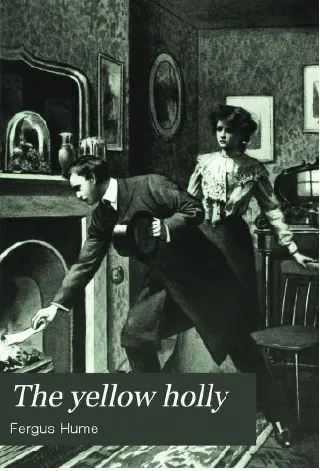
THE CLASSIC COLLECTION · 1903
"The Yellow Holly" by Fergus Hume is a novel written in the early 20th century. The story sets the stage for a murder mystery that revolves around the mysterious death of Mrs. Jersey, the owner of a boarding house filled with colorful, eccentric characters. As the narrative unfolds, we are introduced to a young visitor named Leonard Train who becomes entangled in the intrigue, particularly in connection to George Brendon, who has a hidden past and a complicated relationship with the deceased. At the start of the novel, we find Mrs. Jersey hosting a casual gathering for her boarders in her drawing room. The atmosphere is filled with old-fashioned charm and an underlying tension, hinting at the complicated lives of those in attendance, including the intriguing newcomer, Leonard Train. As the night progresses, we learn that Mrs. Jersey harbors secrets that connect her to one of the attendees, George Brendon. The opening concludes with the sudden and shocking murder of Mrs. Jersey, setting off a series of events that will challenge the relationships and motives of all characters involved, leaving readers eager to discover who may be responsible for the tragedy that has befallen Amelia Square.
Introduction adapted from the source catalogue; source summaries may be automatically generated.
Free to read · English · 100,057 words · No account needed
MAKE TIME FOR A GOOD BOOK
On by default. Untick to stop anonymous reading totals. Each page counts after 10 seconds in view. How this works.
Anonymous counting is on unless you have switched it off.
Derrington, at his own table, was too polite to press the matter, but he scored up another victory to Brendon's strong will. More, he passed off the matter with a laugh. "You have the hereditary gout, I see, George, when you are afraid of a glass of port."
"It's not that, sir, but I drink very little. I work on milk."
"Bah!" Derrington made a wry face. "Then your work----"
"Is all the better for it. Those who drink beer think beer."
"And those who drink milk think cows, I should say."
"Your knowledge on that point prevents contradiction on mine."
Derrington chuckled. This was just the kind of epigrammatic reply he relished. "You must enter the Diplomatic Service sir," said he, looking approvingly from under his bushy brows.
"Don't you think I'm rather old?"
"Brains are never old, sir. And you have 'em. It's what the Diplomatic Service in this country requires and what it never gets. I was in the Service myself at one time."
"So I have heard," said Brendon, cracking nuts composedly.
"Eh! What did you hear?"
"You must excuse me at your own table, sir."
"Pooh, if you want to say anything disagreeable my own table is the safest place you can say it at. I can't throw things at you."
"Still, a guest must be polite," argued George.
"I like my guests to be truthful."
"Very well, sir, if you will have it--and I feel that it would be bad manners to refuse your request--it is said that you nearly set Europe by the ears when you were ambassador."
Derrington roared. "I did--I did, and I wish I had brought about the war I wanted. It would have done no end of good."
"Does war ever do good?" asked Brendon, doubtfully.
"Certainly. It stirs up things, and teaches men how to use their hands and brains. Without war there is too much wrapping up in cotton-wool. Don't tell me, George, that you aren't a soldier at heart, for nearly all your ancestors fought for their country.
"And fought their country also, I believe."
"When they didn't get their rights," said Derrington, grimly. "I have been a fighter myself all my life, and I've held my own."
"So they say, sir, and I admire you for it."
"Hah! Very good of you, I'm sure," said Derrington, ironically, "but in my old age I can't hold my own, so I have to call in you."
George looked surprised. "Do you intend to do me the honor to ask for
my advice, sir?"
"Bless my soul, are you also without understanding, sir? Didn't I say
so when you first came?"
"Of course. I forgot."
Your reading position is saved on this browser. Take it to another device with a library code. Reading pages adapt to text, rather than matching a printed edition.
Fergus Hume

Fergus Hume

Fergus Hume
Fergus Hume
BEHIND THE BOOK
This eBook is for the use of anyone anywhere in the United States and most other parts of the world at no cost and with almost no restrictions whatsoever. You may copy it, give it away or re-use it under the terms of the Project Gutenberg License included with this eBook or online at www.gutenberg.org. If you are not located in the United States, you will have to check the laws of the country where you are located before using this eBook. Read the source licence.
The original source file, including credits and licence, is retained by this library. Request an original-format copy at no charge. Please include the book title and Project Gutenberg identifier #54979.
KEEP YOUR CURIOSITY GOING
Coulson Kernahan

Maurice Baring
Frances Wright
Cécile Tormay

Frederic Jesup Stimson

W. H. P. (William Henry Pope) Jarvis