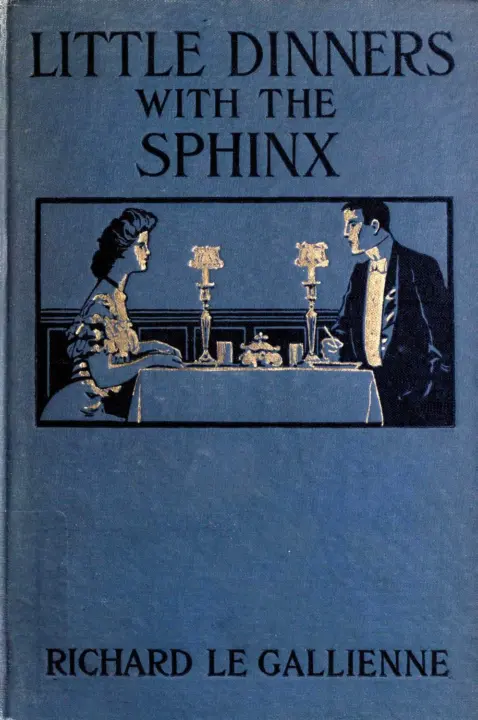
Little Dinners With the Sphinx, and Other Prose Fancies
Richard Le Gallienne
THE CLASSIC COLLECTION · 1900
"The Worshipper of the Image" by Richard Le Gallienne is a novel written during the turn of the 20th century, known for its exploration of love, art, and the boundaries of reality. The story centers around Antony, a man ensnared by the beautiful yet haunting image of a woman named Silencieux, which he treats as his muse. As Antony's obsession with this image deepens, it sets into motion a tragic series of events that intertwine his love for his wife Beatrice and his infatuation with Silencieux. At the start of the novel, the tranquil yet eerie setting of a secluded wood sets the stage for Antony's first encounters with Silencieux. He frequently expresses his affection towards the image, personifying it as a source of artistic inspiration. The contrast between his devotion to Silencieux and the reality of his life with Beatrice is established, as he becomes increasingly withdrawn from her. Moments of quiet reflection are interrupted by fleeting interactions with Beatrice and the world around him, suggesting a looming tension as his fantasies begin to overshadow his responsibilities and relationships. The opening chapter introduces an atmosphere of silenced beauty and foreshadows the tragic consequences of unbridled artistic obsession.
Introduction adapted from the source catalogue; source summaries may be automatically generated.
Free to read · English · 18,635 words · No account needed
MAKE TIME FOR A GOOD BOOK
On by default. Untick to stop anonymous reading totals. Each page counts after 10 seconds in view. How this works.
Anonymous counting is on unless you have switched it off.
Antony had not written a poem to his wife since their little girl Wonder had been born, now some four years ago. Surely it was from no lack of love, this silence, but merely due to the working of what would seem to be a law of the artistic temperament: that to turn a muse into a wife, however long and faithfully loved, is to bid good-bye to the muse. But a day or two after the coming of Silencieux, Antony found himself suddenly inspired once more to sing of his wife. It was the best poem he had written for a long time, and when it was finished, he came down the wood impatient to read it to Beatrice. This was the poem, which he called "The Northern Sphinx":--
Sphinx of the North, with subtler smile
Than hers who in the yellow South,
With make-believe mysterious mouth,
Deepens the ennui of the Nile;
And, with no secret left to tell,
A worn and withered old coquette,
Dreams sadly that she draws us yet,
With antiquated charm and spell:
Tell me your secret, Sphinx,--for mine!--
What means the colour of your eyes,
Half innocent and all so wise,
Blue as the smoke whose wavering line
Curls upward from the sacred pyre
Of sacrifice or holy death,
Pale twisting wreaths of opal breath,
From fire mounting into fire.
What is the meaning of your hair?
That little fairy palace wrought
With many a grave fantastic thought;
I send a kiss to wander there,
To climb from golden stair to stair,
Wind in and out its cunning bowers,--
O garden gold with golden flowers,
O little palace built of hair!
The meaning of your mouth, who knows?
O mouth, where many meanings meet--
Death kissed it stern, Love kissed it sweet,
And each has shaped its mystic rose.
Mouth of all sweets, whose sweetness sips
Its tribute honey from all hives,
The sweetest of the sweetest lives,
Soft flowers and little children's lips;
Yet rather learnt its heavenly smile
From sorrow, God's divinest art,
Sorrow that breaks and breaks the heart,
Yet makes a music all the while.
Ah! what is that within your eyes,
Upon your lips, within your hair,
The sacred art that makes you fair,
The wisdom that hath made you wise?
Tell me your secret, Sphinx,--for mine!--
The mystic word that from afar
God spake and made you rose and star,
The fiat lux that bade you shine.
While Antony read, Beatrice's face grew sadder and sadder. When he had
finished she said:--
"It is very beautiful, Antony--but it is not written for me."
Your reading position is saved on this browser. Take it to another device with a library code. Reading pages adapt to text, rather than matching a printed edition.
Richard Le Gallienne
Richard Le Gallienne
Richard Le Gallienne
Richard Le Gallienne
BEHIND THE BOOK
This eBook is for the use of anyone anywhere in the United States and most other parts of the world at no cost and with almost no restrictions whatsoever. You may copy it, give it away or re-use it under the terms of the Project Gutenberg License included with this eBook or online at www.gutenberg.org. If you are not located in the United States, you will have to check the laws of the country where you are located before using this eBook. Read the source licence.
The original source file, including credits and licence, is retained by this library. Request an original-format copy at no charge. Please include the book title and Project Gutenberg identifier #10812.
KEEP YOUR CURIOSITY GOING
Coulson Kernahan

Maurice Baring
Frances Wright
Cécile Tormay

Frederic Jesup Stimson

W. H. P. (William Henry Pope) Jarvis