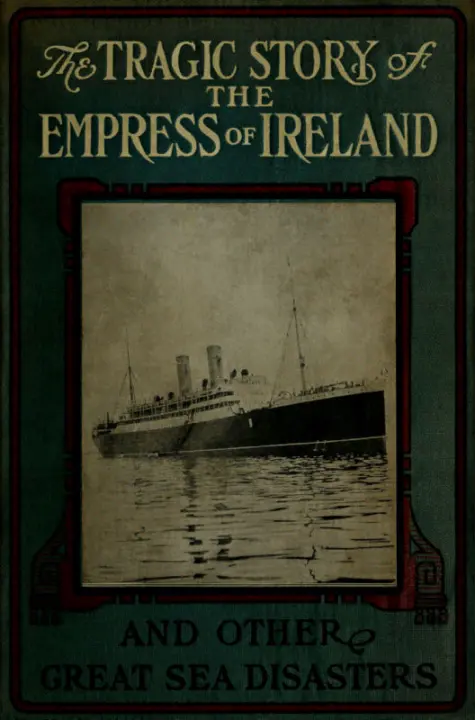
The Tragic Story of the Empress of Ireland, and Other Great Sea Disasters
Logan Marshall
THE CLASSIC COLLECTION · 1915
"The World War" by Logan Marshall is a historical account written in the early 20th century. The text explores the events leading up to World War I, detailing the complex political landscape and the various nations and empires involved in the conflict. It focuses on the dramatic suddenness with which Europe was plunged into war following the assassination of Archduke Franz Ferdinand and the subsequent reactions of the involved nations. The opening of the book sets the stage for the historical narrative that follows, describing the peace that pervaded Europe just before the outbreak of war. It highlights the shock and turmoil experienced across the continent as nations quickly mobilized for conflict. Marshall discusses the deep-rooted causes of the war, emphasizing that the assassination of the archduke served as a catalyst for long-standing tensions between nations. He delves into the political environment, the impacts of militarism, and the catastrophic consequences that ensued, painting a vivid picture of a world on the brink of devastation.
Introduction adapted from the source catalogue; source summaries may be automatically generated.
Free to read · English · 100,105 words · No account needed
MAKE TIME FOR A GOOD BOOK
On by default. Untick to stop anonymous reading totals. Each page counts after 10 seconds in view. How this works.
Anonymous counting is on unless you have switched it off.
Properly the $80,000,000,000 of estimated British wealth should have e included the thousands of millions of treasure in India and Egypt, the gold mines and diamond resources of South Africa, the wheat fields and mines of Canada, the sheep farms and gold of Australia and many other sources; the estimate of population should have included the countless millions from which Britain could draw and did draw in the day of emergency. In this vast Empire British capital had been invested to an enormous amount—the estimated total in 1914 being $2,570,0000,000 for Canada and Newfoundland, $1,893,000,000 in India and Ceylon,$1,850,000,000 in south Africa, $1,660,000,000 in Australia, or a total in all British countries of $8,900,000,000. When the War broke out these Dominions endeavored to help the Mother Country in every possible way and the following table shows what was done in Canada alone during the first few months of the conflict:
Expeditionary force of over 32,000 men, fully equipped; 50,000 others under training for the front. Over 200 field and machine guns. Two submarines, for general service ($1,050,000); H.M.C.S. Niobe and Rainbow for general service. 1,000,000 bags of flour. $100,000 for “Hospice Canadien” in France. $50,000 for the relief of Belgian sufferers.
ALBERTA: 500,000 bushels of oats; 5,000 bags of flour for Belgians. Civil service, 5 per cent of salaries up to $1500 per annum, and 10 per cent in excess of that amount to Canadian Patriotic Fund.
BRITISH COLUMBIA: 25,000 cases of canned salmon; $5,000 to Belgian
Relief Fund.
MANITOBA: 10,000 men; 50,000 bags of flour; $5,000 to Belgian Relief
Fund.
NEW BRUNSWICK: 1,000 men; 100,000 bushels of potatoes, 15,000 barrels
of potatoes for Belgium.
NOVA SCOTIA: $100,000 to the Prince of Wales Fund; apples for the troops; food and clothing for Belgium.
ONTARIO: $500,000; 250,000 bags of flour; 100,000 lbs of evaporated apples for the Navy; $15,000 to the Belgian Relief Fund.
PRINCE EDWARD ISLAND: 100,000 bushels of oats; cheese and hay.
QUEBEC: 4,000,000 lbs of cheese; $25,000 to Belgian Relief Fund.
SASKATCHEWAN: 1,500 horses ($250,000); $5,000 to Belgian Relief Fund
THE YUKON: $6,000 to the Canadian Patriotic fund
OTTAWA: $300,000 (for machine gun sections—4 guns on armored motors and a detachment of 30 men); $50,000 to the Canadian Patriotic Fund.
QUEBEC: $20,000 Canadian Patriotic fund; insuring lives of Quebec
volunteers.
MONTREAL: $150,000 (Canadian Patriotic Fund); battery of quick-firing guns; $10,000 to Belgian Relief fund.
TORONTO: $50,000 (Canadian Patriotic Fund); insuring lives of all Toronto volunteers; 100 horses for training purposes; carload for Belgians of canned provisions.
WINNIPEG: $5,000 monthly to Patriotic Fund
REGINA: $1,000 for comfort of the city’s soldiers; $62,500 To Belgian
Relief Fund.
CALGARY: 1,000 MEN (Legion of Frontiersmen).
HAMILTON: $20,000 Patriotic Fund; $5,000 for local relief.
BERLIN: $10,000 Patriotic Fund.
ST. JOHNS, N.B. $10,000 Patriotic Fund; $2,000 Belgian Fund
Your reading position is saved on this browser. Take it to another device with a library code. Reading pages adapt to text, rather than matching a printed edition.
BEHIND THE BOOK
This eBook is for the use of anyone anywhere in the United States and most other parts of the world at no cost and with almost no restrictions whatsoever. You may copy it, give it away or re-use it under the terms of the Project Gutenberg License included with this eBook or online at www.gutenberg.org. If you are not located in the United States, you will have to check the laws of the country where you are located before using this eBook. Read the source licence.
The original source file, including credits and licence, is retained by this library. Request an original-format copy at no charge. Please include the book title and Project Gutenberg identifier #3779.
KEEP YOUR CURIOSITY GOING
Cécile Tormay

Moritz Busch
John L. Ransom
Frances Wright
Cécile Tormay

Mabel Potter Daggett