
Last letters from the living dead man
David Patterson (Spirit) Hatch
THE CLASSIC COLLECTION · 1633
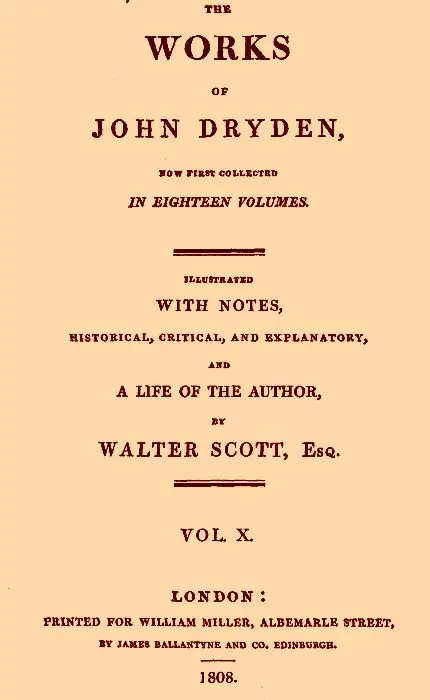
"The Works of John Dryden, now first collected in eighteen volumes. Volume 10" is a collection of literary works, specifically poetry and essays, compiled from the writings of John Dryden and published during the early 19th century. This volume includes Dryden's poem "Religio Laici," which discusses theological matters and presents his perspectives on faith and religion amidst the complexities of his time. The works likely engage with themes of Christianity, sectarianism, and personal belief. The opening of this volume presents "Religio Laici," an epistolary poem where Dryden articulates his beliefs as a layman amidst a tumultuous religious landscape. He navigates the contentious debates between various religious factions, aiming for a rational exposition of faith that reconciles differing viewpoints. Dryden addresses objections to revealed religion versus rational inquiry, emphasizing the importance of individual reason tempered with faith. His arguments suggest a yearning for a balanced perspective, advocating for personal conviction while also acknowledging the authority of the Church of England despite recognizing the shortcomings within traditions.
Introduction adapted from the source catalogue; source summaries may be automatically generated.
Free to read · English · 135,998 words · No account needed
MAKE TIME FOR A GOOD BOOK
On by default. Untick to stop anonymous reading totals. Each page counts after 10 seconds in view. How this works.
Anonymous counting is on unless you have switched it off.
I have dwelt longer on this subject than I intended, and longer than perhaps I ought; for, having laid down, as my foundation, that the Scripture is a rule; that in all things needful to salvation it is clear, sufficient, and ordained by God Almighty for that purpose; I have left myself no right to interpret obscure places, such as concern the possibility of eternal happiness to heathens; because whatsoever is obscure is concluded not necessary to be known.
But, by asserting the Scripture to be the canon of our faith, I have unavoidably created to myself two sorts of enemies; the papists, indeed, more directly, because they have kept the Scripture from us what they could, and have reserved to themselves a right of interpreting what they have delivered under the pretence of infallibility; and the fanatics, more collaterally, because they have assumed what amounts to an infallibility in the private spirit, and have distorted those texts of Scripture which are not necessary to salvation, to the damnable uses of sedition, disturbance, and destruction of the civil government. To begin with the papists, and to speak freely, I think them the less dangerous (at least in appearance) to our present state; for not only the penal laws are in force against them, and their number is contemptible, but also their peerage and commons are excluded from parliaments, and consequently those laws in no probability of being repealed. A general and uninterrupted plot of their clergy, ever since the Reformation, I suppose all protestants believe; for it is not reasonable to think, but that so many of their orders, as were outed from their fat possessions, would endeavour a re-entrance against those whom they account heretics.[10] As for the late design, Mr Coleman's letters, for aught I know, are the best evidence; and what they discover, without wire-drawing their sense, or malicious glosses, all men of reason conclude credible.[11] If there be any thing more than this required of me, I must believe it as well as I am able, in spite of the witnesses, and out of a decent conformity to the votes of parliament; for I suppose the fanatics will not allow the private spirit in this case. Here the infallibility is at least in one part of the government; and our understandings, as well as our wills, are represented. But, to return to the Roman Catholics, how can we be secure from the practice of jesuited papists in that religion? For not two or three of that order, as some of them would impose upon us, but almost the whole body of them, are of opinion, that their infallible master has a right over kings, not only in spirituals, but temporals. Not to name Mariana, Bellarmine, Emanuel Sa, Molina, Santarel, Simancha,[12] and at least twenty others of foreign countries, we can produce of our own nation, Campian, and Doleman or Parsons,[13] (besides many [who] are named whom I have not read,) who all of them attest this doctrine, that the pope can depose and give away the right of any sovereign prince, si vel paulum deflexerit, if he shall never so little warp; but if he once comes to be excommunicated, then the bond of obedience is taken off from subjects; and they may and ought to drive him, like another Nebuchadnezzar, ex hominum Christianorum dominatu, from exercising dominion over Christians; and to this they are bound by virtue of divine precept, and by all the ties of conscience, under no less penalty than damnation. If they answer me, (as a learned priest has lately written,) that this doctrine of the Jesuits is not de fide, and that consequently they are not obliged by it, they must pardon me, if I think they have said nothing to the purpose; for it is a maxim in their church, where points of faith are not decided, and that doctors are of contrary opinions, they may follow which part they please, but more safely the most received and most authorized. And their champion, Bellarmine, has told the world, in his Apology, that the king of England is a vassal to the pope, ratione, directi dominii,[14] and that he holds in villanage of his Roman landlord; which is no new claim put in for England: our chronicles are his authentic witnesses, that King John was deposed by the same plea, and Philip Augustus admitted tenant; and, which makes the more for Bellarmine, the French king was again ejected when our king submitted to the church, and the crown received under the sordid condition of a vassalage.
Your reading position is saved on this browser. Take it to another device with a library code. Reading pages adapt to text, rather than matching a printed edition.
BEHIND THE BOOK
This eBook is for the use of anyone anywhere in the United States and most other parts of the world at no cost and with almost no restrictions whatsoever. You may copy it, give it away or re-use it under the terms of the Project Gutenberg License included with this eBook or online at www.gutenberg.org. If you are not located in the United States, you will have to check the laws of the country where you are located before using this eBook. Read the source licence.
The original source file, including credits and licence, is retained by this library. Request an original-format copy at no charge. Please include the book title and Project Gutenberg identifier #51652.
KEEP YOUR CURIOSITY GOING
David Patterson (Spirit) Hatch

David Patterson (Spirit) Hatch

David Patterson (Spirit) Hatch

Ralph Waldo Emerson

Maurice Baring

Oscar Wilde & James McNeill Whistler