
Last letters from the living dead man
David Patterson (Spirit) Hatch
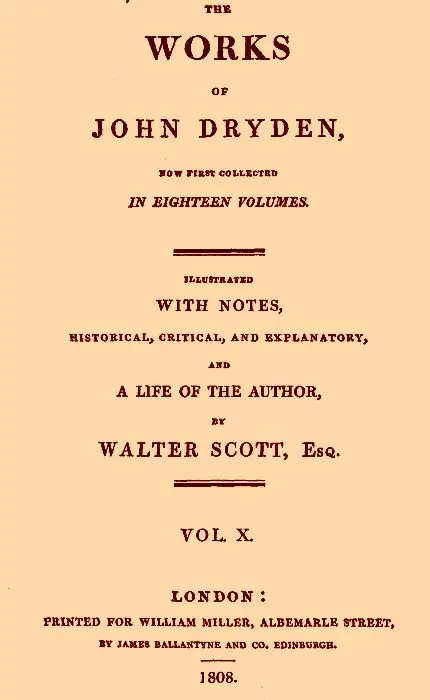
THE CLASSIC COLLECTION · 1633
"The Works of John Dryden, now first collected in eighteen volumes. Volume 10" is a collection of literary works, specifically poetry and essays, compiled from the writings of John Dryden and published during the early 19th century. This volume includes Dryden's poem "Religio Laici," which discusses theological matters and presents his perspectives on faith and religion amidst the complexities of his time. The works likely engage with themes of Christianity, sectarianism, and personal belief. The opening of this volume presents "Religio Laici," an epistolary poem where Dryden articulates his beliefs as a layman amidst a tumultuous religious landscape. He navigates the contentious debates between various religious factions, aiming for a rational exposition of faith that reconciles differing viewpoints. Dryden addresses objections to revealed religion versus rational inquiry, emphasizing the importance of individual reason tempered with faith. His arguments suggest a yearning for a balanced perspective, advocating for personal conviction while also acknowledging the authority of the Church of England despite recognizing the shortcomings within traditions.
Introduction adapted from the source catalogue; source summaries may be automatically generated.
Free to read · English · 135,998 words · No account needed
MAKE TIME FOR A GOOD BOOK
On by default. Untick to stop anonymous reading totals. Each page counts after 10 seconds in view. How this works.
Anonymous counting is on unless you have switched it off.
"St Gregory's Ritual, bound up in the same calve's-skin that the old gentleman, in St Luke, roasted at the return of his prodigal son.
"The quadrant that a Philistine tailor took the height of Goliah by, when he made him his last suit of clothes; for the giant being a man of extraordinary dimensions, it was impossible to do this in any other way than your designers use when they take the height of a country-steeple," &c. &c.--Reasons for Mr Bayes changing his Religion. See Preface.]
[Footnote 83: THE LAUREAT.
Jack Squab's history, in a little drawn,
Down to his evening from his morning dawn.
(Bought by Mr Luttrel, 24th October, 1687.)
Appear, thou mighty bard, to open view; Which yet, we must confess, you need not do. The labour to expose thee we may save; Thou standst upon thy own records a knave, Condemned to live in thy apostate rhymes, The curse of ours, and scoff of future times. Still tacking round with every turn of state, } Reverse to Shaftesbury, thy cursed fate } Is always, at a change, to come too late. } To keep his plots from coxcombs, was his care; His villainy was masked, and thine is bare. Wise men alone could guess at his design, } And could but guess, the threads were spun so fine; } But every purblind fool may see through thine. } Had Dick still kept the regal diadem, Thou hadst been poet laureat still to him, And, long ere now, in lofty verse proclaimed His high extraction, among princes famed; Diffused his glorious deed from pole to pole, Where winds can carry, or where waves can roll: Nay, had our Charles, by heaven's severe decree, Been found and murdered in the royal tree, Even thou hadst praised the fact; his father slain, Thou callest but gently breathing of a vein. Impious and villainous, to bless the blow } That laid at once three lofty nations low, } And gave the royal cause a fatal overthrow! } Scandal to all religions, new and old; } Scandal to them, where pardon's bought and sold, } And mortgaged happiness redeemed for gold. } Tell me, for 'tis a truth you must allow, Who ever changed more in one moon than thou? Even thy own Zimri was more stedfast known, He had but one religion, or had none. What sect of Christians is't thou hast not known, And at one time or other made thy own? A bristled baptist bred, and then thy strain Immaculate was far from sinful stain; No songs, in those blest times, thou didst produce, To brand and shame good manners out of use; The ladies had not then one b---- bob, Nor thou the courtly name of Poet Squab. Next, thy dull muse, an independant jade, On sacred tyranny fine stanzas made; Praised Noll, who even to both extremes did run, To kill the father and dethrone the son. When Charles came in, thou didst a convert grow, More by thy interest, than thy nature so; Under his 'livening beams thy laurels spread; } He first did place that wreath about thy head, } Kindly relieved thy wants, and gave thee bread. } Here 'twas thou mad'st thy bells of fancy chime, And choked the town with suffocating rhyme; Till heroes, formed by thy creating pen, Were grown as cheap and dull as other men. Flushed with success, full gallery and pit, Thou bravest all mankind with want of wit; Nay, in short time wer't grown so proud a ninny, As scarce to allow that Ben himself had any; But when the men of sense thy error saw, They checked thy muse, and kept the termagant in awe. To satire next thy talent was addrest, Fell foul on all, thy friends among the rest: Those who the oft'nest did thy wants supply, Abused, traduced, without a reason why; Nay, even thy royal patron was not spared, But an obscene, a santring wretch declared. Thy loyal libel we can still produce; Beyond example, and beyond excuse. O strange return to a forgiving king! But the warmed viper wears the greatest sting. Thy pension lost, and justly without doubt; When servants snarl, we ought to kick 'em out; They that disdain their benefactor's bread, No longer ought by bounty to be fed. That lost, the visor changed, you turn about, And straight a true blue Protestant crept out. The "Friar" now was writ; and some will say, They smell a mal-content through all the play. The Papist too was damned, unfit for trust, } Called treacherous, shameless, profligate, unjust; } And kingly power thought arbitrary lust. } This lasted till thou didst thy pension gain, And that changed both thy morals and thy strain. If to write contradictions nonsense be, Who has more nonsense in their works than thee? We'll mention but thy Layman's Faith and Hind: Who'll think both these, such clashing do we find, Could be the product of one single mind! Here thou wouldst charitable fain appear, Find fault that Athanasius was severe; Thy pity straight to cruelty is raised, And even the pious inquisition praised, And recommended to the present reign, "O happy countries, Italy and Spain!" Have we not cause, in thine own words, to say, } Let none believe what varies every day, } That never was, nor will be, at a stay? } Once heathens might be saved, you did allow, But not, it seems, we greater heathens now. The loyal church, that buoys the kingly line, Damned with a breath, but 'tis such a breath as thine. What credit to thy party can it be, To have gained so lewd a profligate as he, Strayed from our fold, makes us to laugh, not weep; We have but lost what was disgrace to keep. By them mistrusted, and to us a scorn; For 'tis but weakness at the best to turn. True, hadst thou left us in the former reign, } Y'had proved it was not wholly done for gain; } Now the meridian sun is not so plain. } Gold is thy god; for a substantial sum, } Thou to the Turk wouldst run away from Rome, } And sing his holy expedition against Christendom. } But, to conclude; blush with a lasting red, If thou'rt not moved by what's already said, To see thy boars, bears, buzzards, wolves, and owls, And all thy other beasts and other fowls, Routed by two poor mice (unequal fight!); But easy 'tis to conquer in the right. See, there a youth, (a shame to thy gray hairs) Make a mere dunce of all thy threescore years. What in that tedious poem hast thou done, But crammed all Esop's fables into one? But why do I the precious minutes spend On him, that would much rather hang than mend? No, wretch, continue still just as thou art, Thou'rt now in this last scene that crowns thy part. To purchase favour veer with every gale, } And against interest never cease to rail, } Though thou'rt the only proof how interest can prevail. } ]
Your reading position is saved on this browser. Take it to another device with a library code. Reading pages adapt to text, rather than matching a printed edition.
BEHIND THE BOOK
This eBook is for the use of anyone anywhere in the United States and most other parts of the world at no cost and with almost no restrictions whatsoever. You may copy it, give it away or re-use it under the terms of the Project Gutenberg License included with this eBook or online at www.gutenberg.org. If you are not located in the United States, you will have to check the laws of the country where you are located before using this eBook. Read the source licence.
The original source file, including credits and licence, is retained by this library. Request an original-format copy at no charge. Please include the book title and Project Gutenberg identifier #51652.
KEEP YOUR CURIOSITY GOING
David Patterson (Spirit) Hatch

David Patterson (Spirit) Hatch

David Patterson (Spirit) Hatch

Ralph Waldo Emerson

Maurice Baring

Oscar Wilde & James McNeill Whistler