
Last letters from the living dead man
David Patterson (Spirit) Hatch
THE CLASSIC COLLECTION · 1633
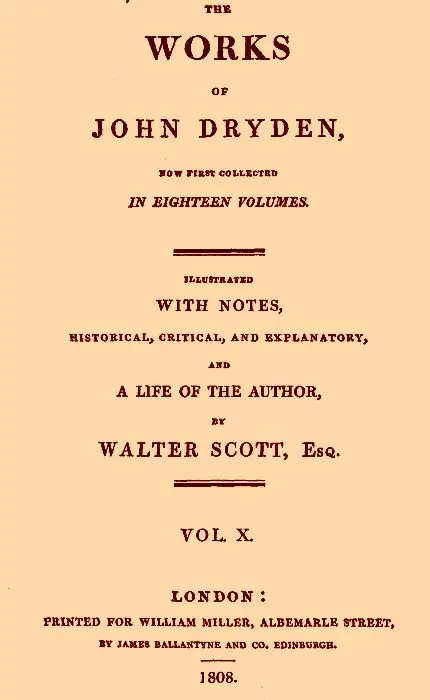
"The Works of John Dryden, now first collected in eighteen volumes. Volume 10" is a collection of literary works, specifically poetry and essays, compiled from the writings of John Dryden and published during the early 19th century. This volume includes Dryden's poem "Religio Laici," which discusses theological matters and presents his perspectives on faith and religion amidst the complexities of his time. The works likely engage with themes of Christianity, sectarianism, and personal belief. The opening of this volume presents "Religio Laici," an epistolary poem where Dryden articulates his beliefs as a layman amidst a tumultuous religious landscape. He navigates the contentious debates between various religious factions, aiming for a rational exposition of faith that reconciles differing viewpoints. Dryden addresses objections to revealed religion versus rational inquiry, emphasizing the importance of individual reason tempered with faith. His arguments suggest a yearning for a balanced perspective, advocating for personal conviction while also acknowledging the authority of the Church of England despite recognizing the shortcomings within traditions.
Introduction adapted from the source catalogue; source summaries may be automatically generated.
Free to read · English · 135,998 words · No account needed
MAKE TIME FOR A GOOD BOOK
On by default. Untick to stop anonymous reading totals. Each page counts after 10 seconds in view. How this works.
Anonymous counting is on unless you have switched it off.
A Poem, with so bold a title, and a name prefixed from which the handling of so serious a subject would not be expected, may reasonably oblige the author to say somewhat in defence, both of himself and of his undertaking. In the first place, if it be objected to me, that, being a layman, I ought not to have concerned myself with speculations, which belong to the profession of divinity; I could answer, that perhaps laymen, with equal advantages of parts and knowledge, are not the most incompetent judges of sacred things; but, in the due sense of my own weakness, and want of learning, I plead not this; I pretend not to make myself a judge of faith in others, but only to make a confession of my own. I lay no unhallowed hand upon the ark, but wait on it, with the reverence that becomes me, at a distance. In the next place, I will ingenuously confess, that the helps I have used in this small treatise, were many of them taken from the works of our own reverend divines of the church of England; so that the weapons with which I combat irreligion, are already consecrated; though I suppose they may be taken down as lawfully as the sword of Goliah was by David, when they are to be employed for the common cause against the enemies of piety. I intend not by this to entitle them to any of my errors, which yet I hope are only those of charity to mankind; and such as my own charity has caused me to commit, that of others may more easily excuse. Being naturally inclined to scepticism in philosophy, I have no reason to impose my opinions in a subject which is above it; but whatever they are, I submit them with all reverence to my mother church, accounting them no further mine, than as they are authorised, or at least uncondemned, by her. And, indeed, to secure myself on this side, I have used the necessary precaution of shewing this paper before it was published to a judicious and learned friend; a man indefatigably zealous in the service of the church and state, and whose writings have highly deserved of both. He was pleased to approve the body of the discourse, and I hope he is more my friend than to do it out of complaisance: It is true, he had too good a taste to like it all; and, amongst some other faults, recommended to my second view, what I have written, perhaps too boldly, on St Athanasius, which he advised me wholly to omit. I am sensible enough, that I had done more prudently to have followed his opinion; but then I could not have satisfied myself, that I had done honestly not to have written what was my own. It has always been my thought, that heathens, who never did, nor without miracle could, hear of the name of Christ, were yet in a possibility of salvation. Neither will it enter easily into my belief, that before the coming of our Saviour, the whole world, excepting only the Jewish nation, should lie under the inevitable necessity of everlasting punishment, for want of that revelation, which was confined to so small a spot of ground as that of Palestine. Among the sons of Noah, we read of one only who was accursed; and, if a blessing, in the ripeness of time, was reserved for Japhet, of whose progeny we are, it seems unaccountable to me, why so many generations of the same offspring, as preceded our Saviour in the flesh, should be all involved in one common condemnation, and yet that their posterity should be entitled to the hopes of salvation; as if a bill of exclusion had passed only on the fathers, which debarred not the sons from their succession: or, that so many ages had been delivered over to hell, and so many reserved for heaven, and that the devil had the first choice, and God the next. Truly I am apt to think, that the revealed religion, which was taught by Noah to all his sons, might continue for some ages in the whole posterity. That afterwards it was included wholly in the family of Shem, is manifest; but when the progenies of Cham and Japhet swarmed into colonies, and those colonies were subdivided into many others, in process of time their descendants lost, by little and little, the primitive and purer rites of divine worship, retaining only the notion of one deity; to which succeeding generations added others; for men took their degrees in those ages from conquerors to gods. Revelation being thus eclipsed to almost all mankind, the light of nature, as the next in dignity, was substituted; and that is it which St Paul concludes to be the rule of the heathens, and by which they are hereafter to be judged. If my supposition be true, then the consequence, which I have assumed in my poem, may be also true; namely, that Deism, or the principles of natural worship, are only faint remnants, or dying flames, of revealed religion, in the posterity of Noah; and that our modern philosophers, nay, and some of our philosophising divines, have too much exalted the faculties of our souls, when they have maintained, that, by their force, mankind has been able to find out, that there is one supreme agent, or intellectual being, which we call God; that praise and prayer are his due worship; and the rest of those deducements, which I am confident are the remote effects of revelation, and unattainable by our discourse, I mean as simply considered, and without the benefit of divine illumination. So that we have not lifted up ourselves to God, by the weak pinions of our reason, but he has been pleased to descend to us; and what Socrates said of him, what Plato writ, and the rest of the heathen philosophers of several nations, is all no more than the twilight of revelation, after the sun of it was set in the race of Noah. That there is something above us, some principle of motion, our reason can apprehend, though it cannot discover what it is by its own virtue: and, indeed, it is very improbable that we, who, by the strength of our faculties, cannot enter into the knowledge of any being, not so much as of our own, should be able to find out, by them, that supreme nature, which we cannot otherwise define, than by saying it is infinite; as if infinite were definable, or infinity a subject for our narrow understanding. They, who would prove religion by reason, do but weaken the cause which they endeavour to support: it is to take away the pillars from our faith, and to prop it only with a twig; it is to design a tower, like that of Babel, which, if it were possible, as it is not, to reach heaven, would come to nothing by the confusion of the workmen. For every man is building a several way; impotently conceited of his own model and his own materials, reason is always striving, and always at a loss; and of necessity it must so come to pass, while it is exercised about that which is not its proper object. Let us be content, at last, to know God by his own methods; at least, so much of him as he is pleased to reveal to us in the sacred Scriptures. To apprehend them to be the word of God is all our reason has to do; for all beyond it is the work of faith, which is the seal of heaven impressed upon our human understanding.
Your reading position is saved on this browser. Take it to another device with a library code. Reading pages adapt to text, rather than matching a printed edition.
BEHIND THE BOOK
This eBook is for the use of anyone anywhere in the United States and most other parts of the world at no cost and with almost no restrictions whatsoever. You may copy it, give it away or re-use it under the terms of the Project Gutenberg License included with this eBook or online at www.gutenberg.org. If you are not located in the United States, you will have to check the laws of the country where you are located before using this eBook. Read the source licence.
The original source file, including credits and licence, is retained by this library. Request an original-format copy at no charge. Please include the book title and Project Gutenberg identifier #51652.
KEEP YOUR CURIOSITY GOING
David Patterson (Spirit) Hatch

David Patterson (Spirit) Hatch

David Patterson (Spirit) Hatch

Ralph Waldo Emerson

Maurice Baring

Oscar Wilde & James McNeill Whistler