
Last letters from the living dead man
David Patterson (Spirit) Hatch
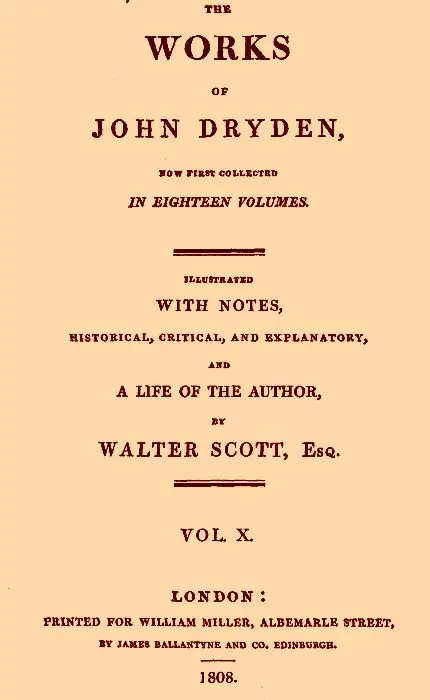
THE CLASSIC COLLECTION · 1633
"The Works of John Dryden, now first collected in eighteen volumes. Volume 10" is a collection of literary works, specifically poetry and essays, compiled from the writings of John Dryden and published during the early 19th century. This volume includes Dryden's poem "Religio Laici," which discusses theological matters and presents his perspectives on faith and religion amidst the complexities of his time. The works likely engage with themes of Christianity, sectarianism, and personal belief. The opening of this volume presents "Religio Laici," an epistolary poem where Dryden articulates his beliefs as a layman amidst a tumultuous religious landscape. He navigates the contentious debates between various religious factions, aiming for a rational exposition of faith that reconciles differing viewpoints. Dryden addresses objections to revealed religion versus rational inquiry, emphasizing the importance of individual reason tempered with faith. His arguments suggest a yearning for a balanced perspective, advocating for personal conviction while also acknowledging the authority of the Church of England despite recognizing the shortcomings within traditions.
Introduction adapted from the source catalogue; source summaries may be automatically generated.
Free to read · English · 135,998 words · No account needed
MAKE TIME FOR A GOOD BOOK
On by default. Untick to stop anonymous reading totals. Each page counts after 10 seconds in view. How this works.
Anonymous counting is on unless you have switched it off.
Shadwell translated, or rather imitated, Moliere's "L'Avare," under the title of "The Miser." In Langbaine's opinion, he has greatly improved upon his original; but in this, as in other cases, the critic is probably singular. "The Miser" was printed in 1672.
"The Humorists" was a play professedly written to expose the reigning vices of the age; but as it was supposed to contain many direct personal allusions, it was unfavourably received by the audience. Shadwell, by way, I suppose, of insinuating to the readers an accurate notion of the characters, or humours, which he means to represent, is, in this and other pieces, at great pains to give a long and minute account of each individual in the dramatis personæ. Thus we have have in "The Humorists,"
"Crazy,--One that is in pox, in debt, and all the misfortunes that can be; and, in the midst of all, in love with most women, and thinks most women in love with him.
"Drybob,--A fantastic coxcomb, that makes it his business to speak fine things and wit, as he thinks; and always takes notice, or makes others take notice, of any thing he thinks well said.
"Brisk,--A brisk, airy, fantastic, singing, dancing coxcomb, that sets up for a well-bred man, and a man of honour; but mistakes in every thing, and values himself only upon the vanity and foppery of gentlemen."
I do not know what to make of the "Hypocrites." Shadwell wrote no play so entitled; nor is it likely he gave any assistance to Medbourne, who translated the famous "Tartuffe" of Moliere, for they were of different opinions in religion and politics. Perhaps Dryden means the characters of the Irish priest and Tory chaplain in "The Lancashire Witches."
Raymond is a character in "The Humorists," described in the dramatis personæ as a "gentleman of wit and honour." Bruce a similar person in "The Virtuoso," characterized as a "gentleman of wit and sense." In these, and in all other characters where wit and an easy style were requisite, Shadwell failed totally. His forte lay in broad, strong comic painting.
Note XII.
Ogleby.--P. 436.
This gentleman, whose name, thanks to our author and Pope, has become almost proverbial for a bad poet, was originally a Scottish dancing-master, when probably Scottish dancing was not so fashionable as at present, and afterwards master of the revels in Ireland. He translated "The Iliad," "The Odyssey," "The Æneid," and "Æsop's Fables," into verse; and his versions were splendidly adorned with sculpture. He also wrote three epic poems, one of which was fortunately burned in the fire of London. Moreover, he conducted the ceremony of Charles the Second's coronation,[448] and erected a theatre in Dublin.
Your reading position is saved on this browser. Take it to another device with a library code. Reading pages adapt to text, rather than matching a printed edition.
BEHIND THE BOOK
This eBook is for the use of anyone anywhere in the United States and most other parts of the world at no cost and with almost no restrictions whatsoever. You may copy it, give it away or re-use it under the terms of the Project Gutenberg License included with this eBook or online at www.gutenberg.org. If you are not located in the United States, you will have to check the laws of the country where you are located before using this eBook. Read the source licence.
The original source file, including credits and licence, is retained by this library. Request an original-format copy at no charge. Please include the book title and Project Gutenberg identifier #51652.
KEEP YOUR CURIOSITY GOING
David Patterson (Spirit) Hatch

David Patterson (Spirit) Hatch

David Patterson (Spirit) Hatch

Ralph Waldo Emerson

Maurice Baring

Oscar Wilde & James McNeill Whistler