
Last letters from the living dead man
David Patterson (Spirit) Hatch
THE CLASSIC COLLECTION · 1633
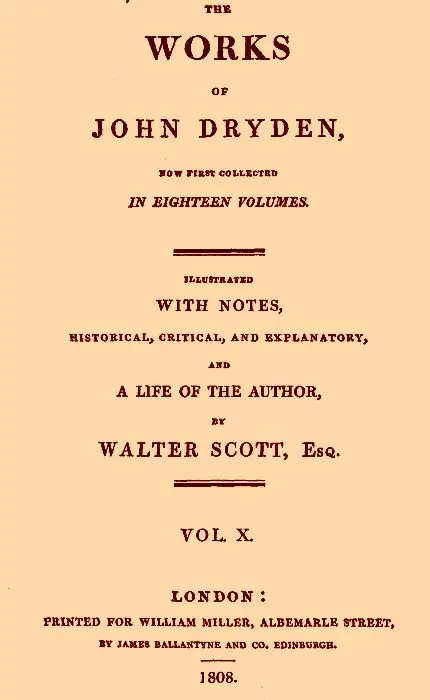
"The Works of John Dryden, now first collected in eighteen volumes. Volume 10" is a collection of literary works, specifically poetry and essays, compiled from the writings of John Dryden and published during the early 19th century. This volume includes Dryden's poem "Religio Laici," which discusses theological matters and presents his perspectives on faith and religion amidst the complexities of his time. The works likely engage with themes of Christianity, sectarianism, and personal belief. The opening of this volume presents "Religio Laici," an epistolary poem where Dryden articulates his beliefs as a layman amidst a tumultuous religious landscape. He navigates the contentious debates between various religious factions, aiming for a rational exposition of faith that reconciles differing viewpoints. Dryden addresses objections to revealed religion versus rational inquiry, emphasizing the importance of individual reason tempered with faith. His arguments suggest a yearning for a balanced perspective, advocating for personal conviction while also acknowledging the authority of the Church of England despite recognizing the shortcomings within traditions.
Introduction adapted from the source catalogue; source summaries may be automatically generated.
Free to read · English · 135,998 words · No account needed
MAKE TIME FOR A GOOD BOOK
On by default. Untick to stop anonymous reading totals. Each page counts after 10 seconds in view. How this works.
Anonymous counting is on unless you have switched it off.
I have had so frequently to call the attention of my reader to the sonorous and emphatic effect of Dryden's versification, that it is almost ridiculous to repeat epithets which apply to every poem which succeeded his Annus Mirabilis; yet I cannot but remark, that the mock heroic may be said to have owed its rise to our author, and that there is hardly any poem, before "Mac-Flecnoe," in which it has been employed with all its qualities of grave and pompous irony, expressed in solemn and sounding verse.
It is no inconsiderable part of the merit of "Mac-Flecnoe," that it led the way to the "Dunciad:" yet, while we acknowledge the more copious and variegated flow of Pope's satire, we must not forget, that, independent of the merit of originality, always inestimable, Dryden's poem claims that of a close and more compact fable, of a single and undisturbed aim. Pope's ridicule and sarcasm is scattered so wide, and among such a number of authors, that it resembles small shot discharged at random among a crowd; while that of Dryden, like a single well-directed bullet, prostrates the individual object against whom it was directed. Besides, the reader is apt to sympathise with the degree of the satirist's provocation, which, in Dryden's case, cannot be disputed; whereas Pope sometimes confounds those, from whom he had received gross incivility, with others who had given him no offence, and with some whose characters were above his accusation. To posterity, the "Mac-Flecnoe" possesses a decided superiority over the "Dunciad," for a very few facts make us master of the argument; while that of the latter poem, excepting the Sixth Book, where the satire is more general, requires a note at every tenth line to render it even intelligible.
Mr Malone has given us the title of the first edition of "Mac-Flecnoe," which the present Editor has never seen, as indeed it is of the last degree of rarity. It was published not by Tonson, but by D. Green, and entitled, "Mac-Flecnoe, or a Satire on the True-blue[415] Protestant Poet, T. S.; by the Author of Absalom and Achitophel." It consisted only of one sheet and a half, and was sold for twopence. The satire was too personal, and too poignant, to fail in attracting immediate attention, and accordingly the poem was quickly sold off. It was not republished until it appeared in Tonson's first Miscellany, in 1684, with a few slight alterations, intended either to point particular verses, or to correct errors of the press, or pen. It must have been generally known, that Dryden was the author of this satire, both because it is stated in the title-page to be by the author of "Absalom and Achitophel," and because there existed no contemporary poet to whom so masterly a production could have been ascribed, even with remote probability; yet Shadwell, in his dedication of the tenth satire of Juvenal, (a most miserable performance,) says, that Dryden, when he taxed him with being the author, "denied it with all the execrations he could think of;" an accusation which was echoed by Brown, though apparently upon the authority of Shadwell alone.[416] From this averment, which is probably made far too broadly, we can only infer, that Dryden, like Swift in the same predicament, left his adversary to prove what he had no title to call upon him to confess; for that he seriously meant to disavow a performance, of which he had from the very beginning sufficiently avouched himself the author, can hardly be supposed for a moment. It has indeed been noticed, that our author has omitted this poem, as well as the "Eulogy on Cromwell," in a list of his plays and poems subjoined to one of his plays; but Dryden might not think fit to admit a personal, and what he probably considered as a fugitive satire, into a formal list of his poetry. We know he entertained a conscious sense of his dignity in this respect; for, excepting in a slight and passing sarcasm, he never deigned to answer any of his literary adversaries, excepting Settle and Shadwell; and he might possibly think, on reflection, that he had done the latter too much honour in making him the subject of a separate and laboured poem. Mr Malone also conceives, that he might be with-held from inserting this poem in an authoritative list of his works, by delicacy towards Dorset, his recent benefactor, who had thought Shadwell worthy of the laurel of which our poet had been divested at the Revolution. Be it as it may, he was afterwards so far from disowning the poem, that, in the Essay on Satire, he gives it, with "Absalom and Achitophel," as instances of his own attempts at the Varronian satire.
Your reading position is saved on this browser. Take it to another device with a library code. Reading pages adapt to text, rather than matching a printed edition.
BEHIND THE BOOK
This eBook is for the use of anyone anywhere in the United States and most other parts of the world at no cost and with almost no restrictions whatsoever. You may copy it, give it away or re-use it under the terms of the Project Gutenberg License included with this eBook or online at www.gutenberg.org. If you are not located in the United States, you will have to check the laws of the country where you are located before using this eBook. Read the source licence.
The original source file, including credits and licence, is retained by this library. Request an original-format copy at no charge. Please include the book title and Project Gutenberg identifier #51652.
KEEP YOUR CURIOSITY GOING
David Patterson (Spirit) Hatch

David Patterson (Spirit) Hatch

David Patterson (Spirit) Hatch

Ralph Waldo Emerson

Maurice Baring

Oscar Wilde & James McNeill Whistler