
Last letters from the living dead man
David Patterson (Spirit) Hatch
THE CLASSIC COLLECTION · 1633
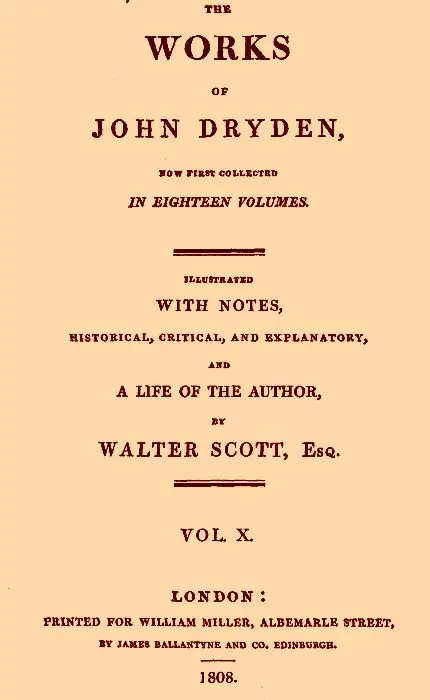
"The Works of John Dryden, now first collected in eighteen volumes. Volume 10" is a collection of literary works, specifically poetry and essays, compiled from the writings of John Dryden and published during the early 19th century. This volume includes Dryden's poem "Religio Laici," which discusses theological matters and presents his perspectives on faith and religion amidst the complexities of his time. The works likely engage with themes of Christianity, sectarianism, and personal belief. The opening of this volume presents "Religio Laici," an epistolary poem where Dryden articulates his beliefs as a layman amidst a tumultuous religious landscape. He navigates the contentious debates between various religious factions, aiming for a rational exposition of faith that reconciles differing viewpoints. Dryden addresses objections to revealed religion versus rational inquiry, emphasizing the importance of individual reason tempered with faith. His arguments suggest a yearning for a balanced perspective, advocating for personal conviction while also acknowledging the authority of the Church of England despite recognizing the shortcomings within traditions.
Introduction adapted from the source catalogue; source summaries may be automatically generated.
Free to read · English · 135,998 words · No account needed
MAKE TIME FOR A GOOD BOOK
On by default. Untick to stop anonymous reading totals. Each page counts after 10 seconds in view. How this works.
Anonymous counting is on unless you have switched it off.
The old Play, to which this prologue was prefixed upon its revival, was originally acted in 1634, three or four years after the appearance of Jonson's "Alchemist;" to which, therefore, it could not possibly afford any hint. Dryden, observing the resemblance between the plays, took the plagiarism for granted, because the style of "Albumazar" is certainly the most antiquated. This appearance of antiquity is, however, only a consequence of the vein of pedantry which runs through the whole piece. It was written by ---- Tomkins, a scholar of Trinity College, and acted before King James VI. by the gentlemen of that house, 9th March, 1614. It is, upon the whole, a very excellent play; yet the author, whether consulting his own taste, or that of our British Solomon, before whom it was to be represented, has contrived to give it an air of such learned stiffness, that it much more resembles the translation of a play from Terence or Plautus, than an original English composition. By this pedantic affectation, the humour of the play is completely smothered; and although there are several very excellent comic situations in the action, yet neither the attempt to revive it in Dryden's time, nor those which followed in 1748 and 1773, met with any success.
As Dryden had imputed, very rashly, however, and groundlessly, the guilt of plagiarism to Jonson, he made this supposed crime the introduction to a similar slur on Shadwell, who at that time seems to have been possessed of the laurel; a circumstance which ascertains the date of the prologue to be posterior to the Revolution.
To say this comedy pleased long ago,
Is not enough to make it pass you now.
Yet, gentlemen, your ancestors had wit,
When few men censured, and when fewer writ.
And Jonson, of those few the best, chose this,
As the best model of his master-piece:
Subtle was got by our Albumazar,
That Alchymist by this Astrologer;
Here he was fashioned, and we may suppose,
He liked the fashion well, who wore the clothes.
But Ben made nobly his what he did mould;
What was another's lead, becomes his gold:
Like an unrighteous conqueror he reigns,
Yet rules that well, which he unjustly gains.
But this our age such authors does afford,
As make whole plays, and yet scarce write one word;
Who, in this anarchy of wit, rob all,
And what's their plunder, their possession call;
Who, like bold padders, scorn by night to prey,
But rob by sun-shine, in the face of day:
Nay, scarce the common ceremony use
Of, "Stand, Sir, and deliver up your Muse;"
But knock the poet down, and, with a grace,
Mount Pegasus before the owner's face.
Faith, if you have such country Toms abroad,[406]
'Tis time for all true men to leave that road.
Yet it were modest, could it but be said,
They strip the living, but these rob the dead;
Dare with the mummies of the Muses play,
And make love to them the Egyptian way;
Or, as a rhiming author would have said,
Join the dead living to the living dead.
Such men in poetry may claim some part,
They have the license, though they want the art;
And might, where theft was praised, for laureats stand;[407]
Poets, not of the head, but of the hand.
They make the benefits of others studying,
Much like the meals of politic Jack-Pudding,
Whose dish to challenge no man has the courage;
'Tis all his own, when once he has spit i'the porridge.
But, gentlemen, you're all concerned in this;
You are in fault for what they do amiss;
For they their thefts still undiscovered think,
And durst not steal, unless you please to wink.
Perhaps, you may award by your decree,
They should refund,--but that can never be;
For, should you letters of reprisal seal,
These men write that which no man else would steal.
Your reading position is saved on this browser. Take it to another device with a library code. Reading pages adapt to text, rather than matching a printed edition.
BEHIND THE BOOK
This eBook is for the use of anyone anywhere in the United States and most other parts of the world at no cost and with almost no restrictions whatsoever. You may copy it, give it away or re-use it under the terms of the Project Gutenberg License included with this eBook or online at www.gutenberg.org. If you are not located in the United States, you will have to check the laws of the country where you are located before using this eBook. Read the source licence.
The original source file, including credits and licence, is retained by this library. Request an original-format copy at no charge. Please include the book title and Project Gutenberg identifier #51652.
KEEP YOUR CURIOSITY GOING
David Patterson (Spirit) Hatch

David Patterson (Spirit) Hatch

David Patterson (Spirit) Hatch

Ralph Waldo Emerson

Maurice Baring

Oscar Wilde & James McNeill Whistler