
Last letters from the living dead man
David Patterson (Spirit) Hatch
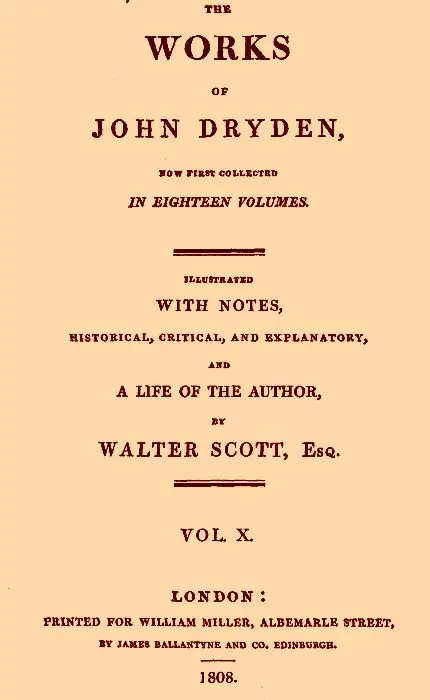
THE CLASSIC COLLECTION · 1633
"The Works of John Dryden, now first collected in eighteen volumes. Volume 10" is a collection of literary works, specifically poetry and essays, compiled from the writings of John Dryden and published during the early 19th century. This volume includes Dryden's poem "Religio Laici," which discusses theological matters and presents his perspectives on faith and religion amidst the complexities of his time. The works likely engage with themes of Christianity, sectarianism, and personal belief. The opening of this volume presents "Religio Laici," an epistolary poem where Dryden articulates his beliefs as a layman amidst a tumultuous religious landscape. He navigates the contentious debates between various religious factions, aiming for a rational exposition of faith that reconciles differing viewpoints. Dryden addresses objections to revealed religion versus rational inquiry, emphasizing the importance of individual reason tempered with faith. His arguments suggest a yearning for a balanced perspective, advocating for personal conviction while also acknowledging the authority of the Church of England despite recognizing the shortcomings within traditions.
Introduction adapted from the source catalogue; source summaries may be automatically generated.
Free to read · English · 135,998 words · No account needed
MAKE TIME FOR A GOOD BOOK
On by default. Untick to stop anonymous reading totals. Each page counts after 10 seconds in view. How this works.
Anonymous counting is on unless you have switched it off.
How Pennsylvania's air agrees with Quakers,
And Carolina's with Associators;
Both e'en too good for madmen and for traitors.[390]
Truth is, our land with saints is so run o'er,
And every age produces such a store,
That now there's need of two New Englands more.
What's this, you'll say, to us, and our vocation? Only thus much, that we have left our station, And made this theatre our new plantation.
The factious natives never could agree;
But aiming, as they called it, to be free,
Those play-house Whigs set up for property.[391]
Some say, they no obedience paid of late;
But would new tears and jealousies create,
Till topsy-turvy they had turned the state.
Plain sense, without the talent of foretelling, Might guess 'twould end in downright knocks and quelling; For seldom comes there better of rebelling.
When men will, needlessly, their freedom barter For lawless power, sometimes they catch a Tartar;-- There's a damned word that rhimes to this, called Charter.[392]
But, since the victory with us remains,
You shall be called to twelve in all our gains,
If you'll not think us saucy for our pains.
Old men shall have good old plays to delight them; And you, fair ladies and gallants, that slight them, We'll treat with good new plays, if our new wits can write them.
We'll take no blundering verse, no fustain tumor, No dribbling love, from this or that presumer; No dull fat fool shammed on the stage for humour:[393]
For, faith, some of them such vile stuff have made, As none but fools or fairies ever played; But 'twas, as shopmen say, to force a trade.
We've given you tragedies, all sense defying,
And singing men, in woful metre dying;
This 'tis when heavy lubbers will be flying.
All these disasters we will hope to weather; We bring you none of our old lumber hither; Whig poets and Whig sheriffs[394] may hang together.
[Footnote 388: In this last point Colley is, however, mistaken. See p.
328.]
[Footnote 389: The American colonies, from the time of the first troubles in the reign of Charles I., continued to be the place of refuge to all who were discontented with the government of the time, or experienced oppression under it. The settlers did not fail to excite their countrymen to emigration, by exaggerated accounts of the fertility and advantages of their places of refuge, which were circulated by the hawkers.]
Your reading position is saved on this browser. Take it to another device with a library code. Reading pages adapt to text, rather than matching a printed edition.
BEHIND THE BOOK
This eBook is for the use of anyone anywhere in the United States and most other parts of the world at no cost and with almost no restrictions whatsoever. You may copy it, give it away or re-use it under the terms of the Project Gutenberg License included with this eBook or online at www.gutenberg.org. If you are not located in the United States, you will have to check the laws of the country where you are located before using this eBook. Read the source licence.
The original source file, including credits and licence, is retained by this library. Request an original-format copy at no charge. Please include the book title and Project Gutenberg identifier #51652.
KEEP YOUR CURIOSITY GOING
David Patterson (Spirit) Hatch

David Patterson (Spirit) Hatch

David Patterson (Spirit) Hatch

Ralph Waldo Emerson

Maurice Baring

Oscar Wilde & James McNeill Whistler