
Last letters from the living dead man
David Patterson (Spirit) Hatch
THE CLASSIC COLLECTION · 1633
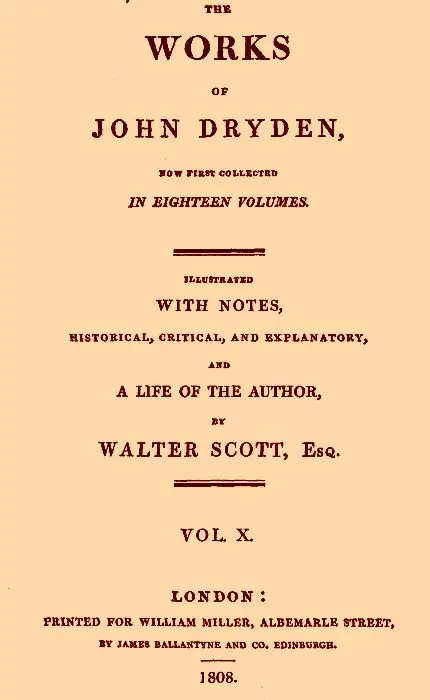
"The Works of John Dryden, now first collected in eighteen volumes. Volume 10" is a collection of literary works, specifically poetry and essays, compiled from the writings of John Dryden and published during the early 19th century. This volume includes Dryden's poem "Religio Laici," which discusses theological matters and presents his perspectives on faith and religion amidst the complexities of his time. The works likely engage with themes of Christianity, sectarianism, and personal belief. The opening of this volume presents "Religio Laici," an epistolary poem where Dryden articulates his beliefs as a layman amidst a tumultuous religious landscape. He navigates the contentious debates between various religious factions, aiming for a rational exposition of faith that reconciles differing viewpoints. Dryden addresses objections to revealed religion versus rational inquiry, emphasizing the importance of individual reason tempered with faith. His arguments suggest a yearning for a balanced perspective, advocating for personal conviction while also acknowledging the authority of the Church of England despite recognizing the shortcomings within traditions.
Introduction adapted from the source catalogue; source summaries may be automatically generated.
Free to read · English · 135,998 words · No account needed
MAKE TIME FOR A GOOD BOOK
On by default. Untick to stop anonymous reading totals. Each page counts after 10 seconds in view. How this works.
Anonymous counting is on unless you have switched it off.
The "Loyal Brother, or the Persian Prince," was the first play of Southerne, afterwards so deservedly famous as a tragic poet. It is said to be borrowed from a novel, called, "Tachmas, Prince of Persia." The character of the Loyal Brother is obviously designed as a compliment to the Duke of York, whose adherents and opponents now divided the nation. Southerne was at this time but three-and-twenty. It is said, that, upon offering Dryden five guineas for the following prologue, which had hitherto been the usual compliment made him for such favours, the bard returned the money; and added, "not that I do so out of disrespect to you, young man, but the players have had my goods too cheap. In future, I must have ten guineas." Southerne was the first poet who drew large profit from the author's nights; insomuch, that he is said to have cleared by one play seven hundred pounds; a circumstance that greatly surprised Dryden, who seldom gained by his best pieces more than a seventh part of the sum. From these circumstances, Pope, in his verses to Southerne on his birth-day, distinguishes him as
----Tom, whom heaven sent down to raise
The price of prologues and of plays.
The prologue, as might be expected, is very severe upon the Whigs; and alludes to all the popular subjects of dispute between the factions. The refusal of supplies, and the petition against the king's guards, are slightly noticed, but the great pope-burning is particularly dwelt upon; and probably the reader will be pleased with an opportunity of comparing the account in the prologue with that given by Roger North, who seems to have entertained the same fear with Dryden, that the rabble might chuse to cry, God save the king, at Whitehall.
"But, to return to our tumults.--After it was found that there was to be a reinforcement at the next anniversary, which was in 1682, it is not to be thought that the court was asleep, or that the king would not endeavour to put a stop to this brutal outrage. His majesty thought fit to take the ordinary regular course; which was, to send for the lord mayor, &c. and to charge him to prevent riots in the city. So the lord mayor and sheriffs attended the king in council; and there they were told, that dangerous tumults and disorders were designed in the city upon the 17th of November next, at night, on pretence of bonfires; and his majesty expected that they, who were entrusted with the government of the city, for keeping the peace, should, by their authority, prevent all such riotous disorders, which, permitted to go on, was a misdemeanour of their whole body. Then one of them came forward, and, in a whining tone, told the king, that they did not apprehend any danger to his majesty, or the city, from these bonfires; there was an ardour of the people against popery, which they delighted to express in that manner, but meant no harm: And, if they should go about to hinder them, it would be taken as if they favoured popery; and, considering the great numbers, and their zeal, it might make them outrageous, which, let alone, would not be; and perhaps they themselves might not be secure in resisting them, no not in their own houses; and they hoped his majesty would not have them so exposed, so long as they could assure his majesty that care should be taken, that, if they went about any ill thing, they should be prevented: or to this purpose, as I had it from undoubted authority. This was the godly care they had of the public peace, and the repose of the city; by which the king saw plainly what they were, and what was to be expected from them. There wanted not those who suggested the sending regiments into the city; but the king (always witty) said, he did not love to play with his horse. But his majesty ordered that a party of horse should be drawn up, and make a strong guard on the outside of Temple-Bar; and all the other guards were ordered to be in a posture at a minute's warning; and so he took a middle, but secure and inoffensive way; and these guards did not break up till all the rout was over.
Your reading position is saved on this browser. Take it to another device with a library code. Reading pages adapt to text, rather than matching a printed edition.
BEHIND THE BOOK
This eBook is for the use of anyone anywhere in the United States and most other parts of the world at no cost and with almost no restrictions whatsoever. You may copy it, give it away or re-use it under the terms of the Project Gutenberg License included with this eBook or online at www.gutenberg.org. If you are not located in the United States, you will have to check the laws of the country where you are located before using this eBook. Read the source licence.
The original source file, including credits and licence, is retained by this library. Request an original-format copy at no charge. Please include the book title and Project Gutenberg identifier #51652.
KEEP YOUR CURIOSITY GOING
David Patterson (Spirit) Hatch

David Patterson (Spirit) Hatch

David Patterson (Spirit) Hatch

Ralph Waldo Emerson

Maurice Baring

Oscar Wilde & James McNeill Whistler