
Last letters from the living dead man
David Patterson (Spirit) Hatch
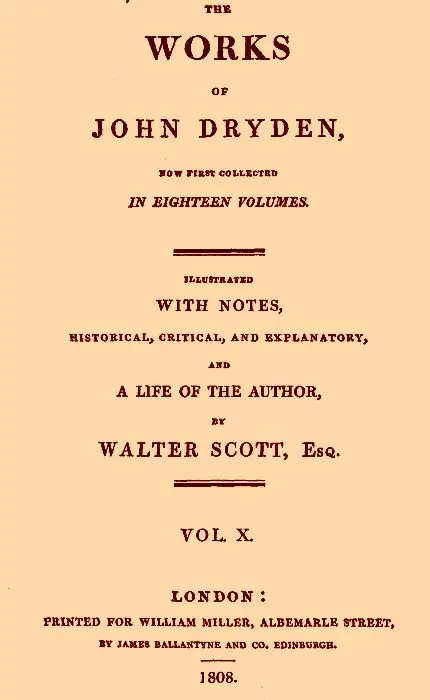
THE CLASSIC COLLECTION · 1633
"The Works of John Dryden, now first collected in eighteen volumes. Volume 10" is a collection of literary works, specifically poetry and essays, compiled from the writings of John Dryden and published during the early 19th century. This volume includes Dryden's poem "Religio Laici," which discusses theological matters and presents his perspectives on faith and religion amidst the complexities of his time. The works likely engage with themes of Christianity, sectarianism, and personal belief. The opening of this volume presents "Religio Laici," an epistolary poem where Dryden articulates his beliefs as a layman amidst a tumultuous religious landscape. He navigates the contentious debates between various religious factions, aiming for a rational exposition of faith that reconciles differing viewpoints. Dryden addresses objections to revealed religion versus rational inquiry, emphasizing the importance of individual reason tempered with faith. His arguments suggest a yearning for a balanced perspective, advocating for personal conviction while also acknowledging the authority of the Church of England despite recognizing the shortcomings within traditions.
Introduction adapted from the source catalogue; source summaries may be automatically generated.
Free to read · English · 135,998 words · No account needed
MAKE TIME FOR A GOOD BOOK
On by default. Untick to stop anonymous reading totals. Each page counts after 10 seconds in view. How this works.
Anonymous counting is on unless you have switched it off.
[Footnote 337: This seems to be an allusion to the recent death of Mr Scroop; a man of fortune, who, about this time, was stabbed in the theatre at Dorset-Gardens by Sir Thomas Armstrong, afterwards the confidential friend of the Duke of Monmouth. Langbaine says, he witnessed this real tragedy, which happened during the representation of "Macbeth," as altered and revised by D'Avenant in 1674. Mr Scroop died immediately after his removal into a neighbouring house.]
[Footnote 338: Alluding to the recent establishment in
Lincoln's-Inn-Fields, then separated from the city by a large vacant
space.]
[Footnote 339: "The three boys in buff," were, I believe, the three Bold Beauchamps in an old ranting play:
"The three bold Beauchamps shall revive again,
And, with the London Prentice, conquer Spain."
]
[Footnote 340: Some part of the ornaments of D'Avenant's scenes probably presented the portraits of dramatic writers.]
Hart, who had been a captain in the civil wars, belonged to the King's company. He was an excellent actor, and particularly celebrated in the character of Othello. He left the stage, according to Cibber, on the union of the companies in 1686. But it appears from a paper published in a note on the article "Betterton" in the Biographia, that he retired in 1681, upon receiving a pension from Dr D'Avenant, then manager of the Duke's company, who in this manner bought off both Hart and Kynaston, and greatly weakened the opposite set.
Poets, your subjects, have their parts assigned, To unbend, and to divert their sovereign's mind; When tired with following nature, you think fit To seek repose in the cool shades of wit, And, from the sweet retreat, with joy survey What rests, and what is conquered, of the way. Here, free yourselves from envy, care, and strife, You view the various turns of human life; Safe in our scene, through dangerous courts you go, And, undebauched, the vice of cities know. Your theories are here to practice brought, As in mechanic operations wrought; And man, the little world, before you set, As once the sphere of crystal[341] shewed the great. Blest sure are you above all mortal kind, If to your fortunes you can suit your mind; Content to see, and shun, those ills we show, And crimes on theatres alone to know. With joy we bring what our dead authors writ, And beg from you the value of their wit: That Shakespeare's, Fletcher's, and great Jonson's claim, May be renewed from those who gave them fame. None of our living poets dare appear; For muses so severe are worshipped here, That, conscious of their faults, they shun the eye, } And, as profane, from sacred places fly, } Rather than see the offended God, and die. } We bring no imperfections, but our own; Such faults as made are by the makers shown; And you have been so kind, that we may boast, The greatest judges still can pardon most. Poets must stoop, when they would please our pit, Debased even to the level of their wit; Disdaining that, which yet they know will take, Hating themselves what their applause must make. But when to praise from you they would aspire, Though they, like eagles, mount, your Jove is higher. So far your knowledge all their power transcends, As what should be, beyond what is, extends.
Your reading position is saved on this browser. Take it to another device with a library code. Reading pages adapt to text, rather than matching a printed edition.
BEHIND THE BOOK
This eBook is for the use of anyone anywhere in the United States and most other parts of the world at no cost and with almost no restrictions whatsoever. You may copy it, give it away or re-use it under the terms of the Project Gutenberg License included with this eBook or online at www.gutenberg.org. If you are not located in the United States, you will have to check the laws of the country where you are located before using this eBook. Read the source licence.
The original source file, including credits and licence, is retained by this library. Request an original-format copy at no charge. Please include the book title and Project Gutenberg identifier #51652.
KEEP YOUR CURIOSITY GOING
David Patterson (Spirit) Hatch

David Patterson (Spirit) Hatch

David Patterson (Spirit) Hatch

Ralph Waldo Emerson

Maurice Baring

Oscar Wilde & James McNeill Whistler