
Last letters from the living dead man
David Patterson (Spirit) Hatch
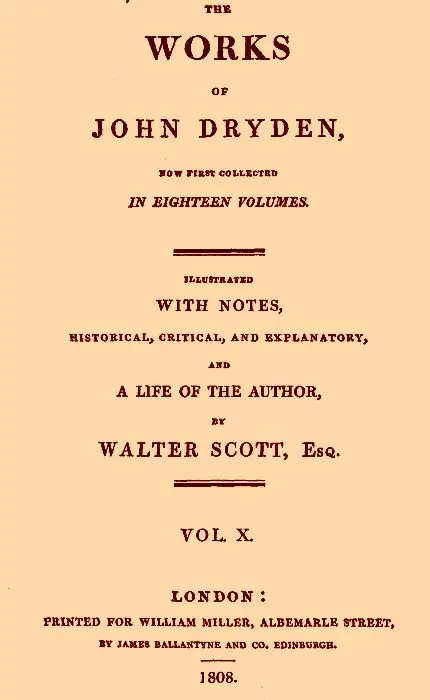
THE CLASSIC COLLECTION · 1633
"The Works of John Dryden, now first collected in eighteen volumes. Volume 10" is a collection of literary works, specifically poetry and essays, compiled from the writings of John Dryden and published during the early 19th century. This volume includes Dryden's poem "Religio Laici," which discusses theological matters and presents his perspectives on faith and religion amidst the complexities of his time. The works likely engage with themes of Christianity, sectarianism, and personal belief. The opening of this volume presents "Religio Laici," an epistolary poem where Dryden articulates his beliefs as a layman amidst a tumultuous religious landscape. He navigates the contentious debates between various religious factions, aiming for a rational exposition of faith that reconciles differing viewpoints. Dryden addresses objections to revealed religion versus rational inquiry, emphasizing the importance of individual reason tempered with faith. His arguments suggest a yearning for a balanced perspective, advocating for personal conviction while also acknowledging the authority of the Church of England despite recognizing the shortcomings within traditions.
Introduction adapted from the source catalogue; source summaries may be automatically generated.
Free to read · English · 135,998 words · No account needed
MAKE TIME FOR A GOOD BOOK
On by default. Untick to stop anonymous reading totals. Each page counts after 10 seconds in view. How this works.
Anonymous counting is on unless you have switched it off.
The Drury-Lane theatre, after being burned in 1671-2, was rebuilt upon a plan furnished by Sir Christopher Wren, who superintended the execution. It is said to have been most admirably planned, but spoiled by some injudicious alterations in the course of building. The following Prologue informs us, that the exterior decorations were plain and simple in comparison to those of the rival house in Dorset Gardens, which, as repeatedly noticed, had been splendidly fitted up under the direction of D'Avenant, noted for his attachment to stage pomp and shew. It appears that Charles II., who was possessed of considerable taste, and did not disdain to interest himself in the affairs of the drama, had himself recommended to the King's company, the simplicity and frugality of scenery and ornament to which the poet alludes. The other house were not unapt to boast of the superior splendour which is here conceded to them. In the epilogue to "Psyche" the actors boast,
----Gallants, you can tell,
No foreign stage can ours in pomp excel;
And here none e'er shall treat you half so well.
Poor players have this day such splendour shown,
Which yet but by great monarchs has been done.
D'Avenant, by whom the Duke's company were long directed, was the first who introduced regular scenery upon a public stage. His drama of the "Siege of Rhodes" seems to have been the first exhibited with these decorations.--See MALONE'S Account of the English Stage."
A plain-built house, after so long a stay, Will send you half unsatisfied away; When, fallen from your expected pomp, you find A bare convenience only is designed. You, who each day can theatres behold, Like Nero's palace, shining all with gold, Our mean ungilded stage will scorn, we fear, And, for the homely room, disdain the chear. Yet now cheap druggets to a mode are grown, } And a plain suit, since we can make but one, } Is better than to be by tarnished gawdry known.} They, who are by your favours wealthy made, With mighty sums may carry on the trade; We, broken bankers, half destroyed by fire, } With our small stock to humble roofs retire;} Pity our loss, while you their pomp admire. } For fame and honour we no longer strive; We yield in both, and only beg--to live; Unable to support their vast expence, Who build and treat with such magnificence, That, like the ambitious monarchs of the age, They give the law to our provincial stage. Great neighbours enviously promote excess, While they impose their splendour on the less; But only fools, and they of vast estate, } The extremity of modes will imitate, } The dangling knee-fringe, and the bib-cravat,} Yet if some pride with want may be allowed, We in our plainness may be justly proud; Our Royal Master willed it should be so; Whate'er he's pleased to own, can need no show: That sacred name gives ornament and grace, And, like his stamp, makes basest metal pass. 'Twere folly now a stately pile to raise, To build a playhouse while you throw down plays; While scenes, machines, and empty operas reign, And for the pencil you the pen disdain; While troops of famished Frenchmen hither drive, And laugh at those upon whose alms they live: Old English authors vanish, and give place To these new conquerors of the Norman race. More tamely than your fathers you submit; You're now grown vassals to them in your wit. Mark, when they play, how our fine fops advance } The mighty merits of their men of France, } Keep time, cry, Bon! and humour the cadence.} Well, please yourselves; but sure 'tis understood, That French machines have ne'er done England good.[335] I would not prophecy our house's fate; But while vain shows and scenes you over-rate, 'Tis to be feared---- That, as a fire the former house o'erthrew, Machines and tempests[336] will destroy the new.
Your reading position is saved on this browser. Take it to another device with a library code. Reading pages adapt to text, rather than matching a printed edition.
BEHIND THE BOOK
This eBook is for the use of anyone anywhere in the United States and most other parts of the world at no cost and with almost no restrictions whatsoever. You may copy it, give it away or re-use it under the terms of the Project Gutenberg License included with this eBook or online at www.gutenberg.org. If you are not located in the United States, you will have to check the laws of the country where you are located before using this eBook. Read the source licence.
The original source file, including credits and licence, is retained by this library. Request an original-format copy at no charge. Please include the book title and Project Gutenberg identifier #51652.
KEEP YOUR CURIOSITY GOING
David Patterson (Spirit) Hatch

David Patterson (Spirit) Hatch

David Patterson (Spirit) Hatch

Ralph Waldo Emerson

Maurice Baring

Oscar Wilde & James McNeill Whistler