
Last letters from the living dead man
David Patterson (Spirit) Hatch
THE CLASSIC COLLECTION · 1633
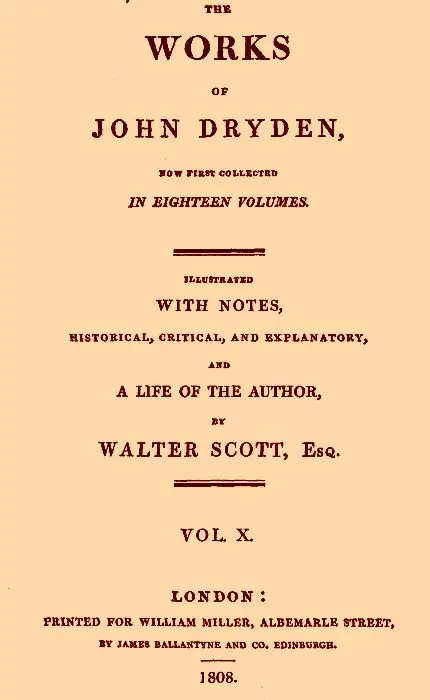
"The Works of John Dryden, now first collected in eighteen volumes. Volume 10" is a collection of literary works, specifically poetry and essays, compiled from the writings of John Dryden and published during the early 19th century. This volume includes Dryden's poem "Religio Laici," which discusses theological matters and presents his perspectives on faith and religion amidst the complexities of his time. The works likely engage with themes of Christianity, sectarianism, and personal belief. The opening of this volume presents "Religio Laici," an epistolary poem where Dryden articulates his beliefs as a layman amidst a tumultuous religious landscape. He navigates the contentious debates between various religious factions, aiming for a rational exposition of faith that reconciles differing viewpoints. Dryden addresses objections to revealed religion versus rational inquiry, emphasizing the importance of individual reason tempered with faith. His arguments suggest a yearning for a balanced perspective, advocating for personal conviction while also acknowledging the authority of the Church of England despite recognizing the shortcomings within traditions.
Introduction adapted from the source catalogue; source summaries may be automatically generated.
Free to read · English · 135,998 words · No account needed
MAKE TIME FOR A GOOD BOOK
On by default. Untick to stop anonymous reading totals. Each page counts after 10 seconds in view. How this works.
Anonymous counting is on unless you have switched it off.
It is not surprising that Dryden soon obtained a complete and absolute superiority in this style of composition over all who pretended to compete with him. While the harmony of his verse gave that advantage to the speaker, which was wanting in the harsh, coarse, broken measure of his contemporaries, his powers of reasoning and of satire left them as far behind in sense as in sound. This superiority, and the great influence which he had in the management of the theatre, made it usual to invoke his assistance in the case of new plays; many of which he accordingly furnished either with prologues or epilogues. The players also had recourse to him upon any remarkable occasion; as, when a new house was opened; when the theatre was honoured by a visit from the king or duke; when they played at Oxford, during the public acts; or, in short, in all cases when an occasional prologue was thought necessary to grace their performance.
The collection of these pieces, which follows, is far from being the least valuable part of our author's labours. The variety and richness of fancy which they indicate, is one of Dryden's most remarkable poetical attributes. Whether the theme be, the youth and inexperience or the age and past services, of the author; the plainness or magnificence of a new theatre; the superiority of ancient authors, or the exaltation of the moderns; the censure of political faction, or of fashionable follies; the praise of the monarch, or the ridicule of the administration; the poet never fails to treat it with the liveliness appropriate to verses intended to be spoken, and spoken before a numerous assembly. The manner which Dryden assumes, varies also with the nature of his audience. The prologues and epilogues, intended for the London stage, are written in a tone of superiority, as if the poet, conscious of the justice of his own laws of criticism, rather imposed them upon the public as absolute and undeniable, than as standing in need of their ratification. And if he sometimes condescends to solicit, in a more humble style, the approbation of the audience, and to state circumstances of apology, and pleas of favour, it is only in the case of other poets; for, in the prologues of his own plays, he always rather demands than begs their applause; and if he acknowledges any defects in the piece, he takes care to intimate, that they are introduced in compliance with the evil taste of the age; and that the audience must take the blame to themselves, instead of throwing it upon the writer. This bold, style of address, although it occasionally drew upon our author the charge of presumption, was, nevertheless, so well supported by his perception of what was just in criticism, and his powers of defending even what was actually wrong, that a miscellaneous audience was, in general, fain to submit to a domination, as successfully supported as boldly claimed. In the Oxford prologues, on the other hand, the audience furnished by that seat of the Muses, as of more competent judgment, are addressed with more respectful deference by the poet.[330] He seems, in these, to lay down his rules of criticism, as it were under correction of superior judges; and intermingles them with such compliments to the taste and learning of the members of the university, as he disdains to bestow upon the motley audience of the metropolis. In one style, the author seems dictating to scholars, whose conceit and presumption must be lowered by censure, to make them sensible of their own deficiencies, and induce them to receive the offered instruction; in the other, he seems to deliver his opinions before men, whom he acknowledges as his equals, if not his superiors, in the arts of which he is treating. And although Brown has very grossly charged Dryden with having affected, for the university, an esteem and respect, which he was far from really feeling; and with having exposed its members, in their turn, to the ridicule of the London audience, whom he had stigmatized in his Oxford prologues as void of taste and judgment; it is but fair to state, that nothing can be produced in proof of such an accusation.[331] In another respect, the reader may remark a pleasing difference between the London prologues and epilogues, and those spoken at Oxford. The licence of the times permitted, and even exacted from an author, in these compositions, the indulgence of an indelicate vein of humour; which, however humiliating, is, in general, successful in a vulgar or mixed audience, as turning upon subjects adapted to the meanest capacity. This continued even down to our times; for, till very lately, it was expected by the mobbish part of the audience, that they should be indemnified for the patience with which they had listened to the moral lessons of a tragedy, by the indecency of the epilogue. In Dryden's time, this coarse raillery was carried to great excess; but our author, however culpable in other compositions, is, generally speaking, more correct than his contemporaries in his prologues and epilogues. In the Oxford pieces, particularly, where the decorum of manners, suited to that mother of learning, required him to abstain from all licentious allusion, Dryden has given some excellent specimens of how little he needed to rely upon this obvious and vulgar aid, for the amusement of his audience. Upon the whole, it will be difficult to find pieces of this occasional nature so interesting and unexceptionable as those spoken at Oxford. They are, as they ought to be, by far the most laboured and correct which our author gave to the stage. It may not be improper to add, that the players were only permitted to visit Oxford during the Public Acts, which were frequently celebrated on occasions of public rejoicing. They acted, it would appear, in a Tennis-court, fitted up as an occasional theatre; and the prologues and epilogues of Dryden tended doubtless greatly to conciliate the favour of an audience, consisting of all that was learned in the generation then mature, and all that was hopeful in that which was rising to succeed it.
Your reading position is saved on this browser. Take it to another device with a library code. Reading pages adapt to text, rather than matching a printed edition.
BEHIND THE BOOK
This eBook is for the use of anyone anywhere in the United States and most other parts of the world at no cost and with almost no restrictions whatsoever. You may copy it, give it away or re-use it under the terms of the Project Gutenberg License included with this eBook or online at www.gutenberg.org. If you are not located in the United States, you will have to check the laws of the country where you are located before using this eBook. Read the source licence.
The original source file, including credits and licence, is retained by this library. Request an original-format copy at no charge. Please include the book title and Project Gutenberg identifier #51652.
KEEP YOUR CURIOSITY GOING
David Patterson (Spirit) Hatch

David Patterson (Spirit) Hatch

David Patterson (Spirit) Hatch

Ralph Waldo Emerson

Maurice Baring

Oscar Wilde & James McNeill Whistler