
Last letters from the living dead man
David Patterson (Spirit) Hatch
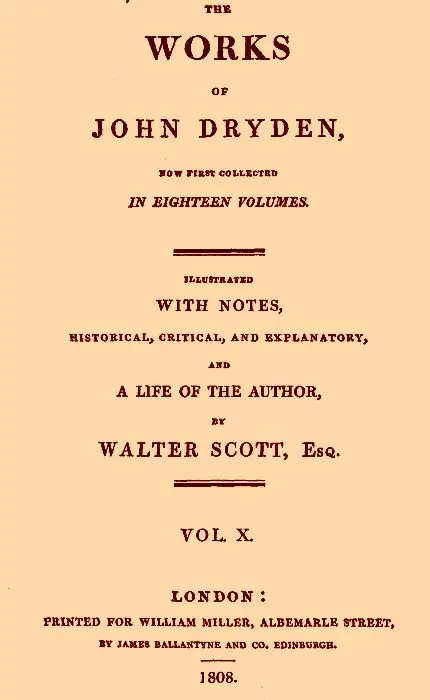
THE CLASSIC COLLECTION · 1633
"The Works of John Dryden, now first collected in eighteen volumes. Volume 10" is a collection of literary works, specifically poetry and essays, compiled from the writings of John Dryden and published during the early 19th century. This volume includes Dryden's poem "Religio Laici," which discusses theological matters and presents his perspectives on faith and religion amidst the complexities of his time. The works likely engage with themes of Christianity, sectarianism, and personal belief. The opening of this volume presents "Religio Laici," an epistolary poem where Dryden articulates his beliefs as a layman amidst a tumultuous religious landscape. He navigates the contentious debates between various religious factions, aiming for a rational exposition of faith that reconciles differing viewpoints. Dryden addresses objections to revealed religion versus rational inquiry, emphasizing the importance of individual reason tempered with faith. His arguments suggest a yearning for a balanced perspective, advocating for personal conviction while also acknowledging the authority of the Church of England despite recognizing the shortcomings within traditions.
Introduction adapted from the source catalogue; source summaries may be automatically generated.
Free to read · English · 135,998 words · No account needed
MAKE TIME FOR A GOOD BOOK
On by default. Untick to stop anonymous reading totals. Each page counts after 10 seconds in view. How this works.
Anonymous counting is on unless you have switched it off.
[Footnote 289: The 10th of June.]
[Footnote 290: Whitsunday.]
[Footnote 291: Trinity Sunday, the octave of Whitsunday.]
[Footnote 292: Note I.]
[Footnote 293: Alluding only to the commonwealth party here, and in other parts of the poem. DRYDEN.--See Note II.]
[Footnote 294: Rev. xii. v. 4.]
[Footnote 295: The Cross.]
[Footnote 296: The Crescent, which the Turks bear for their arms.
DRYDEN. Note III.]
[Footnote 297: The Pope, in the time of Constantine the Great; alluding to the present Pope. DRYDEN.--See Note IV.]
[Footnote 298: King James II.]
[Footnote 299: Bill of Exclusion.]
[Footnote 300: The Lemmon Ore, on which the vessel of King James was lost in his return from Scotland. The crew perished, and he himself escaped with difficulty. See Vol. IX. p. 401.]
[Footnote 301: Venerable is here used in its original sense, as deserving of veneration. But the epithet has been so commonly connected with old age, that a modern poet would hardly venture to apply it to an infant.]
[Footnote 302: Note V.]
[Footnote 303: Alluding to the temptation in the wilderness.]
[Footnote 304:
Restitit Æneas, clarâque in luce refulsit, Os, humerosque deo similis; namque ipsa decoram Cæsariem nato genetrix, lumenque juventæ Purpureum, et lætos oculis afflarat honores.
Æneid, Lib. I.
]
[Footnote 305: Edward the Black Prince, born on Trinity Sunday.]
[Footnote 306: The motto of the poem explained.]
[Footnote 307: St George.]
[Footnote 308: The great Civil War.]
[Footnote 309: The Fire of London.]
[Footnote 310: The Popish plot.]
[Footnote 311: The Test-act.]
[Footnote 312: The death of the Jesuits, executed for the Plot.]
[Footnote 313: All the queen's former children died in infancy.]
[Footnote 314: The year 1688, big with so many events of importance, commenced very unfavourably with stormy weather, and an epidemical distemper among men and cattle.]
[Footnote 315: 1 Kings, chap, xxxiv.]
[Footnote 316: Note VI.]
[Footnote 317: Original sin, supposed to be washed off by baptism.]
[Footnote 318: See "The Hind and the Panther," p. 224.]
[Footnote 319: The prince christened, but not named.]
[Footnote 320: Jehovah, or the name of God, unlawful to be pronounced
by the Jews. DRYDEN.]
[Footnote 321: Some authors say, that the true name of Rome was kept a secret, ne hostes incantamentis deos elicerent. DRYDEN.]
[Footnote 322: Candia, where Jupiter was born and lived secretly.
DRYDEN.]
[Footnote 323: Pallas, or Minerva, said by the poets to have been bred
up by hand. DRYDEN.]
[Footnote 324: The prince had no wet nurse.]
[Footnote 325: The sudden false report of the prince's death. See Note
VII.]
[Footnote 326: 2 Kings, chap. iv.]
[Footnote 327: 1 Samuel, chap. iv. v. 10.]
[Footnote 328: Exodus, chap. xvii. v. 8.]
[Footnote 329: Aristides. See his Life in Plutarch.]
Note I.
Hail, son of prayers! by holy violence
Drawn down from heaven!----P. 290.
Your reading position is saved on this browser. Take it to another device with a library code. Reading pages adapt to text, rather than matching a printed edition.
BEHIND THE BOOK
This eBook is for the use of anyone anywhere in the United States and most other parts of the world at no cost and with almost no restrictions whatsoever. You may copy it, give it away or re-use it under the terms of the Project Gutenberg License included with this eBook or online at www.gutenberg.org. If you are not located in the United States, you will have to check the laws of the country where you are located before using this eBook. Read the source licence.
The original source file, including credits and licence, is retained by this library. Request an original-format copy at no charge. Please include the book title and Project Gutenberg identifier #51652.
KEEP YOUR CURIOSITY GOING
David Patterson (Spirit) Hatch

David Patterson (Spirit) Hatch

David Patterson (Spirit) Hatch

Ralph Waldo Emerson

Maurice Baring

Oscar Wilde & James McNeill Whistler