
Last letters from the living dead man
David Patterson (Spirit) Hatch
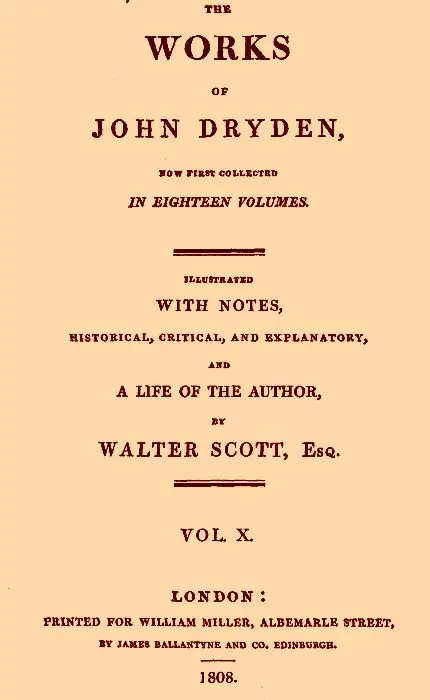
THE CLASSIC COLLECTION · 1633
"The Works of John Dryden, now first collected in eighteen volumes. Volume 10" is a collection of literary works, specifically poetry and essays, compiled from the writings of John Dryden and published during the early 19th century. This volume includes Dryden's poem "Religio Laici," which discusses theological matters and presents his perspectives on faith and religion amidst the complexities of his time. The works likely engage with themes of Christianity, sectarianism, and personal belief. The opening of this volume presents "Religio Laici," an epistolary poem where Dryden articulates his beliefs as a layman amidst a tumultuous religious landscape. He navigates the contentious debates between various religious factions, aiming for a rational exposition of faith that reconciles differing viewpoints. Dryden addresses objections to revealed religion versus rational inquiry, emphasizing the importance of individual reason tempered with faith. His arguments suggest a yearning for a balanced perspective, advocating for personal conviction while also acknowledging the authority of the Church of England despite recognizing the shortcomings within traditions.
Introduction adapted from the source catalogue; source summaries may be automatically generated.
Free to read · English · 135,998 words · No account needed
MAKE TIME FOR A GOOD BOOK
On by default. Untick to stop anonymous reading totals. Each page counts after 10 seconds in view. How this works.
Anonymous counting is on unless you have switched it off.
Bayes. Oh, Lord, nothing at all! I could design twenty of 'em in an hour, if I had but witty fellows about me to draw 'em. I was proffered a pension to go into Holland and contrive their emblems; but, hang 'em, they are dull rogues, and would spoil my invention."--Hind and Panther Transprosed.
Note XXVII.
The noble Buzzard ever pleased me best.--P. 233.
Gilbert Burnet, well known as an historian, was born of a good family in Scotland, in 1643. He went through his studies with success; and, being ordained by the Bishop of Edinburgh, obtained the living of Salton, in East Lothian, in 1665. While in this living, he drew up a memorial of the abuses of the Scotch bishops, and was instrumental in procuring the induction of Presbyterian divines into vacant churches; a step which he afterwards condemned as imprudent.[279] To measures so unfavourable for Episcopacy, Dryden seems to allude, in these lines:
I know he hates the Pigeon-house and Farm,
And more, in time of war, has done us harm;
But all his hate on trivial points depends,
Give up our forms, and we shall soon be friends.
Burnet's opinion, or rather indifference, concerning forms, may be guessed at, from the applause with which he quotes a saying of Dr Henry More; "None of them are bad enough to make men bad, and I am sure none of them are good enough to make men good." He was next created professor of divinity at Glasgow; but as his active temper led him to mingle much in political life, he speedily distinguished himself rather as a politician than a theologian. In 1672 he was made one of the king's chaplains, and was in high favour both with Charles and his brother. He enjoyed much of the countenance of the Duke of Lauderdale; but a quarrel taking place between them, the duke represented Burnet's conduct in such terms, that he was deprived of his chaplainry, and forced to resign his professor's chair, and abandon Scotland. He had an opportunity of revenging himself upon Lauderdale, as will be noticed in a subsequent note. During the time of the Popish plot, he again received a portion of the royal countenance. He was then preacher at the Rolls Chapel, under the patronage of Sir Harbottle Grimstone, master of the rolls, as also lecturer at St Clement's, and enjoyed a high degree of public consideration. Having, as he conceived, a fit opportunity to awaken the conscience of Charles, he ventured upon sending him a letter, where he treated his personal vices, and the faults of his government, with great severity,[280] and by which he forfeited his favour for ever. This freedom, with his low-church tenets, gave also offence to the Duke of York, who was, moreover, offended with him for some interference in the affair of the Exclusion, in which, if he did not go all the length of Shaftesbury, he recommended the appointment of a prince-regent; a measure scarcely more palatable to the successor. At length, his regard for Lord Russell, and the share which he took in penning, or circulating, his dying declaration, drew upon him the full resentment of both brothers. To this, a whimsical accident, in the choice of a text for the day of the gun-powder plot, happened to contribute. The preacher chanced (for we must believe what he assures us, ex verbo sacerdotis) to pitch on these words: "Save me from the lion's mouth; thou hast delivered me from the horns of the unicorn." This was interpreted as referring to the supporters of the royal arms; and Burnet was discharged, by the king's command, both from lecturing at St Clement's, and preaching at the Rolls Chapel. After this final breach with the court he went abroad, and, having travelled through France and Italy, settled in Holland at the court of the Prince of Orange. Here he did not fail, with that ready insinuation which seems to have distinguished him, to make himself of consequence to the prince, and especially to the princess, afterwards Queen Mary. From this place of refuge he sent forth several papers, in single sheets, relating to the controversy in England; and the clergy, who had formerly looked upon him with some suspicion, began now to treat with great attention and respect a person so capable of serving their cause. He was consulted upon every emergency; which confidence was no doubt owing partly to his situation near the person of the Prince of Orange, the Protestant heir of the crown. He stood forward as the champion of the church of England, in the controversy with Parker concerning the Test.[281] In the "History of his Own Times," the bishop talks with complacency of the sway which circumstances had given him among the clergy, and of the important matters which fell under his management; for, by express command of the Prince of Orange, he was admitted into all the secrets of the English intrigues. These insinuations of Burnet's importance, although they afterwards drew the ridicule of Pope, and the Tory wits of Queen Anne's reign, may, from the very satire of Dryden, be proved to have been well founded. This acquired importance of Burnet is the alliance between the Pigeon-house and Buzzard, which Dryden reprobates, believing, or wishing to make others believe, that Burnet held opinions unfavourable to Episcopacy. James considered this divine as so formidable an enemy, that he wrote two very severe letters to his daughter against him, and proceeded so far as to insist that he should be forbidden the court; a circumstance which did not prevent his privately receiving a double degree of countenance. A prosecution for high treason was next commenced against Burnet, and a demand was made that he should be delivered up; which the States evaded, by declaring that he was naturalized, by marrying a Dutch lady. The court of England were then supposed to have formed some plan, as they had attempted in the case of Peyton, of seizing, or perhaps assassinating him, and a reward of L. 3000 was offered for the service. Burnet, however, confident in the protection of the prince and states of Holland, answered, replied, and retorted, and carried on almost an immediate controversy with his sovereign, dated from the court of his son-in-law. This active politician had a very important share in the Revolution, and reaped his reward, by being advanced to the see of Salisbury. He died on the 17th of March, 1714-15.
Your reading position is saved on this browser. Take it to another device with a library code. Reading pages adapt to text, rather than matching a printed edition.
BEHIND THE BOOK
This eBook is for the use of anyone anywhere in the United States and most other parts of the world at no cost and with almost no restrictions whatsoever. You may copy it, give it away or re-use it under the terms of the Project Gutenberg License included with this eBook or online at www.gutenberg.org. If you are not located in the United States, you will have to check the laws of the country where you are located before using this eBook. Read the source licence.
The original source file, including credits and licence, is retained by this library. Request an original-format copy at no charge. Please include the book title and Project Gutenberg identifier #51652.
KEEP YOUR CURIOSITY GOING
David Patterson (Spirit) Hatch

David Patterson (Spirit) Hatch

David Patterson (Spirit) Hatch

Ralph Waldo Emerson

Maurice Baring

Oscar Wilde & James McNeill Whistler