
Last letters from the living dead man
David Patterson (Spirit) Hatch
THE CLASSIC COLLECTION · 1633
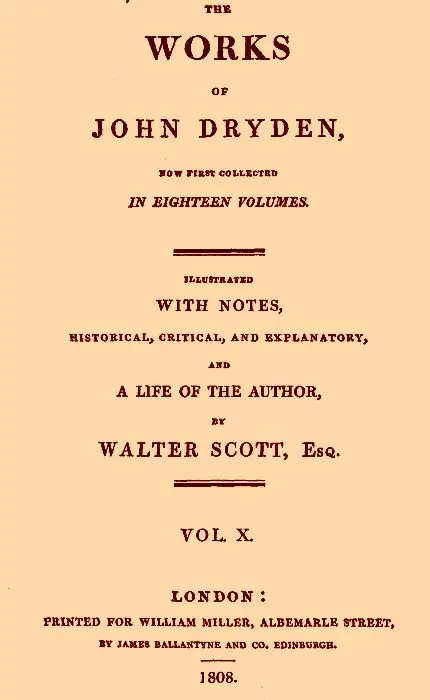
"The Works of John Dryden, now first collected in eighteen volumes. Volume 10" is a collection of literary works, specifically poetry and essays, compiled from the writings of John Dryden and published during the early 19th century. This volume includes Dryden's poem "Religio Laici," which discusses theological matters and presents his perspectives on faith and religion amidst the complexities of his time. The works likely engage with themes of Christianity, sectarianism, and personal belief. The opening of this volume presents "Religio Laici," an epistolary poem where Dryden articulates his beliefs as a layman amidst a tumultuous religious landscape. He navigates the contentious debates between various religious factions, aiming for a rational exposition of faith that reconciles differing viewpoints. Dryden addresses objections to revealed religion versus rational inquiry, emphasizing the importance of individual reason tempered with faith. His arguments suggest a yearning for a balanced perspective, advocating for personal conviction while also acknowledging the authority of the Church of England despite recognizing the shortcomings within traditions.
Introduction adapted from the source catalogue; source summaries may be automatically generated.
Free to read · English · 135,998 words · No account needed
MAKE TIME FOR A GOOD BOOK
On by default. Untick to stop anonymous reading totals. Each page counts after 10 seconds in view. How this works.
Anonymous counting is on unless you have switched it off.
"Secondly, That, for healing our differences, it be appointed, that neither side, in their sermons, touch upon matters of controversy with animating reflections; but that those discourses may wholly tend to peace and piety, religion and sound morality; and that, in all public catechisms, the solid grounds and principles of religion may be solely explicated and established, all reflecting animosities being laid aside.
"Thirdly, That some learned, devout, and sober persons, may be made choice of on both sides, who may truly state matters of controversy betwixt us; to the end, each one may know others pretensions, and the tenets they cannot abandon, without breaking the chain of apostolic faith; which, if it be done, we shall, it may be, find that to be true, which the Papists often tell us, that the difference betwixt them and us is not so great as many make it; nor their tenets so pernicious, but if we saw them naked, we should, if not embrace them as truths, yet not condemn them as errors, much less as pernicious doctrines. Yet if, notwithstanding all this, we cannot perfectly agree in some points, let us, however, endeavour to live together in the bonds of love and charity, as becomes good Christians and loyal subjects, and join together to oppugn those known maxims, and pernicious errors, which destroy the essence of religion, loyalty, and good government."--Remonstrance, by way of Address, to the Church of England, 1685.
Note XVII.
Yet still remember, that you wield a sword, Forged by your foes against your sovereign lord; Designed to hew the imperial cedar down, Defraud succession, and dis-heir the crown.--P. 219.
The Test-act was passed in the year 1678, while the popish plot was in its vigour, and the Earl of Shaftesbury was urging every point against the Catholics, with his eyes uniformly fixed upon the Bill of Exclusion as his crowning measure. It imposed on all who should sit in parliament, a declaration of their abhorrence of the doctrine of transubstantiation. The Duke of York, with tears in his eyes, moved for a proviso to exempt himself, protesting, that he cast himself upon the House in the greatest concern he could have in the world; and that whatever his religion might be, it should only be a private thing between God and his own soul. Notwithstanding this pathetic appeal, he carried his point but by two votes. With seven other peers he protested against the bill. Dryden therefore, and probably with great justice, represents this test as a part of his machinations against the Duke of York, whose party was at that time, and afterwards, warmly espoused by the church of England. But though the Test-act was devised by a statesman whom they hated, and carried by a party whom they had opposed, the high-church clergy were not the less unwilling to part with it when they found the advantages which it gave them against the Papists in King James's reign. Hence they were loaded with the following reproaches: "My business is to set forth, in its own colours, the extraordinary loyalty of those men, who obstinately maintain a test contrived by the faction to usher in the Bill of Exclusion: And it is much admired, even by some of her own children, that the grave and matron-like church of England, which values herself so much for her antiquity, should be over-fond of a new point of faith, lately broached by a famous act of an infallible parliament, convened at Westminster, and guided by the holy spirit of Shaftesbury. But I doubt there are some parliaments in the world which will not so easily admit this new article into their creed, though the church of England labours so much to maintain it as a special evidence of her singular loyalty."--New Test of the Church of England's Loyalty.
Your reading position is saved on this browser. Take it to another device with a library code. Reading pages adapt to text, rather than matching a printed edition.
BEHIND THE BOOK
This eBook is for the use of anyone anywhere in the United States and most other parts of the world at no cost and with almost no restrictions whatsoever. You may copy it, give it away or re-use it under the terms of the Project Gutenberg License included with this eBook or online at www.gutenberg.org. If you are not located in the United States, you will have to check the laws of the country where you are located before using this eBook. Read the source licence.
The original source file, including credits and licence, is retained by this library. Request an original-format copy at no charge. Please include the book title and Project Gutenberg identifier #51652.
KEEP YOUR CURIOSITY GOING
David Patterson (Spirit) Hatch

David Patterson (Spirit) Hatch

David Patterson (Spirit) Hatch

Ralph Waldo Emerson

Maurice Baring

Oscar Wilde & James McNeill Whistler