
Last letters from the living dead man
David Patterson (Spirit) Hatch
THE CLASSIC COLLECTION · 1633
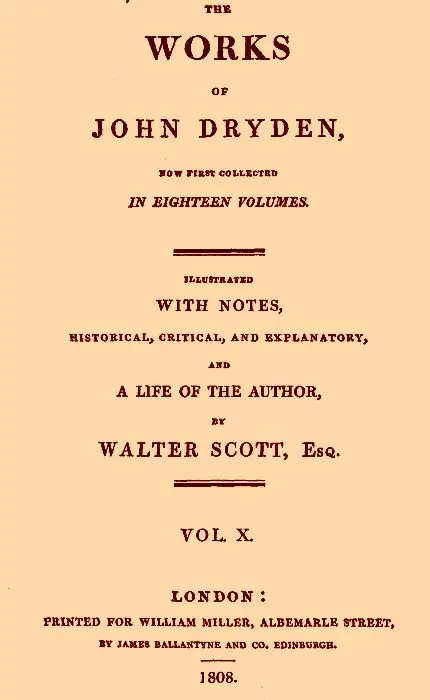
"The Works of John Dryden, now first collected in eighteen volumes. Volume 10" is a collection of literary works, specifically poetry and essays, compiled from the writings of John Dryden and published during the early 19th century. This volume includes Dryden's poem "Religio Laici," which discusses theological matters and presents his perspectives on faith and religion amidst the complexities of his time. The works likely engage with themes of Christianity, sectarianism, and personal belief. The opening of this volume presents "Religio Laici," an epistolary poem where Dryden articulates his beliefs as a layman amidst a tumultuous religious landscape. He navigates the contentious debates between various religious factions, aiming for a rational exposition of faith that reconciles differing viewpoints. Dryden addresses objections to revealed religion versus rational inquiry, emphasizing the importance of individual reason tempered with faith. His arguments suggest a yearning for a balanced perspective, advocating for personal conviction while also acknowledging the authority of the Church of England despite recognizing the shortcomings within traditions.
Introduction adapted from the source catalogue; source summaries may be automatically generated.
Free to read · English · 135,998 words · No account needed
MAKE TIME FOR A GOOD BOOK
On by default. Untick to stop anonymous reading totals. Each page counts after 10 seconds in view. How this works.
Anonymous counting is on unless you have switched it off.
I would not, from what is above stated, be understood to mean, that Dryden wrote this poem merely with a view to politics, and that he was himself sceptical in the matters of which it treats.--On the contrary, I have no doubt, that it expresses, without disguise or reservation, what was then the author's serious and firm, though, as it unfortunately proved, not his unalterable religious opinion. The remarkable line in the "Hind and Panther," seems to refer to the state of his mind at this period; and this system of divinity was among the "new sparkles which his pride had struck forth," after he had abandoned the fanatical doctrines in which he was doubtless educated.[2] It is therefore probable, that, having formed for himself, on grounds which seemed to warrant it, a rational exposition of the national creed, he was willing to communicate it to the public at a period, when moderation of religious zeal was so essentially necessary to the repose of the nation.
Considered in this point of view, the Religio Laici is one of the most admirable poems in the language. The argumentative part is conducted with singular skill, upon those topics which occasioned the principal animosity between the religious sects; and the deductions are drawn in favour of the church of England with so much apparent impartiality, that those who could not assent, had at least no title to be angry. The opinions of the various classes of free-thinkers are combated by an appeal to those feelings of the human mind, which always acknowledge an offended Deity, and to the various modes in which all ages and nations have shewn their sense of the necessity of an atonement by sacrifice and penance. Dryden, however, differs from most philosophers, who suppose this consciousness of guilt to be originally implanted in our bosoms: he, somewhat fantastically, argues, as if it were some remnants of the original faith revealed to Noah, and preserved by the posterity of Shem. The inadequacy of sacrifices and oblations, when compared with the crimes of those by whom they are made, and with the grandeur of the omnipotent Being, to whom they are offered, paves the way for the imputed righteousness of Jesus Christ, the fundamental doctrine of the Christian religion. The fitness of this vicarious sacrifice to accomplish the redemption of man, and vindicate the justice and mercy of God; the obvious impossibility that the writings, or authors, by which it has been conveyed to us, should be less than inspired; the progress of the Christian faith itself, though militating against the corrupt dispositions of humanity, and graced with none of those attractions by which Mahomet, and other false prophets, bribed their followers, are then successively urged as evidences of the Christian religion. The poet then recurs to an objection, at which he had hinted in his preface. If the Christian religion is necessary to salvation, why is it not extended to all nations of the earth? And suppose we grant that the circumstance of the revealed religion having been formerly preached and embraced in great part of the world where it is now unknown, shall be sufficient to subject those regions to be judged by its laws, what is to become of the generations who have lived before the coming of the Messiah? what of the inhabitants of those countries on which the beams of the gospel have never shone? To these doubts, I hope most Christians will think our author returns a liberal, and not a presumptuous answer, in supposing that the heathen will be judged according to the light which it has pleased God to afford them; and that, infinitely less fortunate than us in the extent of their spiritual knowledge, they will only be called upon to answer for their conformity with the dictates of their own conscience. The authority of St Athanasius our author here sets aside, either because in the ardour of his dispute with Arius he carried his doctrine too far, or because his creed only has reference to the decision of a doctrinal question in the Christian church; and the anathema annexed applies not to the heathen world, but to those, who, having heard the orthodox faith preached, have wilfully chosen the heresy. Dryden next takes under review the work of Father Simon; and, after an eulogy on the author and translator, pronounces, that the former was not a bigotted Catholic, since he did not hesitate to challenge some of the traditions of the church of Rome. To these traditions, these "brushwood helps," with which the Catholics endeavoured to fence the doctrines of their church, our author proceeds, and throws them aside as liable to error and corruption. The pretensions of the church of Rome, by her pope and general councils, infallibly to determine the authenticity of church tradition, is the next proposition. To this the poet answers, that if they possess infallibility at all, it ought to go the length of restoring the canon, or correcting the corrupt copies of scripture; a reply which seems to concede to the Romans; as, without denying the grounds of their claim, it only asserts, that it is not sufficiently extended. Upon, the ground, however, that the plea of infallibility, by which the poet is obviously somewhat embarrassed, must be dismissed, as proving too much, the holy scriptures are referred to as the sole rule of faith; admitting such explanations as the church of England has given to the contested doctrines of Christianity. The unlettered Christian, we are told, does well to pursue, in simplicity, his path to heaven; the learned divine is to study well the sacred scriptures, with such assistance as the most early traditions of the church, especially those which are written, may, in doubtful points, afford him. It is in this argument chiefly, that there may be traced a sort of vacillation and uncertainty in our author's opinion, boding what afterwards took place--his acquiescence in the church authority of Rome. Nevertheless, having vaguely pronounced, that some traditions are to be received, and others rejected, he gives his opinion against the Roman see, which dictated to the laity the explications of doctrine as adopted by the church, and prohibited them to form their own opinion upon the text, or even to peruse the sacred volume which contains it. This Dryden contrasts with the opposite evil, of vulgar enthusiasts debasing scripture by their own absurd commentaries, and dividing into as many sects, as there are wayward opinions formed upon speculative doctrine. He concludes, that both extremes are to be avoided; that saving faith does not depend on nice disquisitions; yet, if inquisitive minds are hurried into such, the scripture, and the commentary of the fathers, are their only safe guides:
Your reading position is saved on this browser. Take it to another device with a library code. Reading pages adapt to text, rather than matching a printed edition.
BEHIND THE BOOK
This eBook is for the use of anyone anywhere in the United States and most other parts of the world at no cost and with almost no restrictions whatsoever. You may copy it, give it away or re-use it under the terms of the Project Gutenberg License included with this eBook or online at www.gutenberg.org. If you are not located in the United States, you will have to check the laws of the country where you are located before using this eBook. Read the source licence.
The original source file, including credits and licence, is retained by this library. Request an original-format copy at no charge. Please include the book title and Project Gutenberg identifier #51652.
KEEP YOUR CURIOSITY GOING
David Patterson (Spirit) Hatch

David Patterson (Spirit) Hatch

David Patterson (Spirit) Hatch

Ralph Waldo Emerson

Maurice Baring

Oscar Wilde & James McNeill Whistler